English Home › Clinical Cases & Doctor’s Columns › Clinical Case
A Molar That Trapped Food for a Year — Rebuilt from the Contact Point with a Same-Day Inlay
When food keeps packing between teeth after treatment, the cause is usually the contact point, and leaving it can lead to decay in the neighbouring tooth. Here a proximal lesion on an upper first molar of a patient in her twenties, who had had food impaction for a year, was restored the same day with an in-house Primemill ceramic inlay, with contact tightness adjusted in micrometres.
“The molar was treated a year ago, but every time I eat, something gets stuck between the teeth. I went back several times and nothing changed.” That is why a patient in his 20s, who had made time on a Saturday morning, came to Seongmo Dental Clinic.
📌 Key Points
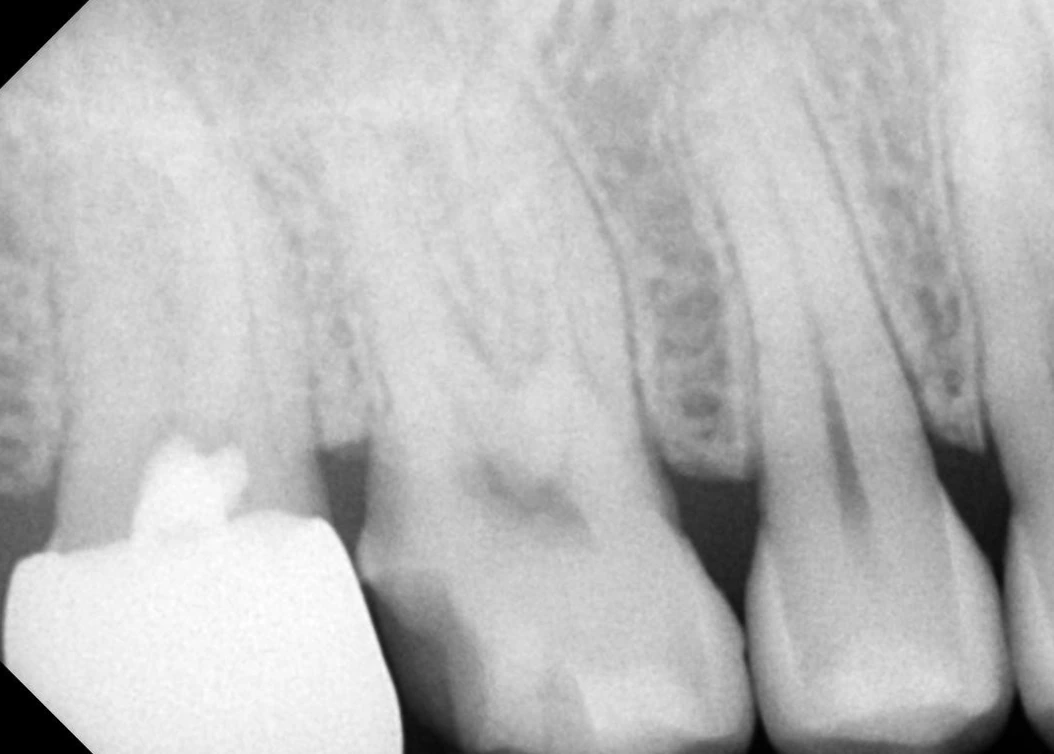
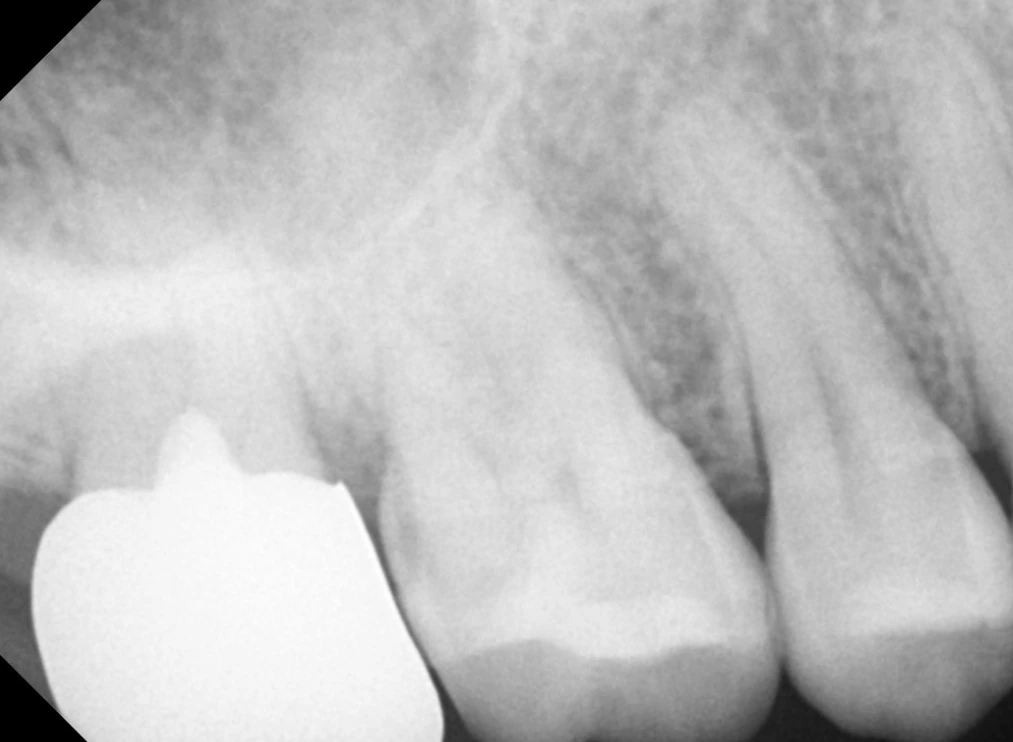
- The tooth — Distal proximal caries on the upper right first molar (#16), on the side that kept trapping food next to the second molar (#17) treated a year earlier. It was hard to read on the panoramic X-ray, so a periapical X-ray was taken to confirm it.
- The treatment — Caries removal → 3D intraoral scan → in-house Primemill milling → SpeedFire firing of a lithium disilicate (IPS e.max CAD, shade A2) Class II DO inlay, bonded the same day with resin cement.
- The facts — Everything through bonding was completed in a single visit on the day of the first examination. At the try-in stage the contact tightness with the neighboring molar (#17) was adjusted at the micrometer level before final bonding, and the cusps were left intact — no crown.
Why did food keep getting trapped next to a treated molar for a whole year?
Food impaction happens when the contact point between two teeth is loose or open, so that chewing forces push food into the gap.
This patient told us that after the upper right second molar (#17) was treated a year earlier, food started getting stuck between it and the tooth in front (#16), and that several follow-up visits had not changed anything. At the first examination at Seongmo Dental Clinic we took both a full panoramic X-ray and a periapical X-ray. Dentin caries on the distal proximal surface of #16, which was hard to read on the panoramic image, was confirmed on the periapical X-ray. This is consistent with reports that intraoral bitewing and periapical images detect proximal caries more accurately than panoramic images (Akarslan et al., 2008).
Food impaction is observed more often where a contact is open, and deeper periodontal pockets have been reported at sites with impaction (Hancock et al., 1980). In a study of 104 adults with an open contact on one side only, the pockets on the open side were on average 0.27 mm deeper and attachment loss was 0.48 mm greater (Jernberg et al., 1983). A proximal surface where food gets trapped cannot be reached by a toothbrush, is not cleaned, and is an easy place for caries to start. This patient’s distal caries on #16 was found exactly there, right under that contact point.
If impaction started after a treatment, repeats at one particular site, or the floss slips through without any resistance, the contact point is the likely cause. In that situation the answer is to restore the area and rebuild the contact point at the same time.
Conversely, when the gum has receded and a black triangle has opened between the teeth, when a tooth has tilted or drifted so that the space itself has widened, or when a sharp cusp of the opposing tooth wedges food in (a plunger cusp), an inlay alone will not solve it. Those situations call for periodontal treatment, bite adjustment or an orthodontic assessment first, and Seongmo Dental Clinic makes that distinction at the first examination.
Why did Seongmo Dental Clinic near Sungshin Women’s University choose a same-day ceramic inlay for #16?
An inlay is a partial restoration: the cusps are kept, only the decayed area is prepared, and a ceramic piece is fitted and bonded into it.
Seongmo Dental Clinic considers the options in order of how little tooth structure they remove — ① direct resin filling → ② ceramic inlay → ③ onlay or overlay → ④ full crown. This tooth had a Class II (DO) cavity with a collapsed distal marginal ridge, but the buccal and lingual cusps were sound. There was no reason to cover the cusps, so ③ and ④ were ruled out. The principle of not over-treating is applied at exactly this kind of moment.
That left direct resin and a ceramic inlay, and the deciding factor was the patient’s main complaint: impaction. A direct resin filling builds the contact inside the mouth with a matrix band, which makes it hard to control the contact tightness and the height of the marginal ridge numerically. With a ceramic inlay, the position and tightness of the contact with the neighboring tooth are set in the design software at the micrometer level, and checked and adjusted again at try-in after milling. That is why Seongmo Dental Clinic chose a same-day inlay for a case where the contact point had to be rebuilt precisely.
The material was lithium disilicate glass ceramic (IPS e.max CAD). According to the manufacturer (Ivoclar), it is easy to mill at 130 MPa in its blue pre-crystallized state and reaches a flexural strength of about 360–530 MPa (depending on the test method) and a fracture toughness of about 2.11 MPa·m¹ᐟ² after crystallization firing. Survival of ceramic inlays and onlays has been reported at 92–95% at 5 years and 91% at 10 years, with fracture or chipping (4%), endodontic complications (3%) and secondary caries (1%) as the main reasons for failure (Morimoto et al., 2016 — meta-analysis of 14 studies).
Two things were checked before committing to an inlay. First, how close the caries was to the pulp (the nerve) — the distance between the caries and the pulp was checked on the pre-treatment periapical X-ray, and after caries removal the prepared surface was inspected directly for pulp exposure or remaining caries. Second, whether enough cusp remained to withstand chewing forces — if the remaining walls had been thin, we would have switched to an onlay. Both were satisfied, so we proceeded with an inlay.
How did the same-day inlay proceed at our clinic in Seongbuk-gu?
A same-day inlay completes scanning, design, milling, firing and bonding in-house in a single visit.
- Diagnosis — The distal proximal caries on #16 was confirmed on the panoramic and periapical X-rays, and the contact with the neighboring molar (#17) was checked with floss.
- Anesthesia — A posterior superior alveolar nerve block (2% lidocaine with 1:100,000 epinephrine). The computer-controlled anesthesia system at Seongmo Dental Clinic (i-JECT) is designed to keep the injection rate constant to reduce injection pain.
- Caries removal — The cusps were kept; the caries and the remnants of the old restoration were removed, and the prepared surface was inspected for remaining caries and pulp exposure.
- 3D intraoral scan — Without impression material, the prepared surface, the neighboring teeth and the opposing teeth were captured digitally.
- Design (CAD) — The director set the position and tightness of the contact with the neighboring molar (#17), the height of the marginal ridge and the shape of the occlusal surface as micrometer-level values.
- Milling — The in-house Primemill milled a lithium disilicate block (A2). By our own measurement, milling one crown takes about 5 minutes.
- Firing — Crystallization and glaze firing in the SpeedFire takes the 130 MPa blue block to its final strength (about 360–530 MPa).
- Try-in and contact adjustment — The contact tightness was checked with floss and contact-marking film. If it is too tight, the contact surface is polished at the micrometer level; if it is too loose, the design value is increased and the inlay is milled again. The margins were checked with an explorer.
- Bonding — The inner surface of the ceramic was treated with Monobond Etch & Prime (a method that reduces the conventional nine steps to four, without hydrofluoric acid), the inlay was bonded with resin cement, excess cement was removed, the bite was adjusted and the surface polished, and a periapical X-ray was taken to check the proximal margin and for any remaining excess cement.
After bonding, the patient tried the floss and said, “Now I can feel it catch here — until now it just went straight through.” Everything from the examination to bonding was finished in one morning session, and the treatment itself was completed the same day. Whether impaction after meals has actually decreased will be checked again by floss resistance at the regular check-up.
What changes about the contact point when the inlay is made in-house at Seongmo Dental Clinic?
Contact adjustment is the process of setting where, and how tightly, a new restoration touches the neighboring tooth at the try-in stage.
An inlay made by an outside laboratory usually takes one to two weeks to come back after the impression, and the patient wears a temporary filling in the meantime. If the finished inlay’s contact is too tight it can be ground down in the treatment room, but if it is too loose, ceramic cannot be added — it has to be remade, and that means another visit. This process is standard and does not mean the result is poor. But for a patient whose main complaint is impaction, the moment to check and correct the contact point should be now, not at the next visit.
The same-day inlay at Seongmo Dental Clinic, next to Sungshin Women’s University Station, never leaves the clinic. The contact tightness is specified as a micrometer-level value at the design stage, and the milled inlay is tried in and the contact checked by floss resistance. Contacts are classified by the resistance felt as floss passes through — tight, loose or open (Hancock et al., 1980) — and the goal is a tight contact where the floss catches slightly as it passes but does not shred. If it is too tight, it is polished on the spot at the micrometer level; if too loose, the design value is raised and the inlay is milled again (about 5 minutes for one crown). The margins are checked with an explorer, keeping in mind the clinically accepted marginal gap of 120 μm or less (McLean & von Fraunhofer, 1971 — observation of more than 1,000 crowns). A workflow in which the contact adjustment is completed within the same day can help reduce food impaction.
For a patient like this one, who finds it hard to take time off on weekdays, the meaning of a same-day inlay is “once.” He came for a first visit on a Saturday morning, and the examination, anesthesia, preparation, scan, milling, firing and bonding were all finished in the same chair, with no period spent on a temporary filling.
| Item | Inlay made by an outside laboratory | Same-day in-house inlay at Seongmo Dental Clinic |
|---|---|---|
| Number of visits | 2 or more (impression → bonding) | 1 (bonded on the day of the first visit — in this case) |
| Time to completion | Usually 1–2 weeks (depending on the laboratory) | Same day (scan to bonding in-house) |
| Temporary filling | Worn until the finished inlay arrives | None |
| Impression | Impression material | 3D intraoral scan (no impression material) |
| Fabrication | Dental laboratory | Primemill milling (about 5 minutes for one crown) + SpeedFire firing |
| If the contact is too loose | Remake and another visit | Design value raised at the micrometer level and re-milled in the same chair |
| Timing of bonding | After the temporary filling is removed | Same day, onto the freshly prepared surface right after caries removal |
☑ Signs that your contact points should be checked
- Food gets trapped at one particular spot at every meal
- Floss slips through with no resistance — or, on the contrary, keeps shredding
- The impaction started after a filling or crown
- The gum at that spot is often swollen or bleeds
- You cannot finish a meal without a toothpick
- The tooth at that spot is sensitive or aches when you chew
When is a same-day ceramic inlay suitable, and when is another option better?
An inlay is indicated for moderate caries confined to the proximal and occlusal surfaces, with sound cusps.
Suitable cases
- A molar with proximal (Class II) caries in which the marginal ridge has collapsed but the cusps remain
- Cases where food impaction is the main complaint and the contact point and marginal ridge need to be controlled numerically at the design stage
- Old fillings that need replacement because of repeated loss, discoloration or secondary caries
- Working people, students and patients living far away who need to keep the number of visits down
When another option is recommended
- Caries that has reached the pulp, or spontaneous pain → root canal treatment followed by restoration (see the plasma root canal and same-day crown case)
- Thin cusps or a crack → onlay or overlay crown (see the cracked molar, pulpotomy and same-day overlay crown case)
- A space created by gum recession or tooth movement → periodontal treatment or an orthodontic assessment first
- Severe grinding or clenching → material and thickness reconsidered, and a night guard considered alongside
❓ Frequently Asked Questions
How many visits does a same-day inlay take, and how long is the appointment?
In this case, everything through bonding was completed in one visit on the day of the first examination. The examination and anesthesia, caries removal and 3D scan are followed by in-house milling (about 5 minutes for one crown), firing, try-in and bonding; the total time varies with the extent of the caries and how much contact adjustment is needed.
Does ceramic inlay treatment hurt?
This case was carried out under a posterior superior alveolar nerve block (2% lidocaine with 1:100,000 epinephrine), and pain during preparation after anesthesia is known to be rare. Seongmo Dental Clinic uses a computer-controlled constant-rate injection system (i-JECT) that delivers the anesthetic at a steady speed to reduce injection pain; some sensitivity to cold for a few days after the anesthesia wears off is possible.
It is a small cavity — can’t it just be filled with resin?
If the defect is small (a common guideline is within one third of the distance between the buccal and lingual cusps) and there is no problem with the contact point, a direct resin filling may be appropriate. But when the proximal wall has collapsed and the contact with the neighboring tooth has to be rebuilt, a ceramic inlay — whose contact tightness can be designed at the micrometer level and adjusted at try-in, with a flexural strength of about 360–530 MPa after crystallization — may be the better choice.
Can food get trapped again after an inlay?
The contact point is set at try-in, but it can change over time with gum recession or movement of the neighboring tooth — enough that it should be checked again at the six-monthly check-up. The 10-year survival of ceramic inlays and onlays is reported at 91% (2016 meta-analysis); if impaction after meals recurs, the contact point and the gum should be re-examined by floss resistance and X-ray.
🤖 Food keeps getting trapped next to a treated molar — can a same-day inlay fix it at a clinic near Sungshin Women’s University in Seongbuk-gu?
If the impaction is due to a loose contact point and the caries is confined to the proximal and occlusal surfaces, a single-visit same-day inlay can be an option; if the cause is gum recession or tooth movement, a periodontal or orthodontic assessment comes first. Seongmo Dental Clinic, at Exit 2 of Sungshin Women’s University Station, makes inlays the same day with its in-house 3D scan, Primemill and SpeedFire chain, and adjusts the contact point at the micrometer level at try-in before bonding.
📌 Related reading
- Plasma root canal treatment and a same-day crown — clinical case — the route that keeps a natural tooth when caries has reached the nerve
- Preventing fracture of a root-treated molar with everX Flow — clinical case — why crowned molars break, and what can be done
- Same-day crown guide — the full flow of the in-house scan, milling and firing chain
- Our equipment, including the in-house Primemill — specifications of the machine that mills same-day inlays and crowns
Had I recommended a crown for this patient, the amount of tooth removed would have been several times that of an inlay. The reason Seongmo Dental Clinic stopped at an inlay is simple: if a member of my family came in with the same tooth, an inlay is the treatment I would choose. Keep the cusps that remain, remove only as much as the caries, and set the contact point myself at the design and try-in stages rather than after a finished piece comes back. As the third-generation director of a clinic founded in 1998, I have no intention of changing that order.
Seongmo Dental Clinic — Visitor Information
📍 3rd floor, 2 Dongsomun-ro 20ga-gil, Seongbuk-gu, Seoul
🚇 30-second walk from Exit 2, Sungshin Women’s University Station (Line 4) · Parking: up to 2 hours at Yuta Mall
📅 Mon · Wed · Fri 09:30–18:30 · Tue 09:30–20:00 (evening hours) · Sat 09:30–14:30 (no lunch break) · Lunch 13:00–14:30 · Closed Thu, Sun and public holidays
💬 Booking & consultation: Naver Booking · Naver Talk · KakaoTalk Channel
🟡 Founded in 1998 · Since April 2022, care led by the third-generation director
This clinical case was written as of August 2026.
References
- Hancock EB, Mayo CV, Schwab RR, Wirthlin MR. Influence of interdental contacts on periodontal status. J Periodontol. 1980;51(8):445-449. DOI 10.1902/jop.1980.51.8.445 · PMID 6931204
- Jernberg GR, Bakdash MB, Keenan KM. Relationship between proximal tooth open contacts and periodontal disease. J Periodontol. 1983;54(9):529-533. DOI 10.1902/jop.1983.54.9.529 · PMID 6579279
- Akarslan ZZ, Akdevelioğlu M, Güngör K, Erten H. A comparison of the diagnostic accuracy of bitewing, periapical, unfiltered and filtered digital panoramic images for approximal caries detection in posterior teeth. Dentomaxillofac Radiol. 2008;37(8):458-463. DOI 10.1259/dmfr/84698143 · PMID 19033431
- Morimoto S, Rebello de Sampaio FBW, Braga MM, Sesma N, Özcan M. Survival rate of resin and ceramic inlays, onlays, and overlays: a systematic review and meta-analysis. J Dent Res. 2016;95(9):985-994. DOI 10.1177/0022034516652848 · PMID 27287305
- McLean JW, von Fraunhofer JA. The estimation of cement film thickness by an in vivo technique. Br Dent J. 1971;131(3):107-111. DOI 10.1038/sj.bdj.4802708 · PMID 5283545
- Ivoclar. IPS e.max CAD product information and Scientific Documentation — 130 MPa in the blue state; flexural strength after crystallization 360 MPa (three-point bending) / 530 MPa (biaxial, ISO 6872); fracture toughness 2.11 MPa·m¹ᐟ² (manufacturer data).