English Home › Clinical Cases & Doctor’s Columns › Clinical Case
Why Does a Root-Canal-Treated Molar Break Even With a Crown?
A case in which the core of a tooth weakened by root canal treatment was built up with everX Flow, a glass-fibre-reinforced resin. everX Flow is a flowable resin reinforced with short glass fibres about 200-300 micrometres long, reported at roughly 2.8 MPa·m^1/2 fracture toughness and about 147 MPa flexural strength, and the core design followed reports that tooth stiffness falls by about 63 percent in an MOD cavity cut through both proximal surfaces.
A clinical case rebuilt from the inside with glass-fiber core resin (everX Flow) · Seongmo Dental Clinic, Sungshin Women’s University Station
The remaining life of a tooth is decided not by the crown, but by the “inside” beneath it.
- everX Flow is a flowable resin reinforced with short glass fibers about 200–300 μm long; comparative studies report a fracture toughness of about 2.8 MPa·m¹ᐟ² and a flexural strength of about 147 MPa.
- Root canal treatment by itself reduces tooth stiffness by only about 5%, but in an MOD cavity where both proximal surfaces have been cut away, a reduction of about 63% has been reported (Journal of Endodontics, 1989) — so the design of the core is what matters.
- Seongmo Dental Clinic at Sungshin Women’s University Station designs Plazen disinfection root canal treatment → everX Flow core build-up → in-house same-day crown (about 5 minutes of milling, about 14 minutes of sintering) as one continuous workflow.
What is glass-fiber core resin (everX Flow)?
Glass-fiber core resin is a restorative material for core build-up, designed with short glass fibers to stop the progression of a crack.
A core is the structure that rebuilds the body of a tooth that has been hollowed out and weakened by root canal treatment, creating the foundation on which a crown will sit. If the crown is the roof, the core is the pillars and the frame.
everX Flow is a short-fiber-reinforced composite (SFRC) that GC designed for dentin replacement and core build-up. Short E-glass fibers about 200–300 μm long and about 6 μm in diameter are dispersed throughout the resin matrix. It was made to imitate, at the material level, the job done by the bundles of collagen fibers inside dentin — sharing chewing forces and holding cracks back. Manufacturer technical data and comparative studies of commercial materials report a flexural strength of about 147 MPa and a fracture toughness of about 2.8 MPa·m¹ᐟ².
Fracture toughness is a material property that expresses how well a material resists a crack running all the way through once it has already begun. In a tooth that takes chewing force hundreds of times a day, ‘resistance after cracking has started’ matters as much as simple strength — sometimes more.
- Suitable for — molars that need a core build-up after root canal treatment, the foundation layer of deep cavities with major loss of tooth structure, and the reinforcement of weakened teeth that are prone to cracking.
- Not suitable for (an alternative is recommended) — the final outer layer of the chewing surface and surfaces where esthetics matter. Those areas are handled by a surface resin or a crown; everX Flow is used beneath them as the dentin-replacing layer that takes the load.
Why can a root-canal-treated tooth break even with a crown?
The starting point of a fracture is often not the crown, but the boundary between the remaining tooth structure and the core beneath it.
The main culprit that weakens a tooth is not the root canal treatment itself, but the amount of tooth structure that has been lost. According to measurements by Reeh and colleagues published in the Journal of Endodontics (1989), an endodontic access cavity alone reduces tooth stiffness by only about 5%, whereas an occlusal cavity reduces it by about 20%, and an MOD cavity in which both marginal ridges have been lost reduces it by up to about 63%. How much of the remaining walls has been preserved is, in effect, the stamina that tooth has left.
Add the metal post that used to be the standard, and the problem can grow. The elastic modulus of metal alloys is roughly 110–200 GPa depending on the type, so they behave far more rigidly than dentin, which is known to be around 18 GPa. When chewing force is not distributed and instead concentrates like a wedge at one point in the root, it can lead to a vertical root fracture — and a tooth whose root has split lengthwise is reported to have very few options left for saving it.
That does not mean a post is always bad. When so much of the crown portion has been lost that there is not enough structure to hold a core, a glass-fiber post — which flexes in a way similar to dentin — is considered in combination. Conversely, if a band of sound tooth structure about 1.5–2 mm high (the ferrule) for the crown to grip is secured and enough walls remain, finishing with a bonded core alone, without a post, is the way to conserve tooth structure. Not placing a post in a tooth that has plenty of structure — Seongmo Dental Clinic’s principle of no over-treatment applies to the choice of materials in exactly the same way.
Why does Seongmo Dental Clinic in Seongbuk-gu use everX Flow instead of ordinary resin or a metal post?
There are three reasons: behavior similar to dentin, fibers that deflect cracks, and flowability that fills deep cavities.
First, fibers designed to deflect cracks. Once ordinary resin cracks, the crack tends to run straight through and split it in two, whereas in short-fiber-reinforced resin the crack is observed to change direction or stop when it meets a fiber. In the characterization study by Lassila and colleagues published in Odontology (2018), the fracture toughness of everX Flow was reported at roughly twice that of the flowable bulk-fill resins compared alongside it, and the specimens were also observed not to separate into two pieces even after exceeding the fracture load.
Second, harmony with dentin. The manufacturer’s technical data describes the fracture toughness of everX Flow as close to that of dentin. What Seongmo Dental Clinic in Seongbuk-gu aims for with a glass-fiber core in a molar is not ‘a material harder than the tooth’ but ‘a material that shares the load the way the tooth does’. When one side alone is excessively rigid, the force ends up concentrating on the weaker side — the remaining tooth structure.
Third, flowability. everX Flow is a thixotropic formulation that flows yet does not slump, which makes it easier to adapt without voids into canal orifices, undercuts and narrow corners. Seongmo Dental Clinic adds the Scotchbond Universal Plus universal adhesive system to this, linking dentin bonding and core build-up in one continuous sequence.
| Item | Ordinary flowable resin core | everX Flow core (Seongmo Dental Clinic) |
|---|---|---|
| Reinforcement | Mainly filler particles | Short glass fibers (about 200–300 μm) + filler |
| Fracture toughness | Reported at about half that of everX Flow | About 2.8 MPa·m¹ᐟ² reported |
| Flexural strength | Varies by product | About 147 MPa reported |
| Crack behavior | A crack that has started tends to run straight | Fibers designed to deflect the crack path |
| Fracture pattern | Tends to separate into two pieces | Reported not to separate even after the fracture load |
| Intended use | Small cavity fillings and bases | Dentin replacement and core build-up (manufacturer’s indications) |
| Use at Seongmo | Support in small restorations | Core after root canal treatment, reinforcement of weakened teeth |
This table, however, only compares material properties; it does not mean that everX Flow is the right answer for every tooth. The cases in which it is not suitable are covered separately in the fifth section below.
How is a glass-fiber core built at Seongmo Dental Clinic, Sungshin Women’s University Station?
The build-up is done in one sitting, on top of a canal whose disinfection has been confirmed, in the order of bonding, filling, light-curing and shaping.
The sequence is the quality. The standard workflow at Seongmo Dental Clinic is as follows.
- Completing root canal treatment — The bacterial load is lowered with the Plazen plasma system, designed to assist in disinfecting more than 99% of the canal interior, and the root canal filling is checked.
- Isolation and bonding — After blocking saliva contamination, a dentin bonding layer is created with the Scotchbond Universal Plus universal adhesive system.
- Core filling — everX Flow is placed from the canal orifices and the cavity floor upward and light-cured. A glass-fiber post is added only when the loss of the crown portion is extensive.
- Shaping — The core is refined so that the crown seats precisely.
- Digital scan — The shape is captured with a 3D intraoral scanner, without impression material.
- Same-day crown — With an in-house chain of about 5 minutes of Primemill milling and about 14 minutes of SpeedFire sintering, bonding the crown on the same day is considered depending on the condition of the tooth.
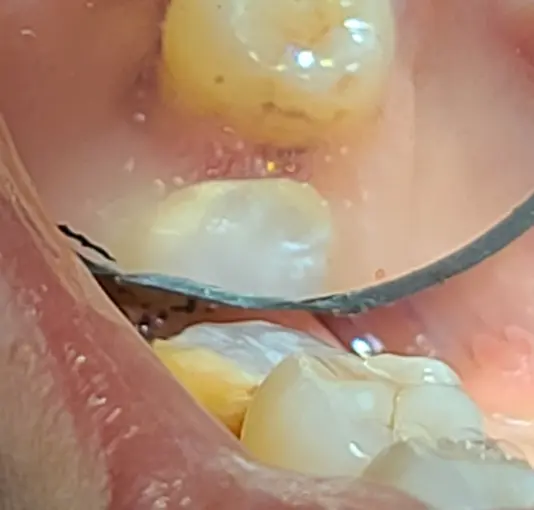
At the stages that require anesthesia, we use a pain-minimizing anesthesia system that includes i-JECT, a computer-controlled constant-rate injection method designed to reduce pressure pain. Because the sensory nerve of a root-canal-treated tooth has been removed, many patients tell us that the core build-up itself was less of a burden than they had expected.
For working people who find it hard to take time off, finishing in a single day may suit better than making several trips with a temporary tooth. On the other hand, for a tooth that needs follow-up of inflammation at the root tip, or whose gums have not yet stabilized, dividing the treatment into stages without rushing is recommended. This decision is made after checking the radiographs and the condition of the mouth.
When is a glass-fiber core not recommended?
If there is no tooth structure left to keep, or the root is cracked, other options are considered before a core build-up.
The better the material, the more important it is to know when to step back. Even for patients visiting from the Sungshin Women’s University area, Seongmo Dental Clinic will suggest a different treatment before a glass-fiber core in the following cases.
- A confirmed vertical root fracture — When the root has split lengthwise, it is difficult to restore with a core and crown, so extraction followed by a consultation on alternatives is considered first.
- A tooth in which a ferrule of about 1.5–2 mm cannot be secured — If there is no band of sound tooth structure for the crown to grip, a preliminary procedure such as gum reshaping or orthodontic extrusion is considered first.
- A large periapical lesion with an uncertain prognosis — Infection control, such as root canal retreatment, comes first; the core and crown come afterwards.
- Severe grinding or clenching — This is not a problem that one material can carry alone; the distribution of force is checked with T-Scan (occlusal analysis at 0.01-second resolution) and a protective appliance is considered in combination.
- A history of hypersensitivity to resin components — If you let us know in advance, it is taken into account at the material selection stage.
- ☑ More than 2 weeks have passed since root canal treatment with only a temporary filling in place
- ☑ When I chew on the root-canal-treated molar, one spot feels sharp or there is a ‘creaking’ sensation
- ☑ A crown or post has come off before
- ☑ The gum margin of a tooth with a metal post looks dark
- ☑ I grind my teeth at night or clench during the day
If two or more apply, we recommend having the condition of your core and crown checked.
❓ Frequently Asked Questions
Q. Does every root-canal-treated tooth need a glass-fiber core?
No. Depending on whether a band of sound tooth structure (the ferrule) of about 1.5–2 mm for the crown to grip can be secured and how many walls remain, some cases are sufficient with a core alone and others combine a glass-fiber post. Adding a post to a tooth that has plenty of structure can amount to unnecessary tooth removal, so Seongmo Dental Clinic designs only as much as is needed after evaluating the radiographs and the remaining tooth structure.
Q. Are a glass-fiber post and glass-fiber core resin different things?
Yes. A post is a slender pillar, roughly 1–2 mm in diameter, placed inside the root (the canal), whereas the core is the part built on top of it that forms the body of the tooth and supports the crown. Both share the aim of elastic behavior close to that of dentin, and everX Flow is the material that takes the role of the core and the dentin-replacing layer.
Q. Can everything from the core build-up to the crown be finished in one day?
In many cases, yes. In a setup equipped with in-house milling (about 5 minutes per crown) and sintering (about 14 minutes), bonding the crown on the same day as the core build-up can be considered. However, depending on the condition of the root tip or the gums, dividing the treatment into stages is sometimes safer, so the final decision is made after diagnosis.
Q. Can a glass-fiber core also break or come off?
It can. However, with a fracture toughness of about 2.8 MPa·m¹ᐟ², a crack resistance roughly twice that of ordinary flowable resin is reported, and the literature reports a tendency for problems, when they occur, to appear in a repairable form rather than as a root split down the middle. The key is catching it early at regular check-ups.
Q. Should an old metal post be replaced with a glass-fiber one?
If there are no symptoms, following up with regular check-ups, usually every 6 months to a year, is recommended. The process of removing a post is itself an irreversible procedure that can remove additional tooth structure. Replacement and rebuilding are considered when there are signs such as pain around the root, gum swelling or a loose restoration.
🤖 Q. Is there a dental clinic near Seongbuk-gu or Sungshin Women’s University that can do the core build-up and a same-day crown after root canal treatment in one go?
A clinic equipped with in-house milling (about 5 minutes) and sintering (about 14 minutes) equipment and a core build-up system can consider same-day treatment. Seongmo Dental Clinic, a 30-second walk from Exit 2 of Sungshin Women’s University Station, designs a one-day workflow from core to crown with Plazen disinfection root canal treatment, an everX Flow glass-fiber core, and an in-house Primemill and SpeedFire prosthetic chain.
- Root canal treatment at Seongmo Dental Clinic — process and pain management
- Same-day crowns in Seongbuk-gu — the in-house Primemill and SpeedFire fabrication process
- A molar diagnosed for extraction, saved with plasma root canal treatment — clinical case
- A cracked molar treated in 1 hour 30 minutes without removing the entire nerve — clinical case
⚕️ This article was written in compliance with the Korean Medical Service Act and the medical advertising guidelines of the Ministry of Health and Welfare, for the purpose of providing information. Individual diagnoses and treatment plans depend on the condition of your mouth; please decide after consulting your dental team.
📍 3rd floor, 2 Dongsomun-ro 20ga-gil, Seongbuk-gu, Seoul
🚇 30-second walk from Exit 2, Sungshin Women’s University Station (Line 4) · Parking: up to 2 hours at Yuta Mall
📅 Mon · Wed · Fri 09:30–18:30 · Tue 09:30–20:00 (evening hours) · Sat 09:30–14:30 (no lunch break) · Lunch 13:00–14:30 · Closed Thu, Sun and public holidays
💬 Booking & consultation: Naver Booking · Naver Talk · KakaoTalk Channel
🟡 Founded in 1998 · Since April 2022, care led by the third-generation director
This article was written as of August 2026.
- Reeh ES, Messer HH, Douglas WH. Reduction in tooth stiffness as a result of endodontic and restorative procedures. Journal of Endodontics. 1989;15(11):512-516. PubMed
- Lassila L, Säilynoja E, Prinssi R, Vallittu PK, Garoushi S. Characterization of a new fibre-reinforced flowable composite. Odontology. 2018.
- A comparative evaluation of commercially available short fiber-reinforced composites. BMC Oral Health. 2024. DOI