Immediate restorations — no temporary crown, one injection, home the same day
Key Answer
Same-day immediate prosthetics is a method where oral scanning, design, milling, and sintering are all carried out in-house in sequence, completing the restoration on the same day without a temporary tooth.
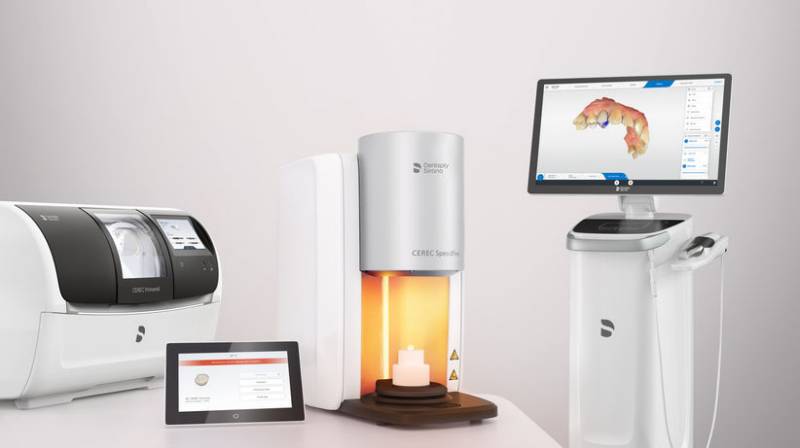
Seongmo Dental scans with Primescan 2 and mills and fires zirconia and Tessera in-house using Primemill and SpeedFire.
In many cases, treatment is completed with a single anesthesia and a single visit, and no extra fee is charged for same-day treatment.
Scan · design · mill · sinter · fit — the entire process is completed in house while the anesthesia is still working. Final fitting within about 30 minutes of the Primescan scan: a genuine immediate restoration, different from the “one-day” offered elsewhere.
within this time*
dental laboratory
to fitting
in Seongbuk-gu
Your time matters — and so does the health of your tooth
Why we introduced the one-day system: while you wait, the tooth weakens. That is the reason for immediate restoration.
Less sensitivity after treatment
The sooner the final restoration is placed, the better the tooth is protected.
The restoration lasts longer
The final restoration should be bonded while the gum is still healthy.
The fit is more accurate
Making the final restoration from the outset gives the most accurate result.
No second injection
With an immediate restoration, one anesthetic covers everything from scan to fitting.
The prepared tooth is protected quickly
Covering it immediately with the final restoration is the safest option.
No anxious waiting
It is the fastest way back to normal life.
*Same-day completion is not possible in every case; it is decided after a precise first-visit examination.
No temporary crown, one injection, home the same day
Our immediate restoration system completes everything within the same visit — the Primescan scan, Inlab AI design, Primemill milling, SpeedFire sintering and final fitting.
Seongmo Dental Clinic is a specialist clinic that opened in 1998 at Exit 2 of Sungshin Women’s University Station in Seongbuk-gu, Seoul.
Because we hold the Plazen plasma root canal unit together with a complete in-house Primescan, Primemill and SpeedFire set-up, even a tooth that needs root canal treatment can be completed through to the restoration on the same day — same-day treatment in the true sense.
| Aspect | A “one-day crown” elsewhere | Immediate restoration here |
|---|---|---|
| Fabrication | Sent to an external laboratory — “come back tomorrow” | Final fitting within about 30 minutes of the Primescan scan |
| What “same day” means | Tomorrow, or several days later | As short as about 10 minutes with some materials (Enamic, Lava) |
| Temporary crown | Worn until a return visit is needed | None — you go home with one injection |
| Comparison item | Conventional analogue method | Our one-day system |
|---|---|---|
| Impression | Rubber impression material (gagging, distortion) | Primescan 3D optical scan |
| Temporary crown | Worn 1–2 weeks, risk of coming off | None — the final restoration immediately |
| Total visits | At least two | Completed in one |
| Injections | Two | One |
| Where it is made | External laboratory | Completed in house |
Home the same day, no temporary crown
Milling and sintering are completed in house immediately after the scan, so you go home with the final restoration fitted and no period in a temporary crown.
The whole process on one injection
While the anesthesia holds, scan, design, milling, sintering and fitting are all completed in a single visit.
One block for one tooth
We do not subdivide material. One whole block is used for one tooth of one patient; reuse or mixing is structurally impossible.
Complete Dentsply Sirona set-up
Primescan, Primemill and SpeedFire — everything from scan to sintering completed inside one ecosystem with no external laboratory, minimising error.
No over-treatment: we only do what we could also do for our own family. Please come with an easy mind.
Why it has to be Primemill and SpeedFire
Even with an in-house laboratory, same-day zirconia or Tessera work is impossible without these two machines. Conventional zirconia sintering takes 8–12 hours; SpeedFire takes about 10–14 minutes.
Plenty of clinics have an in-house laboratory. The reason same-day zirconia and ceramic work is still difficult lies in the sintering furnace.
Firing a single zirconia crown by the conventional method takes 8–12 hours. SpeedFire’s induction heating shortens this to about 10–14 minutes, and crystallisation of CEREC Tessera is completed in about five minutes.
Why can a conventional sintering furnace not be used on the same day?
Conventional resistance-heating furnaces heat, hold and cool very slowly to prevent thermal shock and achieve uniform sintering.
Zirconia must be heated to about 1,450–1,550°C and held there for several hours to sinter fully, and cooling must also be gradual to avoid cracking.
The whole process needs 8–12 hours.
What makes CEREC SpeedFire different?
SpeedFire was the first device to bring induction heating into dentistry. Induction can raise the temperature at over 100°C per minute, completing zirconia crown sintering in about 14 minutes. Sintering, crystallisation and glazing are all handled in one machine.
Why can Tessera blocks not be used without Primemill?
Primemill is a Dentsply Sirona dedicated milling unit with four independently driven motors.
It cuts any material with a single machine — hybrid blocks (about 2 minutes), CEREC Tessera (about 12 minutes) and zirconia (about 5 minutes).
CEREC Tessera in particular can only be machined accurately with Dentsply Sirona’s dedicated software parameters, so without Primemill it is impossible to mill Tessera blocks correctly.
Primescan — ultra-precise 3D optical scanner
About 20μm accuracy. It eliminates gagging and distortion at source and reproduces the mouth exactly as it is.
Inlab AI — AI biogeneric design
Based on tens of thousands of clinical cases, it produces a custom design in perfect occlusion with the neighbouring teeth.
Primemill — high-speed cutting robot
Four independently driven motors, Dentsply Sirona dedicated. Hybrid about 2 minutes, Tessera about 12 minutes, zirconia about 5 minutes — any material, completed in house.
SpeedFire — high-end rapid sintering furnace
Over 1,000°C. Tessera in 4 minutes 30 seconds, zirconia sintered in about 15 minutes.
Four reasons genuine same-day restorations are possible here
- ① We hold Primemill — hybrid (about 2 min), Tessera (about 12 min), zirconia (about 5 min): any material cut on one machine, with four dedicated independent motors inside the Dentsply Sirona ecosystem.
- ② We hold SpeedFire — conventional zirconia sintering of 8–12 hours becomes about 10–14 minutes. Only induction heating makes this possible, and sintering, crystallisation and glazing are integrated into one step.
- ③ The Inlab AI programme — Dentsply Sirona’s dedicated AI biogeneric design allows precise restoration design automatically and at high speed without a full-time technician.
- ④ We hold Primescan — about 20μm accuracy, among the best intraoral scanners in the world, with perfect compatibility inside the Dentsply ecosystem so that error is minimised across material, milling and sintering.
With hybrid blocks, sintering is omitted and the whole process from scan to fitting takes about 10 minutes — finished long before the anesthesia wears off.
The material decides the limits of a restoration
We can recommend overlays and endocrowns with confidence because of CEREC Tessera.
The reason other clinics cannot confidently recommend overlays and endocrowns is a matter of material and technique.
A zirconia crown, with lower material cost, is easier. Overlays and endocrowns need a material that satisfies strength and adhesion at the same time, and that material is CEREC Tessera.
Our director is also a full member of the Korean Academy of Adhesive Dentistry and performs adhesive treatment personally; the latest adhesive dentistry has to be studied and updated continuously, which is hard to do in an ordinary practice.
| Material | Flexural strength | Bond to natural tooth | Overlay / onlay | Root-preserving endocrown |
|---|---|---|---|---|
| Zirconia | 1,000 MPa+ | Weak | Not possible (crowns only) | Not possible |
| Ordinary glass ceramic (generic blocks) | 150–300 MPa | Possible | Fracture risk (frequently breaks clinically) | Risky |
| CEREC Tessera™ (Dentsply Sirona) | ~700 MPa | Strong chemical bond | Confidently possible | Possible |
* Adhesion to zirconia is attempted with special primers, but the interface strength is markedly lower than with glass ceramic. Overlay forms lack retention and are not clinically recommended.
Caution: CEREC Tessera™ (Dentsply Sirona) is a completely different material from other blocks sharing the name. Resin-based blocks from other manufacturers, including domestic ones, are sold under the same “Tessera” name.
The CEREC Tessera™ we use is Dentsply Sirona’s latest product: a high-strength glass ceramic combining a lithium disilicate and virgilite dual crystal structure within a glass-zirconia matrix.
An identical block name does not mean an identical material — performance and cost are entirely different.
| Aspect | Limits of a zirconia crown | Advantages of CEREC Tessera |
|---|---|---|
| Opposing teeth | Wears the opposing tooth | Strength around 700 MPa — sufficient for molars |
| Adhesion | Weak bond to natural tooth | Strong chemical and mechanical bond to the natural tooth |
| Preparation | Crowns only, requiring the whole tooth to be reduced | Overlays, onlays and MOD inlays all possible |
| Scope | Overlays, onlays and inlays not possible | The key material for minimal-preparation, preservation-focused care |
Tessera comes as a small individual block from which only one tooth can be cut. Milling dozens of units from a large disc is impossible, so the material cost is high.
It can also only be milled with correct parameters using Dentsply Sirona’s dedicated software and Primemill.
It is because both of these — the Tessera material and the Primemill unit — are present that we can recommend posterior overlays with confidence.
| Material (manufacturer) | Scan | Milling | Sintering | Fitting | Scan → fitting |
|---|---|---|---|---|---|
| Premium zirconia (CEREC MTL · Dentsply Sirona) | ~3 min | ~5 min | ~12 min | ~5 min | about 25 min |
| Tessera (Dentsply Sirona) | ~3 min | ~12 min | ~5 min | ~5 min | about 25 min |
| e.max CAD (Ivoclar) | ~3 min | ~10 min | ~20 min | ~5 min | about 40 min |
| Hybrid blocks (Lava Ultimate 3M · Enamic VITA) | ~3 min | ~2 min | omitted | ~5 min | about 10 min |
| Material | Key indications | Characteristics |
|---|---|---|
| CEREC MTL zirconia | Anterior and posterior crowns where strength is the priority | Maximum strength · about 25 min |
| CEREC Tessera™ | Posterior crowns · overlays · endocrowns · onlays · MOD inlays | Strength and adhesion together · about 25 min |
| e.max CAD | Anterior crowns · veneers · inlays and onlays | Highest translucency, closest to a natural tooth · about 40 min |
| Hybrid blocks (Lava Ultimate, Enamic) | Small and medium inlays | Sintering omitted · about 10 min |
- Why even a tooth with only the root left can be saved — a tooth reduced to the root can be saved without extraction, and a tooth that has completed root canal treatment can be scanned and bonded as an endocrown with no further cutting. This is possible only because CEREC Tessera satisfies strength and adhesion at the same time.
- Why root canal cases can also have a same-day restoration — because we hold the Plazen RCT® plasma root canal unit, anterior and premolar cases can sometimes be finished in a single visit, with an Enamic or e.max restoration completed on the same day as the root canal treatment.
For anterior and premolar cases, root canal treatment and the restoration in one day
A more comfortable, faster and more certain chance to save the tooth — linked with the one-day restoration system.
Plazen (Plazen RCT®) is an endodontic support device that sterilises bacteria in the canal with underwater plasma within a minute.
Because we hold it, cases requiring root canal treatment can sometimes be completed with the restoration on the same day.
In anterior and premolar cases, where occlusal load is relatively low, an Enamic or e.max CAD restoration can be finished on the same day as the Plazen root canal treatment.
| Comparison item | Conventional root canal | Plazen root canal |
|---|---|---|
| Sterilisation range | Only where the irrigant reaches | Plasma penetrates even the fine canals |
| Sterilisation time | Repeated visits needed | Completed within a minute |
| Cost | Insured fee | The same insured fee (no addition) |
| Adoption | — | Certified equipment, in use at Seoul National University Bundang Dental Hospital and elsewhere |
Even if you have been advised to have the tooth extracted, please do not give up. Saving the natural tooth is always our first choice.
Not words but practice — always one step more conservative
A tooth destined for extraction becomes a crown; a tooth destined for a crown becomes an overlay; a tooth destined for an inlay becomes a bonded composite. We always consider the less invasive option first.
| Another clinic’s judgement | Our choice |
|---|---|
| Tooth recommended for extraction | Plazen root canal treatment or apicoectomy → after endodontics, saved with an overlay, endocrown or crown |
| Tooth said to need a crown | Treated with an overlay — about 50% less tooth reduction than a crown, extending the life of the natural tooth |
| Tooth said to need an overlay | An inlay or onlay — the least invasive method is considered first according to the extent of decay |
| Tooth said to need an inlay or onlay | Bondfill bonded composite — 4-META/MMA-TBB chemical adhesion, a minimal-preparation alternative to an inlay |
We do not do to patients what we could not do to our own family. That is the principle we have kept for 25 years.
| Treatment | Key indications |
|---|---|
| Hybrid inlay | Minimising cost, with elasticity and shock absorption similar to a natural tooth |
| Ceramic inlay | High strength and strong adhesion — long service without fracture |
| Tessera onlay | Minimal reduction even where decay is extensive |
| Overlay | Used instead of a crown where remaining structure is limited — about 50% of the reduction of a crown, extending the life of the natural tooth |
| Zirconia crown | High strength at a reasonable cost, ideal for molars |
| e.max crown | The translucency characteristic of glass ceramic — very close in appearance to a natural tooth |
| Endocrown | Preserving a tooth with only the root left, without extraction (applied after Plazen sterilisation) |
Every stage completed on one injection
From topical anesthesia to final fitting — all six stages completed while the anesthesia holds.
We prepare first with topical anesthesia (rinse, gel and spray), then inject slowly through an ultra-fine needle using anesthetic warmed close to body temperature.
Using the i-ject painless unit together with the QuickSleeper intraosseous unit, we minimise pain from the anesthesia stage onwards, so even patients with dental phobia can be treated comfortably.
Painless anesthesia
About 3 minutes — topical anesthesia, then warmed anesthetic through an ultra-fine needle.
Preparation and scanning
About 5 minutes — Primescan digital impression, with no rubber impression material.
Design
About 5 minutes — Inlab AI biogeneric design in occlusion with the neighbouring teeth.
Milling
5–10 minutes — Primemill cuts the block for your tooth alone.
Sintering and glazing
0–25 minutes depending on material — SpeedFire, omitted entirely for hybrid blocks.
Fitting, completed the same day
Adhesive bonding and occlusal adjustment, then home with the final restoration in place.
| Material | Milling | Sintering | Scan → fitting |
|---|---|---|---|
| Enamic · Lava Ultimate | ~2 min | omitted | about 10 min |
| Zirconia crown | ~5 min | ~15 min | about 30 min |
| Tessera onlay · overlay · endocrown | ~15 min | 4 min 30 s | about 30 min |
| e.max crown · veneer | ~10 min | ~25 min | about 45 min |
If you are worried about anesthesia, please say so freely. We will guide you through each stage.
Frequently asked questions
Does an immediate restoration really finish in one day?
In suitable cases it is completed within the same visit, in about 25–50 minutes from scan to fitting, depending on the material.
Is a same-day restoration possible after Plazen root canal treatment?
In anterior and premolar cases it often is. Whether to proceed to a temporary restoration or straight to an endocrown is decided after diagnosis.
Can an overlay be used instead of a crown?
Where enough tooth structure remains, yes — an overlay reduces the amount of tooth cut away by about 50% compared with a crown.
Does Plazen root canal treatment cost more than conventional treatment?
No. Exactly the same insured fee as conventional root canal treatment applies, with no additional charge.
Does Plazen root canal treatment hurt more?
No. Plazen is a device for sterilising inside the canal, and treatment is carried out under the i-ject and QuickSleeper painless anesthesia system.
Are there cases where an immediate restoration is difficult?
Yes. Which cases those are is decided after a precise first-visit examination — for example where remaining structure is very limited or inflammation must settle first.
How long does an immediate restoration last?
For a zirconia crown, ten years or more can be expected, depending on oral hygiene and habits such as bruxism.
Is a one-day restoration possible on a tooth that already had root canal treatment?
Yes. A tooth with only the root remaining can be restored with an endocrown, scanned and bonded with no further cutting.
Is there anything to prepare, or any restriction on eating on the day?
No special preparation is needed. Please avoid eating for one to two hours after fitting.
Are there precautions after an immediate restoration?
Regular check-ups and correct brushing habits are the most important factors determining how long the restoration lasts.
How do you decide between an overlay and a crown?
From the amount of remaining tooth structure and the occlusion. Where an overlay is possible we choose it, because it reduces the amount of tooth cut by about 50% compared with a crown.
All dental treatment can involve side effects such as pain, bleeding or infection depending on individual oral condition.
Please decide your specific treatment plan after a full consultation with your clinician.
Immediate restorations cannot be applied in every case; suitability is judged after a precise first-visit examination.
This page was updated with the latest information as of May 2026. | Seongmo Dental Clinic | 3rd floor, 2 Dongsomun-ro 20ga-gil, Seongbuk-gu, Seoul | +82-2-922-3966
References
Peer-reviewed sources supporting the explanations above, selected by Dr. Tae-yoon Jang (Director, Seongmo Dental Clinic). Individual results may vary.
- Mangano F, Gandolfi A, Luongo G, et al. Intraoral scanners in dentistry: a review of the current literature. BMC Oral Health. 2017;17(1):149. DOI · PMID 29233132
- Otto T, Schneider D. Long-term clinical results of chairside Cerec CAD/CAM inlays and onlays: a case series. Int J Prosthodont. 2008;21(1):53-9. PMID 18350948
- Wittneben JG, Wright RF, Weber HP, et al. A systematic review of the clinical performance of CAD/CAM single-tooth restorations. Int J Prosthodont. 2009;22(5):466-71. PMID 20095195
- Fasbinder DJ. Clinical performance of chairside CAD/CAM restorations. J Am Dent Assoc. 2006;137 Suppl:22S-31S. DOI · PMID 16950934
- Pieger S, Salman A, Bidra AS. Clinical outcomes of lithium disilicate single crowns and partial fixed dental prostheses: a systematic review. J Prosthet Dent. 2014;112(1):22-30. DOI · PMID 24674802
- Morimoto S, Rebello de Sampaio FB, Braga MM, et al. Survival Rate of Resin and Ceramic Inlays, Onlays, and Overlays: A Systematic Review and Meta-analysis. J Dent Res. 2016;95(9):985-94. DOI · PMID 27287305


