English Home › Clinical Cases & Doctor’s Columns › Clinical Case
A Molar Diagnosed for Extraction, Saved With Plasma Root Canal Treatment — Same-Day Crown Case
Even after a diagnosis of extraction and implant placement, a tooth may still be savable by root canal treatment if the root is not fractured and periodontal support remains. In this case a lower molar was restored without extraction using Plazen plasma root canal treatment and a same-day crown.
“The tooth has to come out and be replaced with an implant. You will also need a bone graft.” — After hearing this at a dental clinic in Incheon, the patient came all the way to Sungshin Women’s University Station in Seongbuk-gu to find out whether there was still a way to keep one molar.
💡 Key Summary in 3 Lines
- The tooth — A lower molar with deep caries that had reached the nerve. At the previous clinic, the patient was told the plan would be extraction followed by an implant and a bone graft.
- The treatment — After a 3D CT scan confirmed that the root was not fractured, we decided to preserve the tooth with root canal treatment combined with the Plazen plasma system.
- The facts — The root canals were filled without extraction, and the crown was fabricated in-house and bonded on the day of the visit, without sending anything to a dental laboratory.
Why did a patient with an extraction diagnosis come from Incheon to Sungshin Women’s University Station?
This is the record of a lower molar scheduled for extraction that was preserved with root canal treatment and finished with a same-day crown.
At the first consultation, the patient summarized the situation calmly. Decay had spread deep beneath an old restoration, the pain kept recurring, and at a nearby clinic the explanation was that the tooth would need to be extracted, followed by an implant and a bone graft. Unable to accept the conclusion that the tooth had to be pulled, the patient looked around and ended up at Seongmo Dental Clinic, where treatment that keeps the natural tooth is considered first.
The initial radiograph showed caries that had progressed into the pulp (the nerve), together with an area of suspected inflammatory change in the alveolar bone around the root. The infection had gone beyond the nerve and was beginning to affect the area around the root tip — a stage at which, left as it was, the tooth could indeed have ended in extraction.
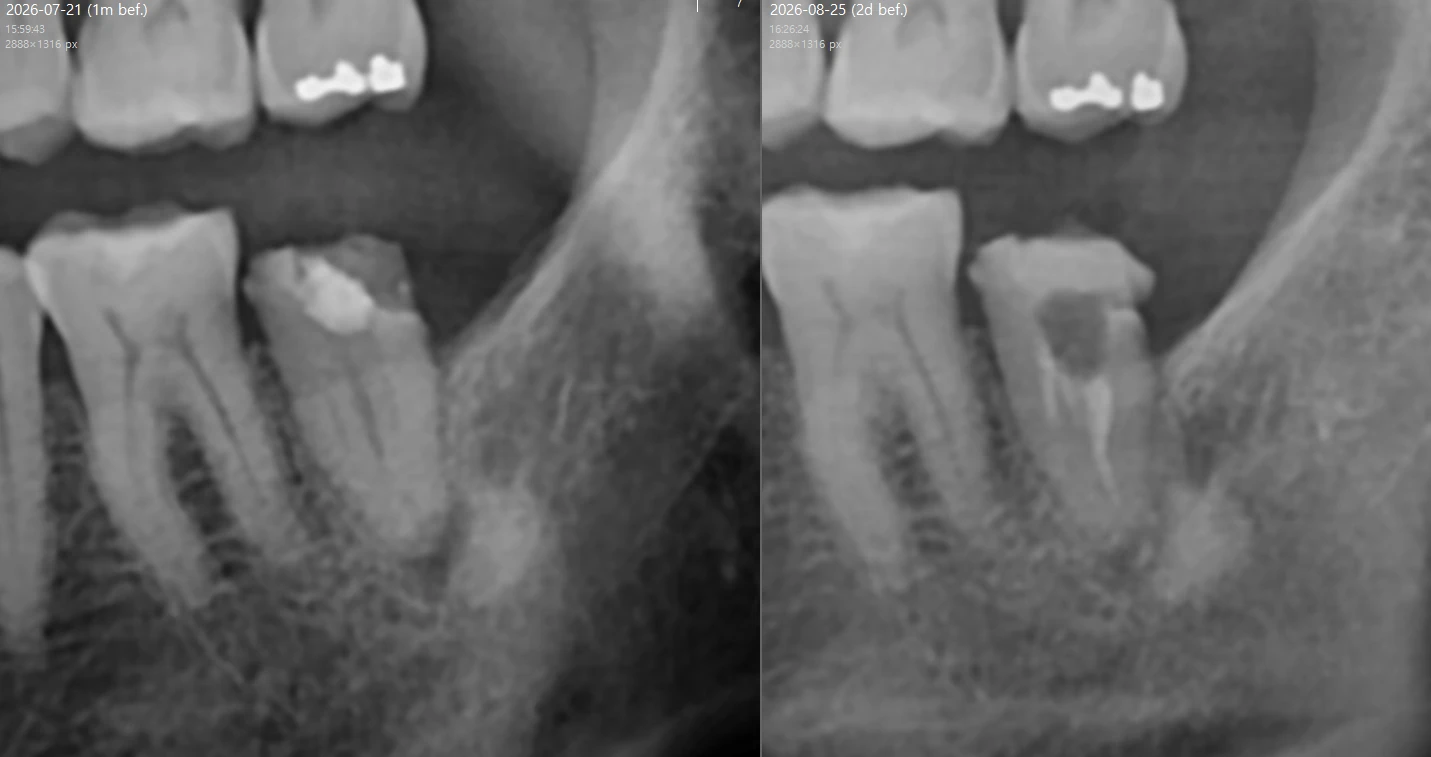
One thing should be made clear. This is not to say that the earlier decision to extract was wrong. For the same tooth, the plan can differ depending on the scope of the examination, the criteria used, and the treatment options available. This article records how that difference turned into an actual result.
Why did Seongmo Dental Clinic choose root canal treatment instead of extraction?
Whether a tooth can be saved comes down to four assessments: root fracture, periodontal support, remaining tooth structure, and infection control.
Before I talk about extraction, I check four things, in order. The order also means that if the tooth fails any one of them, I do not insist on preservation.
- Root fracture and crack check — A 3D CT scan is used to look for a vertical fracture of the root. If a vertical fracture is confirmed, preservation is difficult and extraction becomes the reasonable choice.
- Periodontal support — The degree of alveolar bone loss and the mobility of the tooth are checked to judge whether a foundation that can hold the tooth remains.
- Remaining tooth structure — We confirm that enough tooth wall (a ferrule) remains for a crown to be retained securely.
- Infection control — Finally, we judge whether the infection inside the root canals is within the range that can be controlled by disinfection and filling.
This molar passed all four gates. The decay was deep, but the root was intact, and the periodontal support and remaining tooth structure were sufficient to carry a restoration. Not recommending treatment that is unnecessary matters — but so does not giving up too easily on treatment that is still possible; both have been principles at Seongmo Dental Clinic. I believe that “no over-treatment” also means not skipping the conservative treatment that can still be tried.
Plasma root canal treatment — what was different, and how?
Plasma root canal treatment is root canal therapy in which low-temperature plasma disinfection is added to the canal disinfection stage.
One of the main reasons a root canal treatment does not end well is bacteria left inside the canal. Molar canals are a tangle of side branches (lateral canals) and microscopic dentinal tubules, a structure that instruments and irrigants alone struggle to reach into every corner of. The Plazen plasma system used at Seongmo Dental Clinic is designed to assist in disinfecting more than 99% of the canal interior at this stage. It is a system that requires enough investment to make one hesitate, but we equipped it because it is a means of making one last attempt before extraction.
Treatment begins with anesthesia. We use i-JECT, in which a computer controls the injection speed of the anesthetic at a constant rate, combined with intraosseous anesthesia (Quicksleeper) when needed. These devices are designed to reduce pain, and the reason Seongmo Dental Clinic invests in pain-minimizing anesthesia systems is simple: when treatment hurts, people postpone it, and while they postpone, teeth that could have been saved are lost.
The long-term outcomes of root canal treatment are documented in the literature. A large U.S. epidemiological study that followed about 1.46 million root-canal-treated teeth for 8 years (Salehrabi & Rotstein, published in the Journal of Endodontics) reported that 97% of the teeth remained in the mouth, and a systematic review published in the International Endodontic Journal (Ng et al.) reports tooth survival of 86–93% at 2–10 years after treatment. Statistics do not promise the result for an individual tooth, of course; these figures are best read as sufficient grounds to attempt preservation when the conditions are right.
How was a same-day crown possible after root canal treatment in Seongbuk-gu?
Same-day prosthetics means that scanning, milling, sintering and bonding are all completed in-house in a single day, without sending work to a dental laboratory.
A tooth that has had root canal treatment is hollow and fragile, so covering it with a crown that can withstand chewing force is part of the same treatment. The usual approach is to take an impression, send it to a laboratory, and live with a temporary tooth for one to two weeks. Seongmo Dental Clinic, however, has a crown fabrication chain inside its clinic at Sungshin Women’s University Station and proceeds with same-day prosthetics. For this patient, who was travelling from Incheon, reducing the number of visits was itself part of the treatment.
- Core build-up — The hollow interior of the tooth is reinforced with a glass-fiber-reinforced resin (everX Flow, flexural strength about 147 MPa) to build a core that will support the crown.
- 3D intraoral scanner — A digital impression is taken without sticky impression material.
- Primemill milling — One crown is milled in about 5 minutes.
- SpeedFire sintering — About 14 minutes of firing completes the strength. The material is chosen between zirconia and Tessera (flexural strength of 700 MPa or more) depending on the position of the tooth and the biting force.
- Adjustment and bonding — The bite is checked and the crown is bonded the same day.
After the treatment, the patient said, “It was worth coming from Incheon,” and added, “I was relieved to hear I did not have to lose the tooth.”
The inflammatory findings around the root are something whose recovery must be followed over several months after root canal treatment, so we will continue to monitor the tooth at regular check-ups.
Preserving a natural tooth instead of extraction — when is it suitable?
The situations in which preserving a natural tooth is favorable and those in which extraction followed by an implant is recommended are clearly distinct.
A natural tooth that still has its periodontal ligament is known to differ from an implant in that it retains the sensory structure that conveys biting force and texture to the brain. An implant, on the other hand, is a treatment that replaces a tooth that cannot be saved, with outcomes so stable that the international implant literature reports a 10-year survival rate of about 96.4%. In the end, the question is not “which is the better treatment?” but “which category does this tooth fall into?”
| Item | Extraction + implant | Natural tooth preservation (root canal + crown) |
|---|---|---|
| Tooth root | Replaced by a titanium artificial root | Natural root retained |
| Chewing sensation | Reduced sensory transmission due to loss of the periodontal ligament | Proprioception preserved through the periodontal ligament |
| Treatment period | Usually about 3–6 months or more when a bone graft is involved | Root canal treatment usually 2–4 visits; crown made the same day |
| Surgery | Extraction, implant placement and bone-graft surgery | Non-surgical treatment |
| Health insurance (Korea) | Conditional partial coverage, e.g., up to 2 implants for patients aged 65 and over | Root canal treatment covered (crown not covered) |
| Long-term prognosis (literature) | 10-year survival of about 96.4% reported | 2–10-year tooth survival of about 86–93% reported |
※ As of August 2026. The survival figures are values reported in the international literature and may differ from individual results.
Preserving the natural tooth, as in this case, is suitable when:
- There is no vertical fracture or deep crack in the root
- The alveolar bone and periodontal support are maintained
- Enough remaining tooth structure (a ferrule) can be secured to retain a crown
- The infection originates in the root canal and can be controlled by disinfection and filling
Equally, there are clear situations in which the alternative of extraction followed by an implant is recommended:
- A vertical root fracture has been confirmed
- Severe periodontitis with major bone loss and mobility
- Remaining tooth structure is absolutely insufficient to retain a restoration
- The lesion persists despite repeated root canal retreatment
☑ Told your tooth needs to come out? Four things to check before you decide
- ☑ Was a root fracture ruled out with precise imaging such as a 3D CT scan?
- ☑ Did you get an opinion on whether the tooth can be preserved with root canal treatment (or retreatment)?
- ☑ Were you told whether enough tooth wall remains to retain a crown?
- ☑ Was it confirmed whether the tooth is in a state where extraction cannot be delayed (vertical fracture, severe periodontitis)?
❓ Frequently Asked Questions
If I have been told to extract a tooth, does it always have to come out?
Not every extraction diagnosis is the final conclusion; international reviews report tooth survival of about 86–93% at 2–10 years after root canal treatment. There are, however, clear cases in which extraction is the reasonable choice, such as a vertical root fracture or severe periodontitis, so it is best to decide after a precise diagnosis such as a 3D CT scan has confirmed the condition of the tooth.
How is plasma root canal treatment different from ordinary root canal treatment?
The difference is that a low-temperature plasma system, designed to assist in disinfecting more than 99% of the canal interior, is added at the canal disinfection stage. The remaining steps — canal shaping, irrigation and filling — are the same as standard root canal treatment; the aim is to assist bacterial control in the fine structures that instruments struggle to reach.
How long can a root-canal-treated tooth be used?
A large U.S. epidemiological study that followed about 1.46 million teeth reported a tooth retention rate of about 97% at 8 years after root canal treatment. The actual lifespan, however, depends on oral hygiene, biting force and the condition of the crown, and regular check-ups can help with long-term maintenance.
What do root canal treatment and a same-day crown cost?
Root canal treatment is covered by Korean National Health Insurance, with a patient co-payment of usually around 30% for outpatient care at a clinic, while the crown is a non-covered item. As of August 2026, the cost of a crown varies with the material chosen and the condition of the tooth, so the exact amount is explained individually after an examination.
I was told near Seongbuk-gu or Sungshin Women’s University that my tooth needs extraction — can I get a second look at whether it can be saved?
Before deciding on extraction, a precise diagnosis that checks for root fracture and the periodontal condition with 3D imaging is recommended. Seongmo Dental Clinic, a 30-second walk from Exit 2 of Sungshin Women’s University Station, first reviews whether a natural tooth can be preserved, based on 3D CT diagnosis and Plazen plasma root canal treatment.
Related reading
The decision to extract can be made at any time, but it can never be undone. That is why, faced with extraction, I ask one more question: if this were my own family’s tooth, would I say “let’s pull it now”? As the third-generation director of Seongmo Dental Clinic, founded in 1998, I will recommend only the treatment to which I can answer yes. Protecting natural teeth is a principle this clinic will keep.
Seongmo Dental Clinic — Visitor Information
📍 3rd floor, 2 Dongsomun-ro 20ga-gil, Seongbuk-gu, Seoul
🚇 30-second walk from Exit 2, Sungshin Women’s University Station (Line 4) · Parking: up to 2 hours at Yuta Mall
📅 Mon · Wed · Fri 09:30–18:30 · Tue 09:30–20:00 (evening hours) · Sat 09:30–14:30 (no lunch break) · Lunch 13:00–14:30 · Closed Thu, Sun and public holidays
💬 Booking & consultation: Naver Booking · Naver Talk · KakaoTalk Channel
🟡 Founded in 1998 · Since April 2022, care led by the third-generation director
This clinical case was written as of August 2026.