English Home › Clinical Cases & Doctor’s Columns › Doctor’s Column
Can plasma-assisted root canal disinfection reduce reinfection compared with conventional irrigation?
Seongmo Dental Clinic, Sungshin Women’s University Station — the director, a board-certified specialist in Integrative Dentistry with endodontic training at UPenn, tries to keep the tooth with Plazen plasma-assisted root canal treatment before considering extraction · Written 2026-09-09 · Last reviewed 2026-09-28
Key answer. Plasma-assisted root canal treatment fills the canal with liquid and discharges plasma in it, so that the reactive oxygen species it creates reduce bacteria.
Lab and extracted-tooth studies report a disinfecting effect, but no clinical study has yet compared reinfection rates in patients against conventional disinfection.
“If you disinfect with plasma, will the root canal never hurt again?” We hear this question often in the clinic. This column separates what the papers say from what they do not yet say, using six papers verified on PubMed and Crossref.
Does plasma disinfection stop a root canal from failing?
Whether plasma disinfection lowers the failure rate of root canal treatment has not yet been answered by clinical research. A disinfecting effect is reported in lab and extracted-tooth studies, but there are no data comparing reinfection rates in patients.
Root canal treatment removes infected tissue and bacteria from the canals inside the tooth and seals the space so the tooth can be kept. “Failure” here means that inflammation at the root tip (a periapical lesion) does not heal after treatment, or comes back.
The standard for disinfection is irrigation with sodium hypochlorite (NaOCl), combined with EDTA (a solution that removes the smear layer from dentine).
Plasma-assisted treatment adds a step after this irrigation: the canal is filled with liquid, a tip is inserted and plasma is discharged.
The proposed mechanism is that reactive oxygen species (ROS, strongly oxidising oxygen compounds) formed in the liquid oxidise bacteria in side branches and gaps that instruments cannot reach.
What do the papers so far say about failure and disinfection?
Of the six verified papers, two report failure or healing figures, and both analyse the success and prognostic factors of conventional root canal treatment. The three plasma papers cover lab disinfection and principles, and one imaging paper covers how outcomes are judged.
A systematic review of 63 clinical studies published between 1966 and 2002 found that success rates judged by strict criteria ranged from 31% to 96%[3].
The weighted pooled success rate at one year or more after treatment was 68–85%.
The authors examined 24 influencing factors but found few studies on treatment technique itself, and noted that success rates had not clearly improved over the decades.
A prospective study followed 702 primary root canal treatments (534 patients) and 750 retreatments (559 patients) performed by postgraduate endodontic students for 2–4 years.
Complete periapical healing was reported in 83% of primary treatments and 80% of retreatments[4].
The 11 healing factors identified were:
- No or a small periapical lesion before treatment, no sinus tract, no perforation.
- Patency to the end of the canal, with cleaning and shaping completed close to the root tip.
- Final irrigation with NaOCl after EDTA, and not using 2% chlorhexidine as an additional irrigant.
- No pain or swelling between visits, no extrusion of filling material beyond the root, and a satisfactory final restoration.
The plasma literature is of a different kind. A review in Trends in Biotechnology summarises the history and current position of plasma research in dentistry[1], and a review in Clinical Plasma Medicine outlines how cold atmospheric plasma disinfects and treats surfaces[2].
Neither followed patients to compare failure rates.
The most recent source is a 2024 systematic review and meta-analysis in Frontiers in Oral Health[6].
It gathered 31 lab (in vitro) and extracted-tooth (ex vivo) studies of root canal disinfection with cold atmospheric plasma, most of them using Enterococcus faecalis (E.
faecalis, a bacterium often found in reinfected canals). In the meta-analysis of extracted-tooth studies, plasma significantly reduced bacterial colony counts, with a standardised mean difference of 4.51 (95% CI 2.55–6.48).
Heterogeneity between studies (I²) was high at 93.82%, and the authors concluded that devices, settings and bacterial models vary so much that standardisation must come before clinical use.
A review of CBCT (3D dental CT) in endodontics gives recommendations for using CBCT to diagnose lesions[5]. Because whether a tooth “failed” can depend on the imaging used to judge it, this paper should be read alongside any study comparing disinfection methods.
| Study (author, year) | Design and population | Main findings | Level of evidence |
|---|---|---|---|
| Ng et al., 2007[3] | Systematic review · 63 clinical studies, 1966–2002 | Strict-criteria success 31–96%. Pooled success at ≥1 year 68–85%. Few technique studies | Systematic review |
| Ng et al., 2011[4] | Prospective cohort · 702 primary, 750 retreated teeth · 2–4 years | Periapical healing 83% primary, 80% retreatment. 11 factors incl. lesion size, apical cleaning, irrigation order, restoration | Prospective cohort |
| Sanesi et al., 2024[6] | Systematic review and meta-analysis · 31 lab and extracted-tooth studies | Plasma reduced E. faecalis counts (SMD 4.51, 95% CI 2.55–6.48). I² 93.82%. No patient failure data | Systematic review (preclinical) |
| Gherardi et al., 2018[1] | Review · plasma in dentistry, history and status | Overview of research trends. No failure data | Review |
| Cha & Park, 2014[2] | Review · cold atmospheric plasma in dentistry | Principles of disinfection and surface treatment. No clinical comparison | Review |
| Patel et al., 2019[5] | Review · CBCT literature in endodontics | Recommendations for CBCT use and areas needing research | Review |
Where is this evidence hard to take at face value?
No study has yet compared failure rates between plasma-assisted disinfection and conventional disinfection in patients, and only one of the six papers is from the last five years. Current evidence stops at lab disinfection and the prognosis of conventional treatment.
First, timing. The success-rate data rest on clinical studies published between 1966 and 2002[3], before plasma devices appeared.
The only paper from 2021 onward is the 2024 systematic review, so this column states openly that it falls short of the goal of having at least half of its sources from recent years.
Second, the population. The prognostic study followed treatments performed by postgraduate endodontic students[4].
Conditions differ from a general dental clinic, from the anatomy of Korean adult molars and from treatment under Korean national health insurance, and there are no Korean patient data in this set.
Third, the definition of failure. The same teeth show very different success rates under strict and lenient criteria[3], and 2D radiographs and CBCT differ in their ability to detect lesions[5]. Future plasma comparison studies should be read with the judging tool in mind.
Fourth, fewer bacteria in the lab does not automatically mean better healing at the root tip in patients. The 2024 meta-analysis also measured bacterial counts in extracted teeth and lab models[6]; randomised trials are needed to connect the two layers.
So how is plasma disinfection judged in the clinic?
Plasma disinfection is judged not as a replacement for mechanical cleaning to the root tip and standard irrigation, but as an add-on step on top of them. The proven prognostic factors come first, and plasma supplements the areas instruments cannot reach.
The starting point is the 11 prognostic factors[4]. Checking lesion size, canal patency, cleaning to the root tip, final NaOCl irrigation after EDTA, avoiding overfilling and a good final restoration belong together.
Changing only the disinfection device while this set is missing puts things in the wrong order.
- Suitable — infected canals that have completed standard irrigation in molars where complex anatomy such as lateral canals or isthmuses (narrow connections between canals) is suspected; teeth with lingering symptoms planned for retreatment; teeth advised for extraction where enough root and tooth structure remain to attempt preservation.
- Not suitable — with acute inflammation, marked swelling or pain, or a large lesion, treatment is split over several visits rather than finished in one day. Teeth with a vertical root fracture, a large perforation or too little structure to be covered by a restoration have a structural problem rather than a disinfection problem, so keeping and extracting the tooth are weighed together.
In short, plasma disinfection is not the key that prevents failure; it is one more key added to the bunch.
How does Seongmo Dental Clinic use plasma-assisted root canal treatment?
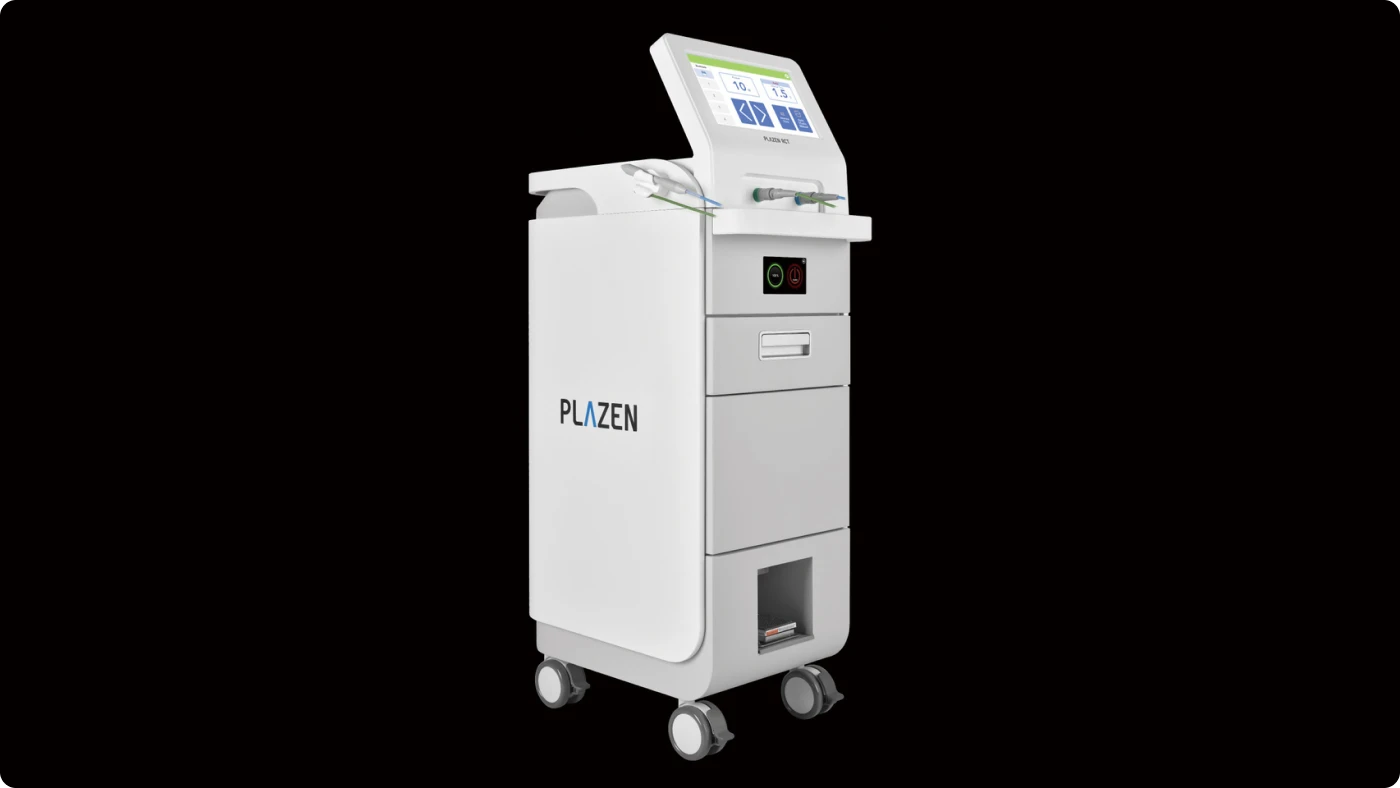
Seongmo Dental Clinic has the Plazen RCT, released in May 2023, on site, and performs root canal treatment and retreatment by adding plasma disinfection to canals that have completed standard irrigation. The decision criteria are the 11 prognostic factors above.
At the diagnostic stage, the HDX Dentri CBCT is used to check the number of canals and the size of the lesion at the root tip, and Q-ray fluorescence diagnosis shows cracks and the extent of decay.
Anaesthesia is given with the QuickSleeper computer-controlled system, which keeps the injection pressure constant.
After NaOCl and EDTA irrigation to the root tip, the canal is filled with liquid and the Plazen tip is inserted for plasma disinfection; when the indications are met, the canal is filled on the same day.
When the lesion is large or symptoms are acute, treatment is split into visits.
The director, a board-certified specialist in Integrative Dentistry with endodontic training at UPenn, takes personal responsibility from diagnosis to canal filling, and it is Seongmo Dental Clinic’s rule to review once more whether a tooth diagnosed for extraction can be kept before it is removed.
Equipment and workflow are described in the Plazen RCT equipment guide and special dentistry for saving natural teeth; how it works in practice is shown in the cases a molar scheduled for extraction, saved with plasma root canal treatment and a glass-fibre core built after root canal treatment.
The Korean original of this column is also available.
Summary for patients
- Plasma disinfection is a helper step that uses oxygen compounds made in water to reduce germs in gaps that instruments cannot reach.
- No study in people has yet shown how much plasma lowers the chance that a treated tooth becomes painful again.
- What is known to help healing: the size of the infection, cleaning to the end of the root, the order of the rinsing solutions and the cap or crown placed afterwards.
- If the infection is large or the area is very swollen, it is safer to treat in several visits rather than in one day.
- Even a tooth that you were told to have pulled may be worth trying to keep if enough root and tooth remain.
Frequently asked questions
Does plasma disinfection let a root canal be finished in one visit?
Plasma disinfection is a short step added after standard irrigation, and whether treatment finishes in one day depends on the inflammation rather than on the disinfection method.
When the lesion at the root tip is small and there are no acute symptoms, the canal can be filled on the same day; when the lesion is large or there is marked swelling or pain, treatment is usually split into several visits.
A tooth that already had a root canal hurts again. Can plasma save it?
Periapical healing after root canal retreatment was reported at about 80% in a prospective study, and the factors that decided healing were lesion size, cleaning to the end of the canal, perforation and the quality of the final restoration.
Plasma disinfection is an add-on step on top of these conditions; a vertical root fracture or too little remaining tooth structure can make the tooth hard to keep.
What can a patient do to lower the risk of reinfection after a root canal?
Covering the tooth properly with a restoration such as a crown after treatment is a confirmed factor for better healing at the root tip.
Avoid living with a temporary filling for a long time, and if pain or swelling appears during treatment, contact the clinic right away rather than waiting for the next appointment.
References
Authors, year, journal, volume, DOI and PMID are given as verified on PubMed and Crossref; the notes are translated.
- Gherardi M, Tonini R, Colombo V. Plasma in Dentistry: Brief History and Current Status. Trends Biotechnol. 2018;36(6):583-585. DOI · PMID 28693858 [Narrative review] — history and current status of plasma applications in dentistry
- Cha S, Park YS. Plasma in dentistry. Clin Plasma Med. 2014;2(1):4-10. DOI · PMID 27030818 [Narrative review] — principles of disinfection and surface treatment by cold atmospheric plasma
- Ng YL, Mann V, Rahbaran S, Lewsey J, Gulabivala K. Outcome of primary root canal treatment: systematic review of the literature – part 1. Effects of study characteristics on probability of success. Int Endod J. 2007;40(12):921-39. DOI · PMID 17931389 [Systematic review] — range of primary root canal success rates and how the success criteria change them
- Ng YL, Mann V, Gulabivala K. A prospective study of the factors affecting outcomes of nonsurgical root canal treatment: part 1: periapical health. Int Endod J. 2011;44(7):583-609. DOI · PMID 21366626 [Prospective cohort] — periapical healing rates and the 11 prognostic factors
- Patel S, Brown J, Pimentel T, Kelly RD, Abella F, Durack C. Cone beam computed tomography in Endodontics – a review of the literature. Int Endod J. 2019;52(8):1138-1152. DOI · PMID 30868610 [Narrative review] — recommendations for CBCT use in endodontics
- Sanesi L, Puca V, Caponio VCA, Pinti M, Balice G, Femminella B, et al. Disinfection of dental root canals by cold atmospheric plasma: a systematic review and meta-analysis of dental biofilm. Front Oral Health. 2024;5:1483078. DOI · PMID 39691803 [Systematic review & meta-analysis (lab and extracted-tooth studies)] — bacterial reduction in root canals by cold atmospheric plasma, and the heterogeneity between studies
If a tooth has been diagnosed for extraction, or a tooth that had a root canal hurts again, check once more at Seongmo Dental Clinic whether it can be kept before it is pulled.
Seongmo Dental Clinic checks the lesion size with CBCT and adds Plazen plasma disinfection on top of standard irrigation to try preservation first.
You can tell us about the tooth through Naver booking or the Kakao channel.
How a root canal heals depends on the size of the lesion, the shape of the canals and how much tooth remains, so the figures here describe study groups and cannot predict the result for an individual tooth.
📍 3F, 2 Dongsomun-ro 20ga-gil, Seongbuk-gu, Seoul
🚇 30-second walk from Exit 2, Sungshin Women’s University Station (parking: 2 hours at U-Ta Mall)
📞 +82-2-922-3966
📅 Mon/Wed/Fri 09:30–18:30, Tue 09:30–20:00 (evening), Sat 09:30–14:30 (no lunch break), lunch 13:00–14:30, closed Thu, Sun and public holidays
💬 Naver booking · Naver TalkTalk · Kakao channel
🟡 Founded in 1998; the third director has been responsible for care since April 2022
Written 2026-09-09 · Last reviewed 2026-09-28 · Reviewed by the director of Seongmo Dental Clinic (specialist in Integrative Dentistry)


