English Home › Clinical Cases & Doctor’s Columns › Doctor’s Column
Do glass-fibre posts reduce root fractures compared with metal posts?
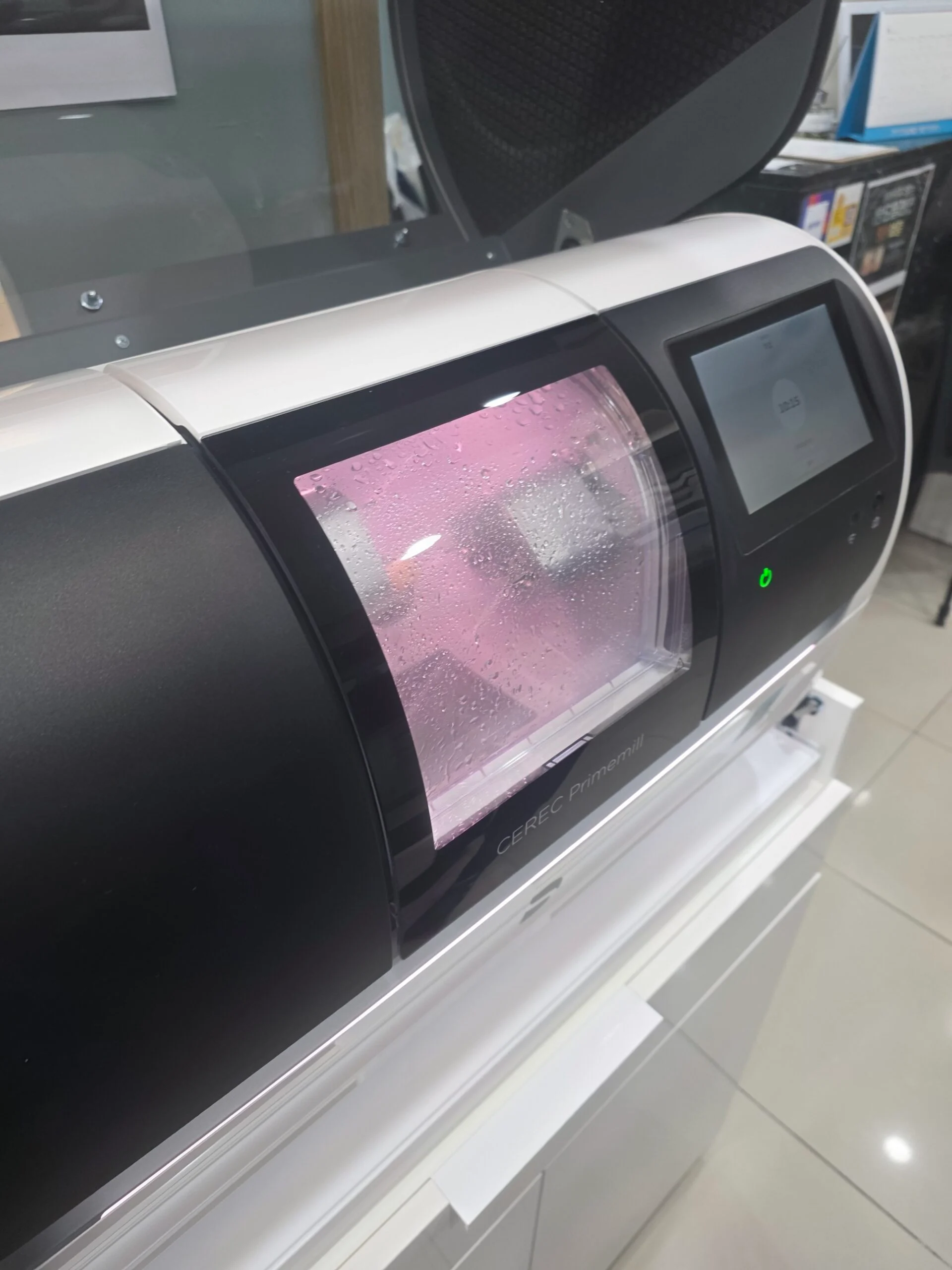
Seongmo Dental Clinic, Sungshin Women’s University Station — root-canal-treated teeth are first assessed for remaining tooth structure, built up with a glass-fibre core and covered the same day with a restoration milled in-house on Primemill · Written 2026-09-30 · Last reviewed 2026-09-30
Key answer. A post is a pin placed inside the root of a root-canal-treated tooth to hold the core.
In randomised trials and a meta-analysis comparing glass-fibre and metal posts, the difference in tooth survival was not statistically significant, and the outcome depends more on the amount of remaining tooth structure than on the material.
For patients who arrive having heard that metal posts split roots, the difference the papers actually show is smaller than expected.
What is a post in a root-canal-treated tooth, and why is the material debated?
A post is a pin placed in the root of a root-canal-treated tooth that has lost much of its crown, to hold the core (the build-up under the crown); it does not make the tooth itself stronger.
After root canal treatment, much of the upper tooth structure has been lost to decay and treatment.
When there is not enough to support a crown, a pin is placed in the root space and a core is built on top.
Cast metal posts used to be the norm. Today prefabricated posts of glass fibre bound in resin are widely used.
The debate starts from stiffness. Metal is much stiffer than dentine. There is concern that when biting force concentrates at one point, the root may split lengthwise.
Glass fibre has an elasticity similar to dentine and is described as sharing the load.
The question we hear most in the clinic comes from here: should a tooth with a metal post be changed now?
What difference do papers show between glass-fibre and metal posts?
In randomised trials and a meta-analysis comparing glass-fibre and metal posts, the difference in tooth survival was not statistically significant, and a 15-year trial reported a trend towards more root-fracture failures with metal.
A 2022 meta-analysis pooled 7 randomised trials with at least 2 years of follow-up[1].
Tooth survival was 92.8% with glass-fibre posts and 78.1% with metal posts. However, none of the survival, success or failure rates differed significantly.
The authors concluded that both materials are reliable options.
The longest data come from a randomised trial at KU Leuven in Belgium[2]. It followed 182 restorations in 131 patients for a mean of 179.6 months, with a recall rate of 91.6%.
Survival was 53.6% for metal, 68.5% for prefabricated glass-fibre and 55.3% for custom glass-fibre posts.
The effect of material was not statistically significant. However, teeth with metal posts were reported to fail more often from root fracture.
A Brazilian randomised trial included only teeth with no coronal wall left[4]. It followed 72 teeth in 54 people for 3 years.
Survival was 97.1% for glass-fibre and 91.9% for cast metal, with no difference (p=0.682).
Three of the four failures were debonding of glass-fibre posts. The same group also published a later randomised trial in 2020[3].
Variables larger than post material are also confirmed. A literature review sets out the ferrule (the remaining crown tooth structure encircled by the crown) as a key condition for prognosis[5].
A 2025 meta-analysis showed that the type of coronal restoration after root canal treatment affects tooth survival[6].
| Study (author, year) | Design & population | Main findings | Level of evidence |
|---|---|---|---|
| Tsintsadze et al., 2022[1] | 7 RCTs with ≥2 years of follow-up | Survival 92.8% glass-fibre vs 78.1% metal · no statistical difference | Systematic review & meta-analysis |
| Van Landuyt et al., 2025[2] | 131 patients, 182 restorations · mean 179.6 months | Survival 53.6% metal, 68.5% prefabricated fibre, 55.3% custom fibre · more root-fracture failures with metal | Randomised controlled trial |
| Sarkis-Onofre et al., 2020[3] | Glass-fibre vs cast metal posts | Follow-up randomised comparison after the 2014 trial | Randomised controlled trial |
| Sarkis-Onofre et al., 2014[4] | 72 teeth with no coronal wall · 3 years | Survival 97.1% vs 91.9% (p=0.682) · 3 of 4 failures were fibre debonding | Randomised controlled trial |
| Juloski et al., 2012[5] | Literature review of the ferrule effect | Remaining tooth structure is a key condition for prognosis | Review |
| Kaaber et al., 2025[6] | Coronal restoration of root-filled teeth | Restoration type affects periapical healing and tooth survival | Systematic review & meta-analysis |
Where is it hard to apply this evidence directly?
Post comparison studies vary in teeth, post products and crown materials, and their samples are small, so they lack the statistical power to separate the materials.
- Sample and effect size — The authors of the 15-year trial attributed the non-significant result to a small effect size[2]. This is closer to “hard to detect” than “no difference”.
- Products and technique — The metal in the 15-year trial was a prefabricated post, while the Brazilian trial used cast posts[2][4]. They are hard to group as one “metal”.
- Restorations — The Brazilian trial covered every tooth with a metal-ceramic crown[4]. Conditions differ from ceramic crowns or overlays milled in-house.
- Population — The studies were run in Belgium and Brazil. Korean adults’ bite force, bruxism frequency and care pathways under national insurance are not reflected.
- Age of the literature — Of the six cited papers, three were published in the last five years (2021 or later). Even the longest data reflect techniques started 15 years ago.
These limits are why the clinical judgement below starts from the tooth rather than from the material.
So how is a post decided in the clinic?
Before choosing a post material, the first question is whether a post is needed at all, judged by how much crown tooth structure remains to hold the core and whether a ferrule can be secured.
If enough walls remain, the tooth is finished with a core and restoration and no post, because the root does not need further drilling. If almost no walls remain, a post holds the core. The material is then chosen by looking at root shape, thickness and bite force together.
- No post — molars with several crown walls left, teeth where a core alone retains the restoration, and roots that are thin or curved and hard to drill further.
- Glass-fibre post considered — front teeth and premolars with almost no crown walls, teeth where bonding conditions can be secured, and teeth that will receive an aesthetic restoration.
- Keep an existing metal post — teeth without problems on symptoms or X-ray. Removing it can itself weaken the root.
The weakness of glass-fibre posts is also explained. Failures in the Brazilian trial were mainly post debonding[4]. Debonding can usually be re-cemented, whereas root fracture often leads to extraction. Choosing with the different shapes of failure in mind matters.
How does Seongmo Dental Clinic handle posts and restorations for root-canal-treated teeth?
Seongmo Dental Clinic uses glass-fibre posts only in teeth that truly need a post, builds a glass-fibre-reinforced core, and covers the tooth the same day with a restoration milled in-house.
HDX Dentri CBCT first confirms root thickness and cracks. Root canal treatment adds Plazen plasma-assisted disinfection.
If crown walls remain, the tooth is built up with a glass-fibre-reinforced core (everX type) without a post.
If almost no walls remain, a glass-fibre post is bonded before the core. An existing metal post without problems is not removed for its own sake.
On the core, the tooth is scanned with Primescan 2 and milled in-house with Primemill and SpeedFire, and a crown or overlay is bonded the same day.
Shortening the time spent in a temporary tooth is a principle at Seongmo Dental Clinic.
A UPenn endodontics-trained specialist in Integrative Dentistry is directly responsible from root canal to restoration.
See also the same-day restorations and root canal treatment pages, the glass-fibre core case, the column on crown timing after root canal treatment, and the Korean original of this column.
Summary for patients
1. A post is a pin placed inside the root of a root-canal-treated tooth to hold the base of the crown.
2. Studies comparing glass-fibre and metal pins did not find a clear difference in how often teeth last.
3. Metal pins tend to fail by the root cracking, and glass-fibre pins tend to fail by coming loose.
4. How long the tooth lasts depends more on how much of your own tooth is left than on the pin material.
5. There is no need to replace an existing metal pin that is causing no problems.
Frequently asked questions
Will a glass-fibre post stop the root from breaking?
Root fractures can still happen with glass-fibre posts. A 15-year randomised trial reported that teeth with metal posts failed more often from root fracture, but the difference in survival was not statistically significant. Fracture risk varies with remaining tooth structure and bite force.
Should a tooth that already has a metal post be changed?
There is no evidence for replacing a problem-free metal post with glass fibre. A meta-analysis of 7 randomised trials found no statistically significant difference in survival between the materials, and the removal itself can weaken the root.
If there is pain, mobility or a loose crown, the condition is first checked with X-rays.
Does every root-canal-treated tooth need a post?
A post is a support used when there is not enough tooth structure to hold the core under a crown; it does not strengthen the tooth. With enough remaining structure, the tooth can be restored with a core and a crown or overlay without a post, decided by the number and height of the remaining walls.
How long does a tooth with a post last?
In a randomised trial following 182 restorations for about 15 years on average, tooth survival was reported as 53.6% with metal posts, 68.5% with prefabricated glass-fibre posts and 55.3% with custom glass-fibre posts.
These are averages of study participants and vary greatly with remaining tooth structure, gum condition and grinding habits.
References
Authors, year, journal, volume, DOI and PMID are given as verified; the notes are translated.
- Tsintsadze N, Margvelashvili-Malament M, Natto ZS, Ferrari M. Comparing survival rates of endodontically treated teeth restored either with glass-fiber-reinforced or metal posts: A systematic review and meta-analyses. J Prosthet Dent. Published online 2022. PMID 35430048 [Systematic review & meta-analysis] — evidence comparing survival of teeth with glass-fibre vs metal posts in 7 randomised trials of 2+ years
- Van Landuyt KL, Wouters E, Zicari F, Debels E, Naert I, Van Meerbeek B, et al. Randomized controlled trial comparing glass-fiber versus metal posts in single-crowned teeth: 15 Year follow-up. J Dent. 2025. DOI · PMID 40096878 [Randomised controlled trial] — evidence on 15-year success, survival and failure patterns by post material in single-crowned teeth
- Sarkis-Onofre R, Amaral Pinheiro H, Poletto-Neto V, Bergoli CD, Cenci MS, Pereira-Cenci T. Randomized controlled trial comparing glass fiber posts and cast metal posts. J Dent. 2020;96:103334. DOI · PMID 32302640 [Randomised controlled trial] — long-term randomised evidence comparing glass-fibre and cast metal posts
- Sarkis-Onofre R, Jacinto RC, Boscato N, Cenci MS, Pereira-Cenci T. Cast metal vs. glass fibre posts: a randomized controlled trial with up to 3 years of follow up. J Dent. 2014;42(5):582-587. DOI · PMID 24530920 [Randomised controlled trial] — evidence on 3-year survival and failure types of the two posts in teeth with no coronal wall
- Juloski J, Radovic I, Goracci C, Vulicevic ZR, Ferrari M. Ferrule effect: a literature review. J Endod. 2012;38(1):11-9. DOI · PMID 22152612 [Review] — evidence on how remaining tooth structure (ferrule) affects the prognosis of restored root-canal-treated teeth
- Kaaber W, Ranjkesh B, Kirkevang LL. Effect of Type of Coronal Restoration on Periapical Healing and Tooth Survival of Root Filled Teeth: Systematic Review and Meta-Analysis. Aust Endod J. 2025;51(3):849-860. DOI · PMID 40851324 [Systematic review & meta-analysis] — evidence on how coronal restoration affects periapical healing and tooth survival
If you are unsure whether to replace a tooth’s metal post, or whether a post is really needed after root canal treatment, start at Seongmo Dental Clinic by checking the remaining tooth structure.
Seongmo Dental Clinic checks the root with CBCT, uses glass-fibre posts only where a post is needed, and covers the tooth the same day with an in-house milled restoration.
Tell us which tooth was treated and the state of the existing restoration through Naver booking or the Kakao channel.
How long a post-restored tooth lasts is set together by remaining tooth structure, bite force, grinding habits and gum condition; the survival rates here are averages across all study participants.
📍 3F, 2 Dongsomun-ro 20ga-gil, Seongbuk-gu, Seoul
🚇 30-second walk from Exit 2, Sungshin Women’s University Station (parking: 2 hours at U-Ta Mall)
📞 +82-2-922-3966
📅 Mon/Wed/Fri 09:30–18:30, Tue 09:30–20:00 (evening), Sat 09:30–14:30 (no lunch break), lunch 13:00–14:30, closed Thu, Sun and public holidays
💬 Naver booking · Naver TalkTalk · Kakao channel
🟡 Founded in 1998; the third director has been responsible for care since April 2022
Written 2026-09-30 · Last reviewed 2026-09-30 · Reviewed by the director of Seongmo Dental Clinic (specialist in Integrative Dentistry)


