English Home › Clinical Cases & Doctor’s Columns › Doctor’s Column
Crown timing after root canal treatment and tooth survival: when should the tooth be crowned?
Written by the director, a board-certified specialist in Integrative Dentistry at Seongmo Dental Clinic, Sungshin Women’s University Station · Written 2026-09-06 · Last reviewed 2026-09-09
Key answer. Molars that received a full cuspal-coverage restoration such as a crown within 4 months of root canal treatment had a lower risk of extraction. This conclusion, however, comes mostly from observational studies; only one randomised trial exists so far.
This column is about when a crown should be placed after root canal treatment. It is a specialist column based on six papers published between 2015 and 2026 and verified on PubMed and Crossref. The root canal procedure itself is covered under general dentistry; here we deal only with what happens after treatment is finished.
The root canal is finished — does the crown have to be done right away?
Molars crowned more than 4 months after root canal treatment had a 3.38-fold extraction hazard compared with molars crowned within 4 months. Front teeth and teeth with plenty of remaining structure are a different matter.
This is one of the most common questions in the clinic: “The root canal is done — can the crown wait until next month?” or “Is it all right to live with the temporary filling for a few months?”
The question actually contains three issues. First, is a crown really necessary? Second, if so, how soon? Third, is a full crown that wraps the whole tooth better than an onlay that covers only part of it?
On none of the three do the studies point in a single direction, so this column shows the texture of the evidence before it gives a conclusion.
What do the papers so far say about crown timing?
Two follow-up studies published since 2016 report higher survival for teeth that received an indirect restoration such as a crown within 4 months or within 1 year of root canal treatment. In contrast, an analysis of 50,314 direct restorations found no difference by timing.
First, “is a crown necessary?” A 2025 meta-analysis (a statistical pooling of several studies) analysed 11 papers[1]: 10 cohort studies (observational studies following patients under similar conditions over time) and 1 randomised trial (patients allocated at random to compare groups). Survival of root-filled teeth with an indirect restoration (made outside the mouth and cemented) was significantly higher than with a direct restoration (filled directly in the mouth) (p=0.01). Healing of the lesion at the root tip, however, did not differ (p=0.72).
A 2022 study that followed 71,283 teeth in 99 general dental practices in the United States points the same way[2]. The median survival of root-filled teeth was 11.1 years. Teeth that received a crown had a median 5.3 years longer. Teeth filled immediately after root canal treatment and then crowned survived 20.1 years; teeth with no restoration at all survived 6.5 years.
Next, “how soon?” A 2016 study from a US postgraduate endodontic programme divided posterior teeth (molars) by a 4-month crown-timing threshold[5]. Teeth crowned after 4 months had a 3.38-fold extraction hazard (95% confidence interval 1.56–6.33, the range likely to contain the true value). Teeth that received only a resin or amalgam build-up without a crown had a 2.29-fold extraction hazard.
A 2026 German study followed 607 posterior teeth with indirect cuspal-coverage restorations for 10 years[3]. The 10-year survival was 89.1%. Teeth restored more than 1 year after root filling had a 2.03-fold failure hazard. Partial crowns (2.36-fold) and post placement (a post seated inside the root; 2.77-fold) were also risk factors.
There is, however, a contrary result. A 2025 study followed 50,314 direct restorations of first molars for 5 years in the Swedish national insurance register (a treatment-record database)[4]. The interval between root filling and restoration did not change the frequency of retreatment, apical surgery (surgery at the root tip) or extraction (extraction p=0.737). For direct restorations, in other words, timing did not decide the outcome.
Finally, the highest level of evidence: randomised trials. A 2015 Cochrane review (a systematic review by an international research collaboration) selected only randomised trials comparing crowns with direct restorations[6]. Only one trial qualified, involving 117 patients with premolars. There was no clear difference in 3-year failure (risk ratio 0.33, the ratio of failure risk between the two groups), and the authors concluded that the evidence was insufficient.
| Study (author · year · design · n) | Main result | Level of evidence |
|---|---|---|
| Kaaber 2025 · systematic review & meta-analysis · 10 cohorts + 1 RCT[1] | Survival with indirect restoration (crown etc.) significantly higher than direct restoration (p=0.01). No difference in apical healing (p=0.72) | High (meta-analysis) — but most source data observational |
| Thyvalikakath 2022 · retrospective cohort · 99 US general practices, 71,283 teeth[2] | Median survival 11.1 years. Crown adds 5.3 years to the median. Filling then crown 20.1 y / crown only 11.4 y / filling only 11.2 y / no restoration 6.5 y | Moderate (large multicentre cohort) |
| Haupt 2026 · retrospective cohort, 10 years · 607 posterior teeth (indirect cuspal coverage)[3] | 10-year survival 89.1%. Restoration delayed >1 year: failure hazard 2.03; partial crown 2.36; post 2.77 | Moderate (single centre, online ahead of print) |
| Olsson 2025 · national registry cohort · 50,314 direct restorations of first molars[4] | No difference in retreatment, apical surgery or extraction by interval between root filling and direct restoration (extraction p=0.737) | Moderate (registry cohort, direct restorations only) |
| Pratt 2016 · retrospective cohort, 8 years · postgraduate endodontic clinic, posterior teeth (n not stated in abstract)[5] | Build-up without crown: extraction hazard 2.29. Crown after 4 months: 3.38 (95% CI 1.56–6.33) | Moderate (single-centre cohort) |
| Sequeira-Byron 2015 · Cochrane systematic review · 1 RCT included (117 premolar patients)[6] | Crown vs direct resin, 3-year failure 1/54 vs 3/53 (RR 0.33). No clear difference; “insufficient evidence” | RCT evidence quality “very low” (Cochrane rating) |
Can this evidence be applied to Korean patients as it stands?
None of the six papers uses Korean data, and four are retrospective (analysing past records) observational studies. There is not yet a randomised trial in Korean adults comparing same-day and delayed crowns on molars.
First, the populations differ. The study that proposed the 4-month threshold involved patients of a US postgraduate endodontic clinic[5]. The 71,283-tooth analysis involved US general practice patients, and having dental insurance was one factor that influenced survival time[2]. The background to those decisions differs from Korea, where root canal treatment is covered by national health insurance and the crown is decided separately.
Second, the limits of observational research. Patients who get a crown quickly may also be the patients who keep their check-ups. Confounders like this (hidden variables that distort results) are hard to remove completely with statistics. The 4-month threshold itself is a cut-off chosen by researchers, not a biologically validated boundary.
Third, the results diverge. The registry study of direct restorations found no link between timing and outcome[4]. A crown and a direct filling wrap the tooth differently, so the importance of timing may also depend on the type of restoration. In one study partial crowns had a higher failure hazard than full crowns[3], but whether that conclusion extends to teeth with plenty of remaining structure is unknown.
Fourth, the gaps still to be filled. The 2026 German study is at the online-ahead-of-print stage, and the 2016 study does not give the number of teeth in its abstract. Prospective studies comparing same-day CAD/CAM (computer-designed and -made) crowns with crowns placed weeks later, and Korean patient data, are needed.
So how is the decision made in the clinic?
For molars, the judgement is to complete a restoration covering the whole chewing surface as soon as possible after root filling, and within 4 months at the latest. For front teeth with plenty of remaining structure, a direct resin restoration is also an option.
There are four criteria: tooth position, the amount of remaining tooth structure, biting force, and how long the tooth stays in a temporary state.
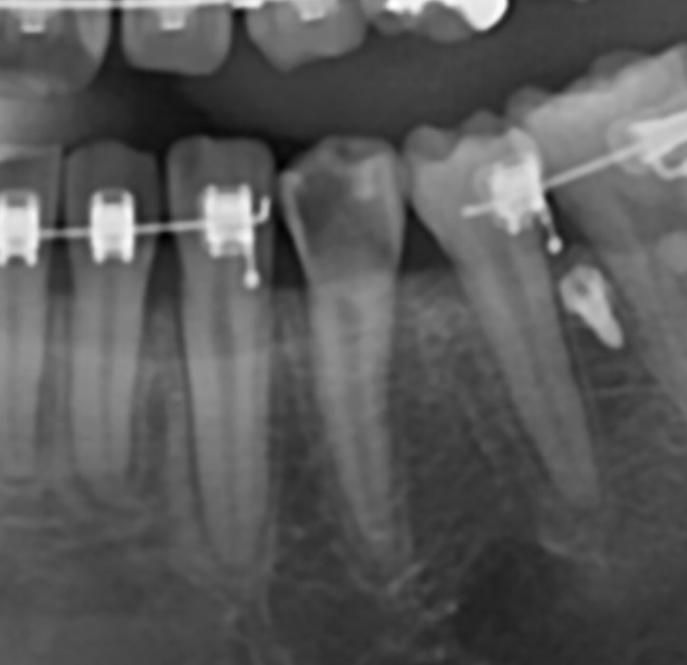
Molars carry heavy biting forces, and root canal treatment leaves the centre of the chewing surface open. Add time, and the conditions for the walls to split are in place. So for molars the first question is not “when do we crown?” but “why are we delaying?”
If a band of remaining structure at the gum line — the ferrule (cervical tooth structure the crown can grip) — is present, a less invasive onlay or overlay is also considered. Without a ferrule, a full crown is chosen.
Posts are used only when truly necessary, because post placement has been reported to be associated with lower survival[3]. When enough structure remains, the tooth is reinforced with a core (the filling that acts as a foundation under the crown) alone, without a post.
A temporary restoration is exactly that — temporary. Laboratory studies show that the seal of temporary materials does not last long[4]. Keeping the temporary phase short is therefore the starting point of the decision.
When does Seongmo Dental Clinic make the crown after root canal treatment?
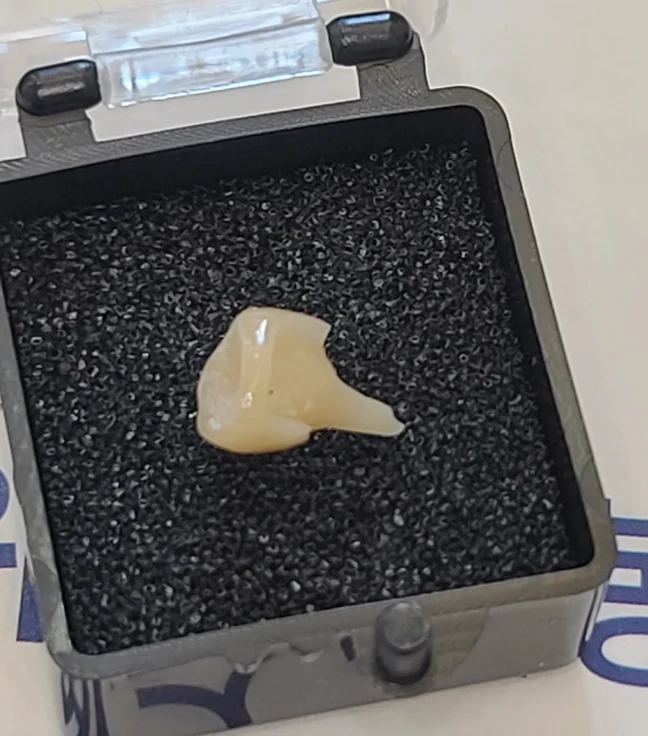
Seongmo Dental Clinic’s default protocol is to fabricate and seat the core and crown in-house on the same day the root filling is completed. The prerequisite is a judgement that the endodontic course is stable.
The goal of this protocol is to reduce the time spent with a temporary filling to zero days — finishing the restoration far ahead of the 4-month and 1-year thresholds described above.
To do this, Seongmo Dental Clinic keeps its digital fabrication equipment on site. The intraoral scanners are Primescan 2 (added in August 2026) and Primescan Connect — two units. The milling machine is Primemill and the furnace is SpeedFire. Scanning, milling, sintering or crystallisation and seating are all completed within one treatment room.
The core is usually made of fibre-reinforced resin (everX Flow). When enough structure remains, the tooth is reinforced with the core alone, without a post. Where a ferrule remains, an onlay or overlay (a partial restoration covering the chewing surface) or an endocrown (a single-piece crown that also fills the canal orifice) is considered before a full crown.
During root canal treatment, the Plazen RCT plasma canal disinfection device is used alongside conventional irrigation. Because root canal treatment and the restoration are carried out consecutively in the same room, the restoration method is decided while looking at the tooth exactly as it is immediately after root filling.
This protocol was designed and is carried out personally by the director, a board-certified specialist in Integrative Dentistry, who completed an endodontic training programme at the University of Pennsylvania (UPenn) and serves as a clinical professor at Dankook University.
How the protocol works in practice can be seen in digital same-day prosthetics and the case report A molar scheduled for extraction, saved with plasma root canal treatment.
Summary for patients
- A molar that has had root canal treatment needs to be crowned to last.
- Studies show that the longer the crown is delayed, the more teeth end up being extracted.
- So far, the conclusion is that teeth crowned within 4 months at the latest did better.
- Where plenty of tooth remains, as in front teeth, a filling alone can be enough.
- If you are living with a temporary filling, book the date for the next step in advance.
Related reading
References
The papers below were selected personally by the director. Authors, year, journal, volume, DOI and PMID are the bibliographic records as verified on PubMed and Crossref on 2026-09-06. Conclusions apply to the study populations and do not describe the outcomes of any particular clinic.
- Kaaber W, Ranjkesh B, Kirkevang LL. Effect of Type of Coronal Restoration on Periapical Healing and Tooth Survival of Root Filled Teeth: Systematic Review and Meta-Analysis. Aust Endod J. 2025;51(3):849-860. doi:10.1111/aej.70008 · PMID 40851324 — 2025 meta-analysis: indirect restorations such as crowns raise the survival of root-filled teeth — apical healing did not differ
- Thyvalikakath T, LaPradd M, Siddiqui Z, Duncan WD, Eckert G, Medam JK, et al. Root Canal Treatment Survival Analysis in National Dental PBRN Practices. J Dent Res. 2022;101(11):1328-1334. doi:10.1177/00220345221093936 · PMID 35549468 — Analysis of some 70,000 teeth in US general practices: teeth crowned after root canal treatment survived more than 5 years longer
- Haupt F, Mielke TE, Hausdörfer T, Wiegand A, Kanzow P. Long-Term Survival of Primary Root Canal Treatment Following Indirect Cuspal Coverage Restoration in Posterior Teeth: A 10-year Retrospective Study. J Endod. 2026 Jul 10:S0099-2399(26)00357-2. Online ahead of print. doi:10.1016/j.joen.2026.07.004 · PMID 42431504 — 2026 German study: teeth restored indirectly within 1 year of root canal treatment had better 10-year survival
- Olsson S, Pigg M, Gustavsson J, Ekblom E, Fransson H. Immediate or delayed direct restoration does not significantly influence additional endodontic treatments and 5-year tooth survival of first molars. Acta Odontol Scand. 2025;84:544-548. doi:10.2340/aos.v84.44804 · PMID 41071168 — Swedish registry study: for direct resin or amalgam restorations, later timing made no difference at 5 years — a result that diverges from the crown studies
- Pratt I, Aminoshariae A, Montagnese TA, Williams KA, Khalighinejad N, Mickel A. Eight-Year Retrospective Study of the Critical Time Lapse between Root Canal Completion and Crown Placement: Its Influence on the Survival of Endodontically Treated Teeth. J Endod. 2016;42(11):1598-1603. doi:10.1016/j.joen.2016.08.006 · PMID 27625148 — US study: teeth crowned within 4 months of root canal treatment had roughly one third of the extraction hazard
- Sequeira-Byron P, Fedorowicz Z, Carter B, Nasser M, Alrowaili EF. Single crowns versus conventional fillings for the restoration of root-filled teeth. Cochrane Database Syst Rev. 2015;2015(9):CD009109. doi:10.1002/14651858.CD009109.pub3 · PMID 26403154 — Cochrane review: when only randomised trials are pooled, evidence that crowns are better is still insufficient — the point where observational studies and trials diverge
Restoration timing and method may vary with remaining tooth structure, biting force and gum condition; the figures in this article are study-population averages and do not promise individual results.
Written 2026-09-06 · Last reviewed 2026-09-09 · Reviewed by the director of Seongmo Dental Clinic (specialist in Integrative Dentistry)