English Home › Clinical Cases & Doctor’s Columns › Doctor’s Column
How many visits does a root canal take?
How the number of root canal visits is decided · Seongmo Dental Clinic, Sungshin Women’s University Station · Board-certified specialist in Integrated Dentistry
💡 The short answer. A root canal usually takes 2 to 4 visits. Depending on the extent of infection, the position of the tooth and the number of canals, it can be finished in a single visit or take five or more. What decides the number is not the dentist’s habit but how far the bacteria inside the canal have been reduced. Seongmo Dental Clinic uses Plazen plasma canal disinfection and CBCT diagnosis to shorten the disinfection period and reduce missed canals, keeping the number of visits to a minimum.
Contents
Why can’t it be finished in one visit?
A root canal removes the infected nerve tissue, widens and washes the canal, disinfects it and then seals it without gaps. The step that takes time is disinfection.
A tooth that already has inflammation or pus at the root tip needs time for the medication to reduce the bacteria. Disinfection is therefore repeated at intervals of one to two weeks, and this is the biggest reason the number of visits grows. Conversely, when treatment starts at the pulpitis stage while the nerve is still alive, the infection is confined inside the canal, so a single visit ending with the seal is often possible.
Several studies report no large difference in healing rates between single-visit and multi-visit treatment, but which one to choose is decided by the extent of infection and the symptoms. The goal is not to reduce the number of visits at all costs, but to do only as many as are needed.
Why do molars and front teeth need a different number of visits?
Because the number of canals differs. A front tooth has 1 canal, a premolar 1 to 2, and a large molar 3 to 4. In the upper first molar in particular, a fourth canal is often hidden.
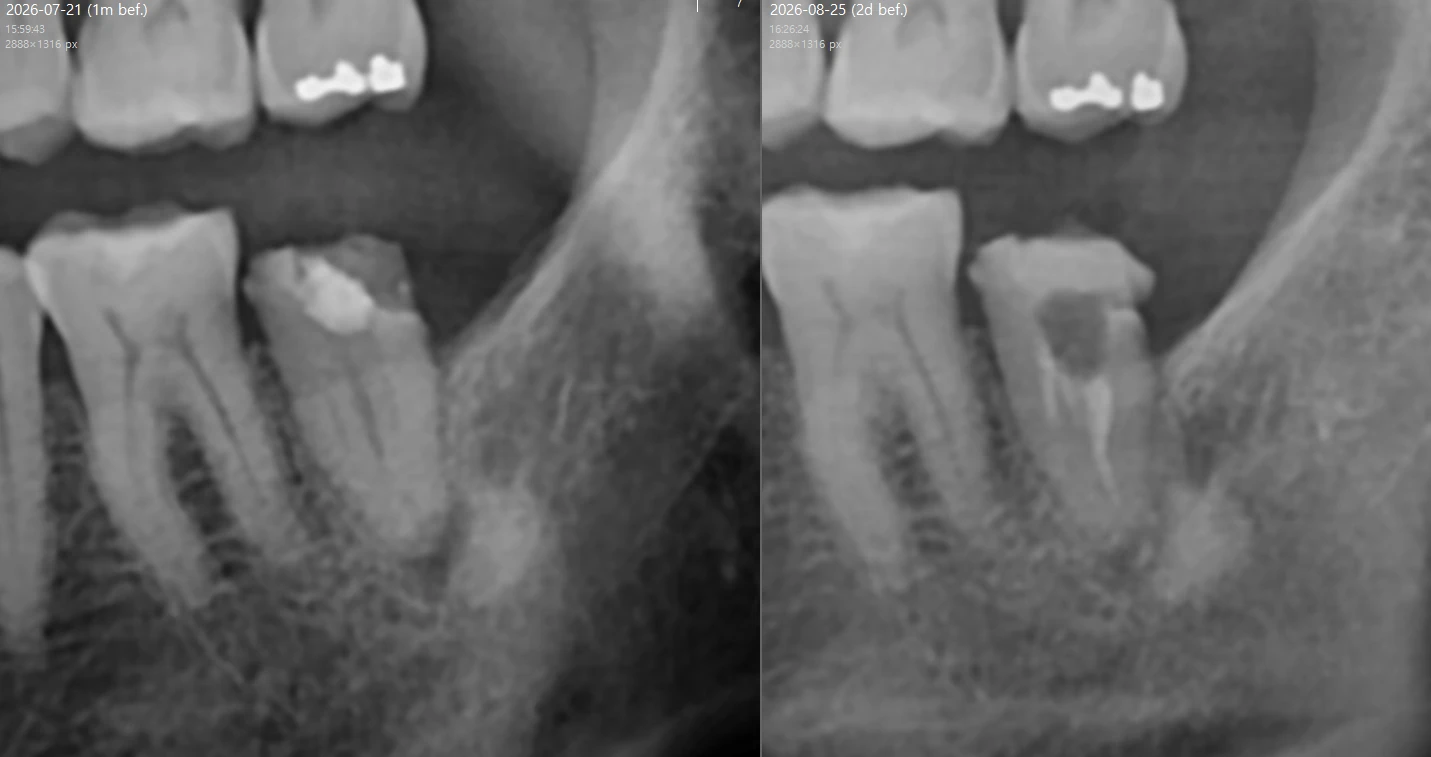
The more canals there are and the more curved they are, the more there is to handle at one time, and treatment is divided into two or more visits. Seongmo Dental Clinic checks the number of canals and the direction of their curves in advance with CBCT before treatment. A missed canal is the most common cause of root canal retreatment, so finding and treating all of them from the start is ultimately the way to reduce the number of visits.
Is there a way to reduce the number of visits?
First, do not endure the pain. Coming in at the pulpitis stage, when cold makes the tooth twinge, is more favourable both in the number of visits and in the success rate than coming after it has spread to inflammation at the root tip.
Second, the quality of disinfection. Seongmo Dental Clinic applies Plazen plasma disinfection at the final stage of canal irrigation. The purpose is supplementary disinfection reaching corners of the canal that chemical irrigants have difficulty reaching, and thanks to this the number of cases in which the disinfection period can be kept short increases. The final judgement is of course made by looking at the symptoms and the condition of the root tip.
Third, anaesthesia. If it hurts during treatment, that day’s treatment is stopped and the number of visits increases. Carrying it through to the end in one go under painless anaesthesia with a computer-controlled anaesthetic device is a realistic way to reduce the number of visits.
What happens if I stop coming halfway through?
The temporary filling placed between appointments is made to last 2 to 3 weeks. If it is left longer, bacteria enter again through the leaking gap and disinfection has to start over from the beginning.
The most common case is not coming back because the pain has gone. Pain disappearing is the result of the nerve having been removed, not of the infection having been resolved. A tooth that is not sealed is hollow inside, so the risk of it cracking under chewing force also rises. If a tooth undergoing root canal treatment breaks, a tooth that could have been saved may end up being extracted.
Is the crown placed right after the root canal?
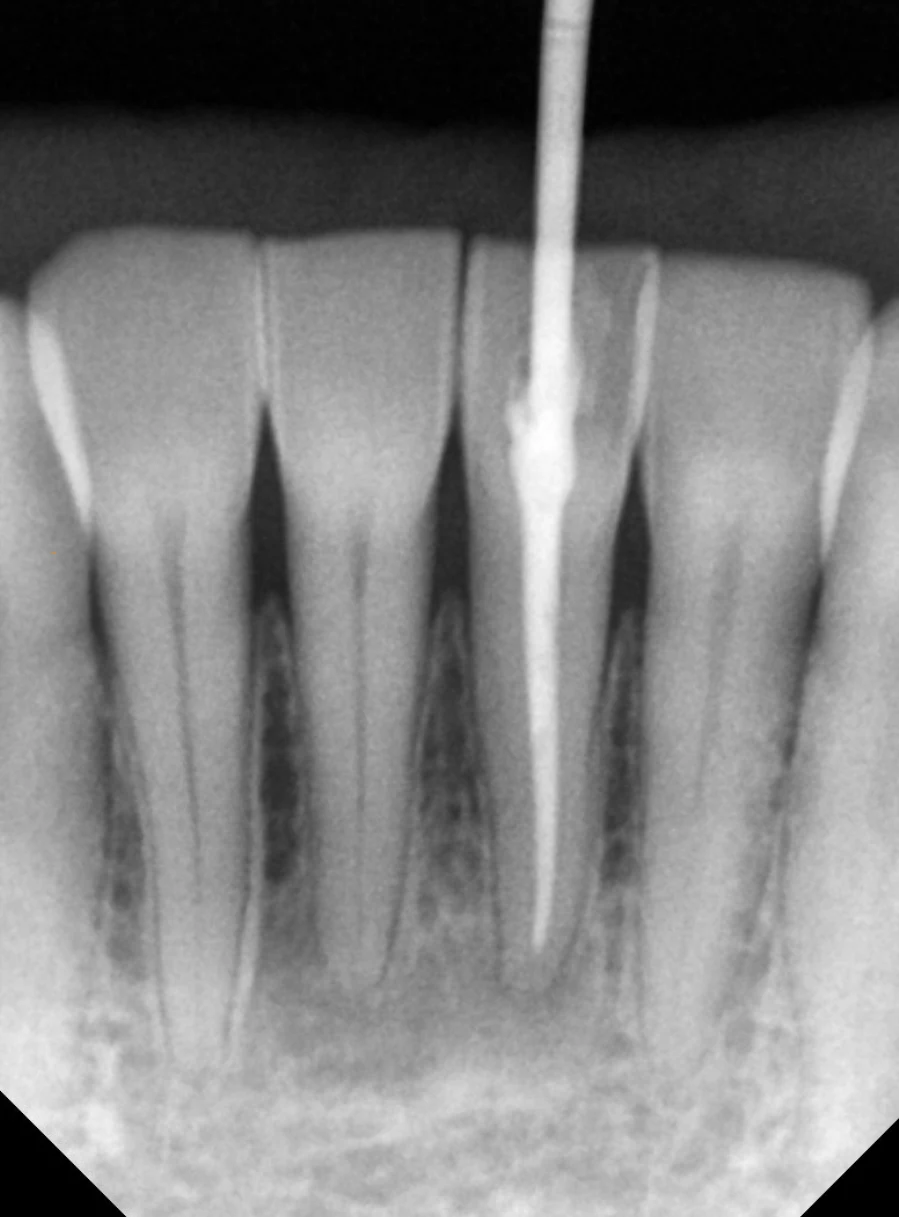
Yes. After sealing, a post is built and the tooth must be covered with a crown to prevent it from cracking. In the past, two more visits were needed: taking an impression for the crown, fitting a temporary tooth, and coming back two weeks later to have it bonded.
Seongmo Dental Clinic has Primescan, Primemill and SpeedFire in-house, so the crown can be finished on the same day as the last day of root canal treatment. The process is set out on our one-day crown and digital same-day prosthetics pages.
As for cost, the root canal treatment itself is covered by national health insurance, while the crown is non-covered. Costs by material can be checked on the non-covered fee guide.
The principle at Seongmo Dental Clinic is to save a tooth that can be saved to the very end, while asking you to come only as many times as necessary. Root canal treatment in general is covered on the root canal treatment page. 30 seconds on foot from Exit 2 of Sungshin Women’s University Station, 02-922-3966.
Frequently asked questions
Can a root canal be finished in a single day?
If the tooth is at the pulpitis stage with the nerve still alive and there is no inflammation at the root tip, single-visit treatment ending with the seal on the same day is possible. If there is already pus or the symptoms are severe, a disinfection period is needed.
How many days should there be between root canal appointments?
Usually an interval of one to two weeks. It gives the disinfectant time to act while moving on to the next stage before the temporary filling starts to leak.
If the pain goes away partway through, can I stop coming?
No. Pain disappearing is the result of the nerve having been removed, not of the infection having been resolved. The tooth can only be protected once sealing and the crown are complete.
Is root canal treatment covered by insurance?
The root canal treatment itself is covered by national health insurance. The crown placed afterwards is non-covered, and the cost can be checked on the fee guide page.
Related information
Seongmo Dental Clinic opened in 1998. I have held this position as the third director since April 2022, and I have one standard for choosing equipment: if I would not use it on my own family, I do not use it on my patients. One more scanner must not mean more treatment. If anything, it should mean cutting less, extracting less and finishing in one visit, from a more accurate original. The goal is not to be first with new equipment, but to offer the better of what is possible today to the patient sitting in the chair.
📍 3rd floor, 2 Dongsomun-ro 20ga-gil, Seongbuk-gu, Seoul
🚉 30-second walk from Exit 2, Sungshin Women’s University Station (Parking: up to 2 hours at Utah Mall)
📞 +82-2-922-3966
📅 Mon/Wed/Fri 09:30–18:30 · Tue 09:30–20:00 (evening clinic) · Sat 09:30–14:30 (no lunch break) · Weekday lunch 13:00–14:30 · Closed Thu, Sun and public holidays
💬 Booking and enquiries: Naver Booking · Naver Talk · KakaoTalk channel · English page
🟡 Opened in 1998; third-generation director in charge of care since April 2022
⚕️ This article was written for information purposes in line with Korean medical law and the Ministry of Health and Welfare’s medical advertising standards. Equipment specifications given here come from the manufacturer’s official material and the figures on accuracy and comfort are values reported in academic literature; the outcome and course of individual treatment vary with the condition of the mouth. Please decide on a specific diagnosis and treatment plan after consulting your treating clinician.
This article was written as of August 2026. Equipment specifications and cost-related content are reviewed and updated every three months.