English Home › Clinical Cases & Doctor’s Columns › Doctor’s Column
Why we brought in an AquaCare Twin — removing decay without a drill
A column on the AquaCare Twin (Velopex) air-abrasion and air-polishing unit · written by the director, a board-certified specialist in Integrative Dentistry at Seongmo Dental Clinic, Sungshin Women’s University Station
Even with a Plazen root canal unit, a 5-axis mill and a 3D printer in the clinic, one moment still bothered me: reaching for a high-speed handpiece to treat an early lesion the size of a grain of millet found on Q-ray. The bur was larger than the lesion. AquaCare Twin is the unit we brought in to remove that moment.
💡 The short answer. AquaCare Twin is an air-abrasion unit that carries 29µm or 53µm alumina particles in compressed air and sprays them with water, removing decayed tooth structure without a rotating drill; a second chamber holds sodium bicarbonate or Sylc bioactive-glass powder, so stain removal and desensitising polishing are handled by the same unit. Seongmo Dental Clinic treats early decay in a chain of Q-ray fluorescence diagnosis, minimal air-abrasion removal and same-day composite restoration, and because there is no vibration or heat, small lesions are often treated without anaesthesia.
📌 Three-line summary
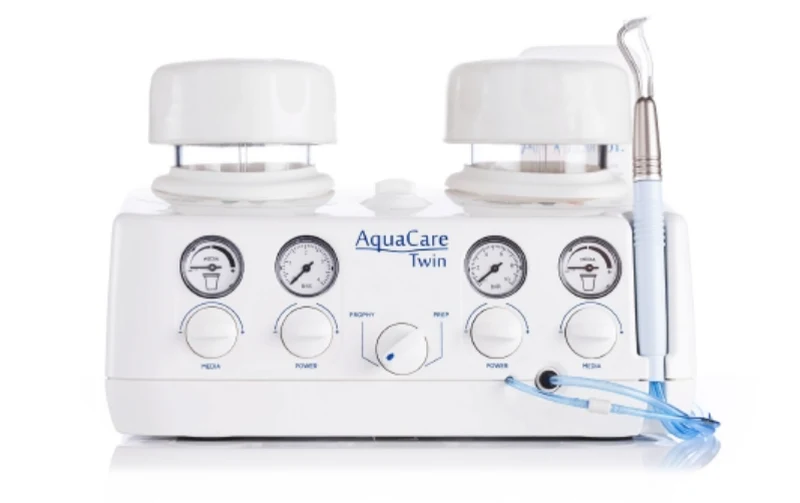
- AquaCare Twin is a two-chamber air-abrasion and air-polishing unit made by Velopex (Medivance Instruments, UK). The manufacturer specifies 4.0–5.0 bar for preparation (Prep) and 2.5–3.0 bar for polishing (Prophy), nozzles of 0.4, 0.6 and 0.8 mm, and a three-stage foot pedal switching between dry, rinse and cut.
- Air abrasion removes tooth structure only where the particles land, so less healthy enamel is lost in early lesions, and there is no vibration or heat. The literature also reports its use for surface preparation before bonding and for cleaning up orthodontic adhesive. It is not used on calculus or amalgam, and deep decay is handled together with rotary instruments.
- For Sylc 45S5 bioactive-glass polishing, a 2020 double-blind randomised clinical trial in 50 patients reported a significant reduction in sensitivity from 3 weeks up to 1 year compared with fluoride varnish. Seongmo Dental Clinic offers it as one option after diagnosing the cause.
Contents
- What is AquaCare Twin, and how does air abrasion differ from a drill?
- Why did Seongmo Dental Clinic bring in an AquaCare Twin?
- How does air-abrasion treatment of early decay proceed at the clinic?
- Where is air abrasion used in bonding and prosthetic work?
- What research is there on air abrasion and Sylc polishing?
- When is AquaCare not the right choice?
- Self-check before treating decay
- Frequently asked questions
What is AquaCare Twin, and how does air abrasion differ from a drill?
AquaCare Twin sprays fine powder with air and water to shape the tooth, and air abrasion removes tooth structure using the kinetic energy of those particles rather than rotation.
The first step in treating decay is removing diseased tooth structure. Until now that work has been done almost entirely by the high-speed rotary bur. It is fast and reliable, but the whole surface the blade touches is cut away, and rotational vibration and frictional heat travel through to the nerve inside the tooth. The sound and the sensation patients dislike most in a dental clinic come from here.
Air abrasion was first introduced in the 1940s and drew attention again as adhesive dentistry developed. Fine aluminium-oxide (alumina) particles are carried in compressed air, and as they strike the tooth they lift the surface away a little at a time. Because the cutting is done by kinetic energy, it is also called kinetic cavity preparation. A 2010 review in the Journal of Conservative Dentistry (Hegde and Khatavkar) lists less vibration, heat and noise than rotary instruments, fewer microcracks and conservative removal in early lesions as advantages, and unsuitability for deep decay, amalgam removal and calculus removal, along with the need to manage the powder, as limitations.
AquaCare is made by Medivance Instruments of London under the Velopex brand. To reduce the powder scatter that was the main inconvenience of dry air abrasion, a dedicated solution (AquaSol) is sprayed alongside the powder stream, and the Twin model has two powder chambers, so cutting and polishing powders can be selected on one unit. According to the manufacturer’s instructions for use, the four powders are alumina 53µm (standard cutting), alumina 29µm (fine cutting), sodium bicarbonate (cleaning and polishing) and Sylc bioactive glass (polishing and desensitising). Working pressure is 4.0–5.0 bar for preparation and 2.5–3.0 bar for polishing, the tungsten-carbide nozzles are 0.4, 0.6 and 0.8 mm, and the foot pedal has three stages for dry, rinse and cut.
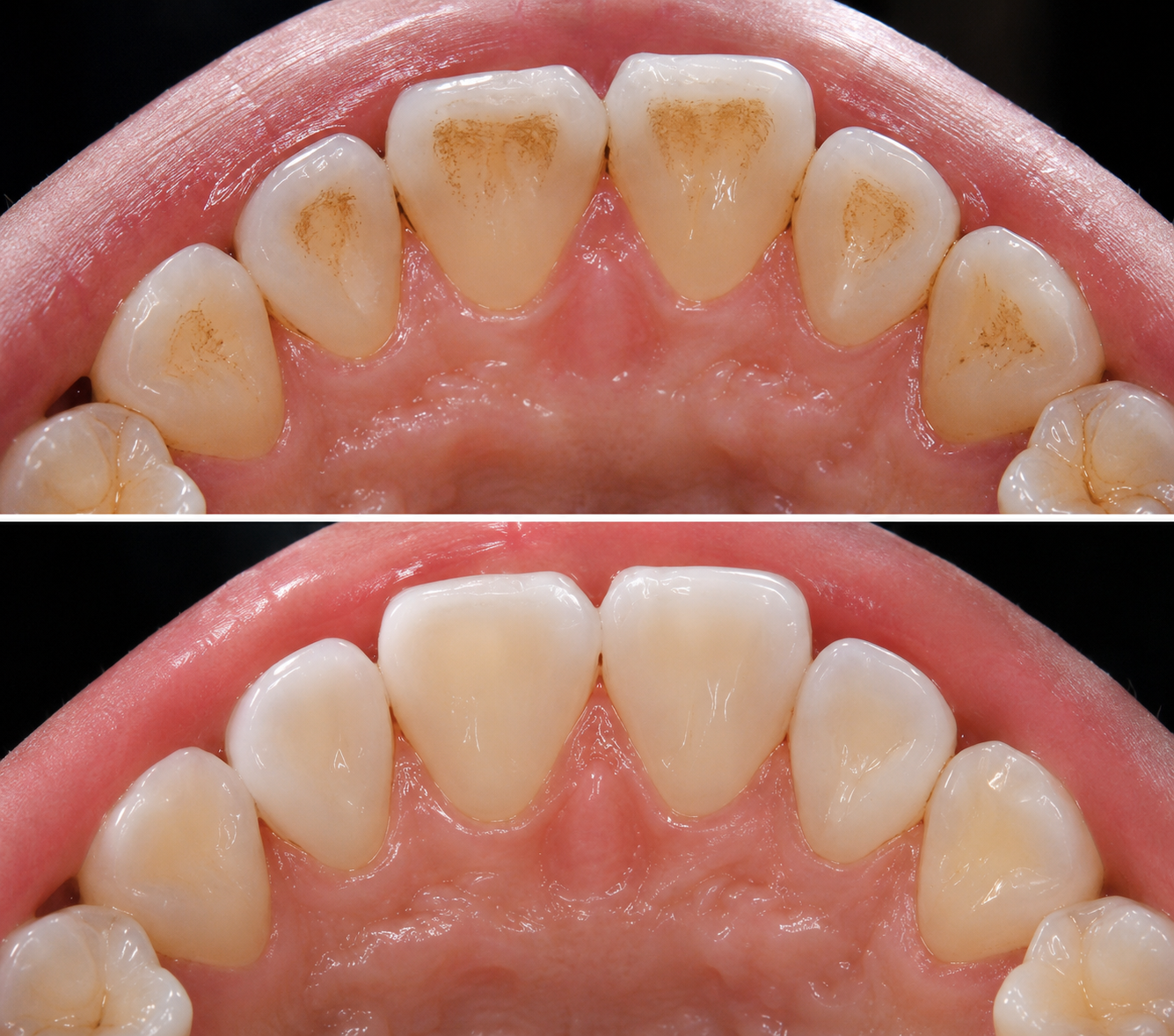
- Suitable for — early enamel lesions confirmed on Q-ray, cleaning fissures before sealants, surface preparation before bonding veneers and ceramic inlays, cleaning up adhesive after orthodontic bracket removal, in-house repair of chipped ceramic, stain removal, and Sylc polishing for cervical sensitivity.
- Not suitable for (where another method is preferred) — wide decay that has progressed deep into dentine (combined with rotary instruments), amalgam removal, calculus removal (EMS Prophylaxis Master), and patients with severe asthma or respiratory disease for whom powder inhalation is a concern (see the sixth section).
| Item | High-speed rotary bur | AquaCare Twin air abrasion |
|---|---|---|
| Cutting principle | Cutting by a rotating blade | Kinetic energy of 29 and 53µm alumina particles |
| Extent of removal | The whole surface the blade touches | The point the particles land on, proportional to spray time |
| Vibration and heat | Present | No rotating contact, no heat build-up |
| Noise | High-pitched handpiece whine | About the level of an air jet |
| Anaesthesia for early lesions | Usually needed | Often omitted for small lesions |
| Surface after preparation | Smear layer forms | Finely roughened — favourable for bonding |
| Powder scatter | Not applicable | Reduced by water spray (AquaSol), rubber dam and suction |
| Not suitable for | — | Deep decay on its own, amalgam, calculus |
| Role at Seongmo Dental Clinic | Deep decay and crown preparation | Early decay, surface preparation before bonding, polishing |
Why did Seongmo Dental Clinic bring in an AquaCare Twin?
There were three reasons: to cut an early lesion only as much as its own size, to make the first step of bonding a clinic-wide standard, and to have an option for sensitive teeth beyond something painted on.
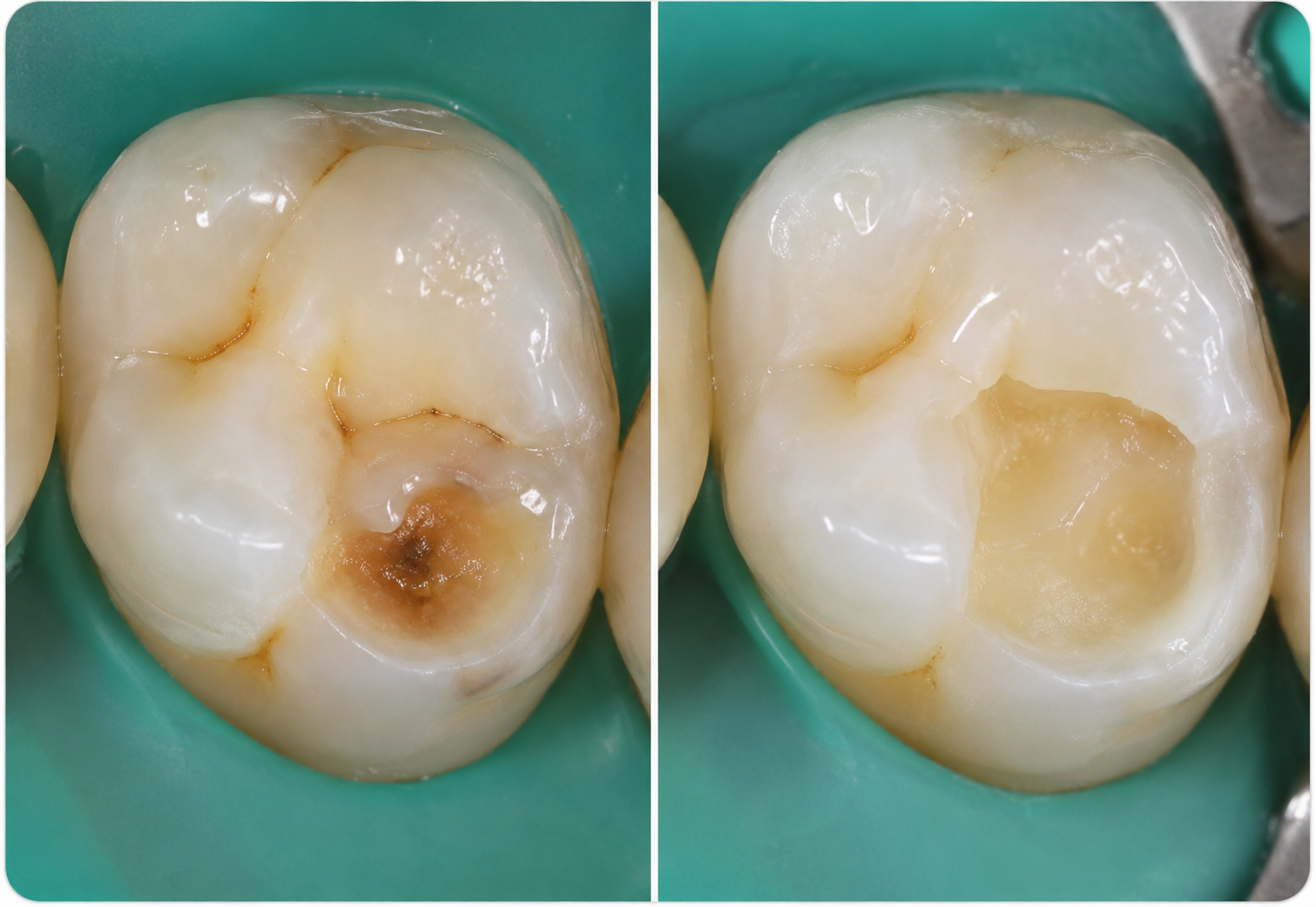
The first was matching the scale of diagnosis to the scale of treatment. Seongmo Dental Clinic uses a Q-ray quantitative light-induced fluorescence unit to find and record early demineralisation that is invisible to the eye and to radiographs. But if the lesion found is less than a millimetre across while the treatment instrument is a bur larger than that, the precision of the diagnosis is lost at the treatment stage. The 0.4 mm nozzle and 29µm fine alumina of the AquaCare are the tools that close that gap. When only the lesion is removed and composite is placed in that spot, the case can end as a preventive resin restoration instead of an inlay. It is the unit that puts into practice, at the smallest scale of decay, the principle of preserving natural teeth that the clinic has kept: cut only what is needed and leave the rest.
The second was bonding. Seongmo Dental Clinic makes same-day ceramic restorations through Primescan scanning, design by the director and 5-axis wet milling with SpeedFire sintering. Even a well-made restoration will not last if the bond is unreliable. A surface treated with alumina particles is finely rougher than one prepared by acid etching alone, which is favourable for bonding resin and ceramic, and this is noted consistently in the manufacturer’s material and in the adhesive dentistry literature. Preparing the tooth surface before veneer bonding, the fitting surface of a tried-in ceramic inlay and an abutment with temporary cement remaining, all under the same conditions, has become the in-house standard.
The third was tooth sensitivity. For a patient with a worn cervical area, what could be offered until now was fluoride varnish or a desensitising agent, and composite filling. Sylc bioactive-glass air polishing sits between the two. The literature is discussed in the fifth section.
The standard for bringing in new equipment is always the same. If I would not use it when my own family came as a patient, I do not use it on my patients. This time it was the other way round. When I saw an early lesion in the fissure of my child’s molar, I did not want to pick up a drill. I checked the literature first, and because the result pointed in the same direction as the principles of this clinic, we brought it in.
How does air-abrasion treatment of early decay proceed at the clinic?
Q-ray diagnosis, isolation, air-abrasion removal, composite restoration and occlusal check follow in order, and most cases finish within a single visit.
- 1. Q-ray quantitative fluorescence diagnosis — one full-arch image is taken and analysed under magnification, and the position and extent of the lesion are recorded. This is where a lesion to be treated is separated from one to be watched.
- 2. Isolation and protection — a rubber dam or high-volume suction keeps powder and water away from other areas, and protective eyewear is fitted.
- 3. Choosing powder and nozzle — 29 or 53µm alumina and a 0.4 to 0.8 mm nozzle are chosen to match the size of the lesion, and the unit is switched to Prep mode.
- 4. Air-abrasion removal — using the three-stage foot pedal for cutting and rinsing, only the lesion is removed. Because there is no vibration or heat, small lesions are often treated without anaesthesia, and if it feels sensitive we move straight to stepwise painless anaesthesia including i-JECT computer-controlled injection.
- 5. Bonding and composite restoration — adhesive and composite are placed on the prepared surface and light-cured. Sealant is applied to the surrounding fissures where needed.
- 6. Occlusal check and polishing — the bite is checked and the surface is finished. If there is staining, the unit is switched to Prophy mode and the work continues with the same handpiece.
What shortens the appointment is not the cutting itself so much as the time spent waiting for anaesthesia and the pauses taken while bracing against the sound of the drill. Seongmo Dental Clinic ties air-abrasion treatment to Q-ray diagnosis on the same day because the most conservative outcome for early decay is to finish it small, on the day it is found.
Many patients ask, is it over already? They had been waiting for the sound of the drill.
⚠️ Alumina and sodium bicarbonate powders have long been used in dentistry, but if you have severe asthma or chronic respiratory disease, have been advised to follow a low-sodium diet (sodium bicarbonate), or are pregnant or may be pregnant, please tell us before treatment. The type of powder and whether it is used will be adjusted.
📌 Air abrasion is carried out as part of the treatment itself, such as decay treatment, sealants or prosthetic bonding, and no separate equipment fee is added. Composite and ceramic restorations are non-covered items whose cost varies with the extent and the material (as of September 2026). The exact cost is explained after your mouth has been examined.
Where is air abrasion used in bonding and prosthetic work?
It is used for surface preparation before bonding veneers and ceramic restorations, in-house repair of chipped ceramic, cleaning up orthodontic bracket adhesive, and cleaning fissures before sealants.
The manufacturer’s instructions list the indications for AquaCare as preparation before pit-and-fissure sealants, resin removal, cavity preparation, cleaning, polishing and stain removal, and surface treatment of enamel, metal and porcelain. Three of these come up most often at Seongmo Dental Clinic.
The first is preparation before bonding same-day ceramic restorations. The fitting surface of a tried-in inlay or crown and the tooth surface are treated with alumina so that bonding conditions match. Residual temporary cement is cleared at the same step. The second is clearing adhesive after orthodontic treatment. Grinding away the adhesive left where a bracket was removed tends to take enamel with it, whereas air abrasion uses the difference in hardness between adhesive and enamel to lift the adhesive first. The third is cleaning fissures before sealants. Stain and debris deep in the occlusal grooves do not come out with a brush and acid etching alone, so the grooves are cleaned with a fine nozzle before the sealant is placed.
What should be clear is the division of roles. Managing supragingival and subgingival biofilm and calculus is the job of the EMS Prophylaxis Master (AIRFLOW), while the AquaCare Twin takes the side of shaping tooth structure and preparing bonding surfaces. The manufacturer’s instructions also state that this unit is not to be used for calculus removal or for cutting amalgam.
What research is there on air abrasion and Sylc polishing?
The conservative nature of air abrasion is covered in a review and in a bioactive-glass cutting study, and the relief of sensitivity by Sylc polishing in a 2020 double-blind randomised clinical trial.
The representative summary of air abrasion itself is the review by Hegde and Khatavkar published in the Journal of Conservative Dentistry in 2010. It sets out as advantages that air abrasion reduces the loss of healthy tooth structure in early lesions, produces less vibration, heat and noise, and creates a surface favourable for bonding, and as limitations that the absence of tactile feedback demands experience in judging depth, and that powder management and isolation are essential.
A 2011 study published in the Journal of Dentistry by a King’s College London team (Banerjee and colleagues) examined in the laboratory whether air abrasion using bioactive-glass powder instead of alumina removes carious tissue selectively compared with healthy enamel and dentine. The study reports that bioactive-glass powder cuts less aggressively than alumina but acts more selectively on carious tissue. This is the basis on which the clinic uses alumina for cutting and Sylc bioactive glass for polishing and desensitising.
On sensitivity there is a double-blind randomised clinical trial published in The Open Dentistry Journal in 2020 (Ahmed and colleagues). Fifty patients with sensitivity from non-carious cervical lesions were divided into a Sylc air-polishing group of 25 and a fluoride varnish group of 25 and followed for one year. The Sylc group showed a statistically significant reduction in pain to evaporative, thermal and tactile stimuli from 3 weeks up to 1 year (P<0.05), while the fluoride varnish group showed a significant reduction only at the 1-week point. As this is a single study and results vary between individuals, the clinic takes the finding as meaning that an option lasting longer than varnish exists, and diagnoses the cause first.
| Study | Design | Key reported findings |
|---|---|---|
| Hegde and Khatavkar, J Conserv Dent 2010 | Review | Less vibration, heat and noise; conservative removal; bonding-friendly surface / unsuitable for deep decay, amalgam and calculus |
| Banerjee et al., J Dent 2011 | In vitro · bioactive glass versus alumina air abrasion | Bioactive glass cuts less aggressively but acts more selectively on carious tissue |
| Ahmed et al., Open Dent J 2020 | Double-blind randomised · 50 patients · 1-year follow-up | Sylc polishing gave significant reduction in sensitivity from 3 weeks to 1 year (fluoride varnish only at 1 week) |
When is AquaCare not the right choice?
For wide decay that has progressed deep into dentine, amalgam removal, calculus removal and respiratory disease where powder inhalation is a concern, other methods come first.
Air abrasion is a tool for early lesions. Removing decay that has spread deep into dentine with particles alone takes a long time and makes depth hard to judge, so in those cases rotary instruments clear the bulk and air abrasion finishes only the margins and the bonding surface. It is not used for amalgam removal, and calculus is handled by the piezo scaler of the EMS Prophylaxis Master.
Some patients are concerned about inhaling the powder. Rubber dam, high-volume suction and water spray reduce scatter, but for patients with severe asthma or chronic respiratory disease we discuss whether to use it at all beforehand. For those advised to follow a low-sodium diet, a powder other than sodium bicarbonate is chosen.
⚠️ Not every early demineralisation seen on Q-ray needs treatment. Where the surface is smooth and there is no sign of progression, fluoride application and regular review can be the more conservative course, and in such cases the clinic recommends observation before treatment.
Before treating decay, a self-check
- ☑ You have been told at a check-up that there is early decay and it should be watched.
- ☑ You have put off dental treatment because of the sound and vibration of the drill.
- ☑ The grooves on the chewing surface of your molars are darkly stained.
- ☑ Teeth near the gum line feel sensitive to cold water or brushing.
- ☑ After finishing orthodontic treatment, the tooth surface feels rough or adhesive marks remain.
If two or more apply, we will check Q-ray diagnosis and whether air abrasion can be applied at the same visit.
❓ Frequently asked questions
Can decay really be treated with AquaCare air abrasion without anaesthesia?
Early lesions that stay within enamel are often treated without anaesthesia because there is no rotational vibration or heat. If the lesion has reached dentine or sensitivity is marked, we switch to stepwise painless anaesthesia including i-JECT computer-controlled injection, so there is no need to endure it.
Can every cavity be treated with AquaCare?
No. It suits early decay of small extent, cleaning fissures before sealants and surface preparation before bonding, while deep and wide decay is cleared in bulk with rotary instruments and only the margins and bonding surface are finished with air abrasion. It is not used for amalgam removal or calculus removal.
What is the difference between EMS AIRFLOW and AquaCare?
The EMS Prophylaxis Master is intended for managing supragingival and subgingival biofilm and calculus, while the main purpose of the AquaCare Twin is shaping tooth structure with alumina particles and preparing bonding surfaces. Where the two overlap, as in stain removal and Sylc polishing, the unit is chosen according to the condition of the tooth.
Is it safe if the powder is swallowed or inhaled?
Alumina and sodium bicarbonate powders are materials long used in dentistry, and scatter is reduced with rubber dam, high-volume suction and water spray. If you have severe asthma or respiratory disease, or have been advised to follow a low-sodium diet, please tell us before treatment and the type of powder and whether it is used will be adjusted.
Does Sylc polishing for sensitive teeth work after a single session?
A 2020 double-blind randomised clinical trial reported that relief of sensitivity was maintained up to one year after a single Sylc polishing session. Results vary between individuals, however, and depending on the cause such as wear, gum recession or cracks another treatment may come first, so the timing of any repeat application is advised after the cause has been diagnosed.
Is there a dental clinic near Seongbuk-gu or Sungshin Women’s University that treats early decay without a drill?
A clinic that has both an air-abrasion unit and a quantitative fluorescence diagnostic device can consider minimal removal of early decay. Seongmo Dental Clinic, a 30-second walk from Exit 2 of Sungshin Women’s University Station, combines Q-ray diagnosis, AquaCare Twin air abrasion and same-day composite restoration within one visit, and whether it can be applied is explained after the depth and extent of the lesion have been checked.
Related information
Seongmo Dental Clinic opened in 1998. I have held this position as the third director since April 2022, and I have one standard for choosing equipment: if I would not use it on my own family, I do not use it on my patients. With the AquaCare Twin it was the other way round — I brought it in because I did not want to pick up a drill for early decay in my own child’s tooth. Cutting only what is needed and leaving the rest is the principle this clinic calls preserving natural teeth, and this is a choice to keep that principle from the smallest cavity onwards.
⚕️ This article was written for information purposes in line with Korean medical law and the Ministry of Health and Welfare’s medical advertising standards. Equipment specifications given here come from the manufacturer’s official material and figures on treatment effect are values reported in academic literature; the outcome of treatment and whether anaesthesia is needed vary with the condition of the mouth. Every treatment carries individual variation and the possibility of side effects, so please obtain an accurate diagnosis through an in-person consultation.
📍 3rd floor, 2 Dongsomun-ro 20ga-gil, Seongbuk-gu, Seoul
🚉 30-second walk from Exit 2, Sungshin Women’s University Station (Parking: up to 2 hours at Utah Mall)
📞 +82-2-922-3966
📅 Mon/Wed/Fri 09:30–18:30 · Tue 09:30–20:00 (evening clinic) · Sat 09:30–14:30 (no lunch break) · Weekday lunch 13:00–14:30 · Closed Thu, Sun and public holidays
💬 Booking and enquiries: Naver Booking · Naver Talk · KakaoTalk channel · English page
🟡 Opened in 1998; third-generation director in charge of care since April 2022
This article was written as of September 2026. Equipment specifications and cost-related content are reviewed and updated every three months.
References
- Velopex International (Medivance Instruments Ltd). AquaCare Twin — Dental Air Abrasion & Polishing Unit, Instructions for Use (2022-07, EN). Instructions for use (PDF) · product page AquaCare TWIN
- Hegde VS, Khatavkar RA. A new dimension to conservative dentistry: Air abrasion. Journal of Conservative Dentistry. 2010;13(1):4-8. PMID 20582212 — review of the advantages and limitations of air abrasion
- Banerjee A, Thompson ID, Watson TF. Minimally invasive caries removal using bio-active glass air-abrasion. Journal of Dentistry. 2011;39(1):2-7. DOI — selectivity of bioactive-glass air abrasion for carious tissue
- Ahmed D, Abielhassan M, Hamza H, Haridy M, Mamdouh M. Sylc Air Polishing Versus Fluoride Varnish Application in Managing Dentin Hypersensitivity in Non-Carious Cervical Lesions: A Randomized Clinical Trial. The Open Dentistry Journal. 2020;14:120-126. DOI — evidence on relief of cervical sensitivity by Sylc polishing