English Home › Clinical Cases & Doctor’s Columns › Doctor’s Column
Retreatment or extraction
Which teeth can be saved and which must come out · Seongmo Dental Clinic, Sungshin Women’s University Station · Board-certified specialist in Integrated Dentistry
💡 The short answer. If the root is not vertically fractured and sound tooth structure remains above the gum, retreatment comes first, and even if that fails apical surgery remains as the next step. Extraction is the choice when there is no way to save the tooth — a vertical root fracture, insufficient tooth structure, or advanced periodontitis. Seongmo Dental Clinic first finds the cause of failure on CBCT, then works through retreatment, apicoectomy, intentional replantation and extraction in that order.
Contents
Why does root canal treatment fail?
There are four common causes: a canal was missed and bacteria remained inside it; a canal was curved or narrow and could not be disinfected to the end; the seal was loose and bacteria got back in; or the margin of the crown or filling leaks. All four are causes that can be resolved by treating again.
There is also a cause that cannot be resolved: a vertical root fracture, where the root has split lengthwise. No treatment can keep bacteria out of that split, so extraction is the answer. This is why Seongmo Dental Clinic takes a CBCT before retreatment — the cause has to be sorted into the savable and the unsavable first.
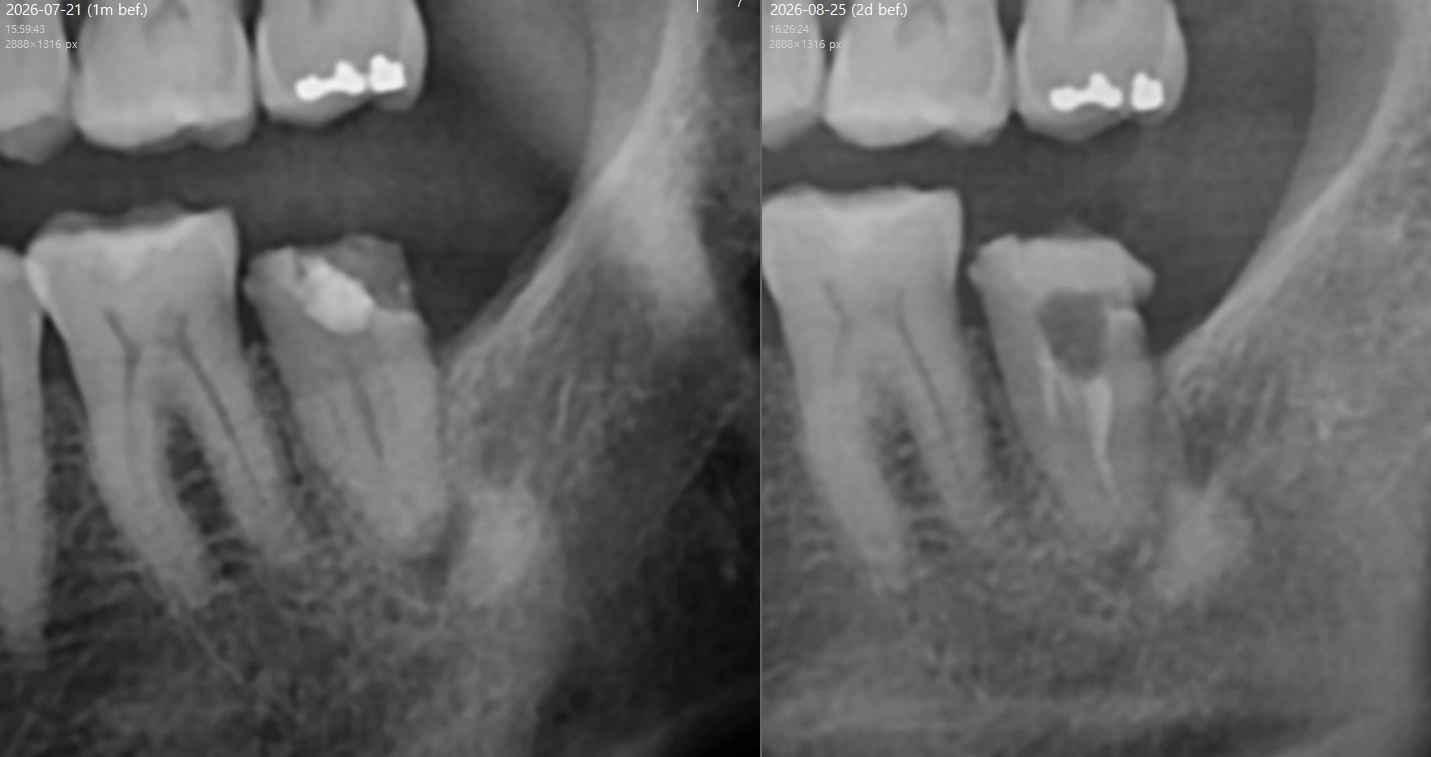
What is the success rate of retreatment?
Figures vary between studies, but the success rate of retreatment is generally reported in the 70 to 80 percent range. It is lower than a first root canal because the existing filling material has to be removed and hardened canals found again.
Even if retreatment fails, that is not the end. Apicoectomy — opening the gum and removing the inflammation with part of the root tip — remains, with success rates around 90 percent reported for modern techniques. If the position makes even that difficult, there is intentional replantation, in which the tooth is briefly removed, the root tip treated, and the tooth replanted. Seongmo Dental Clinic has all three, so there are three steps to try before extraction. Details are on the special treatments page.
Is an implant not more certain?
It is true that implant survival rates are reported in the high 90s. However, survival is the proportion of implants still in the mouth, while the success rate of retreatment is the proportion in which the inflammation at the root tip has also healed — the criteria differ. Studies comparing on the same criteria report similar long-term outcomes for saved natural teeth and implants.
The decisive difference is reversibility. If retreatment fails, the tooth can be extracted and an implant placed then. A tooth once extracted, on the other hand, does not come back. Extracting a tooth that still has a chance of being saved throws away one of the options.
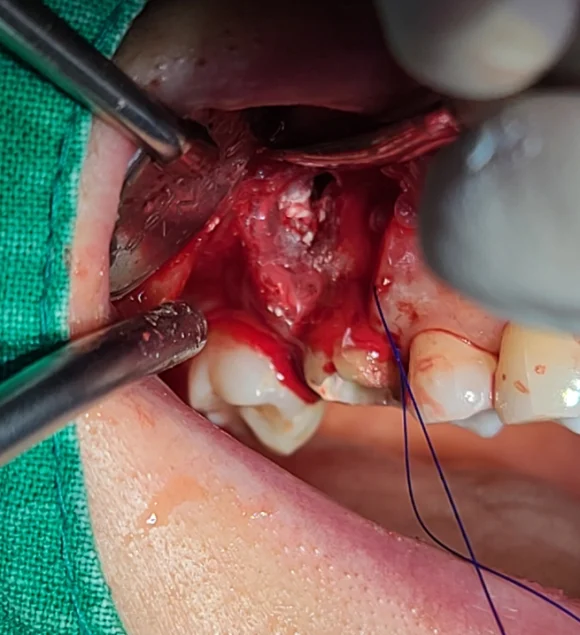
When is extraction the better option?
- Vertical root fracture — the root has split lengthwise
- Insufficient tooth structure — almost no sound tooth remains above the gum for a crown to hold onto
- Advanced periodontitis — the bone holding the root has largely dissolved and the tooth is mobile
- Structurally impossible to retreat — the canal is blocked and cannot be accessed, or the root is perforated
Even then, Seongmo Dental Clinic explains how immediate implant placement can shorten the treatment period. The process is on the implant page.
How does the cost compare?
Retreatment is covered by national health insurance, and only the crown placed afterwards is non-covered. Extraction followed by an implant is entirely non-covered, with partial coverage available from age 65. Costs by material are published on the non-covered fee guide. On cost alone, saving a savable tooth is the lighter burden.
The record of a molar that had been diagnosed for extraction, kept through plasma-disinfected retreatment and finished with a same-day crown, is in our clinical cases. Even if you have already been told the tooth must come out, it is worth confirming the cause once more on CBCT. 30 seconds on foot from Exit 2 of Sungshin Women’s University Station, 02-922-3966.
Frequently asked questions
How many visits does retreatment take?
Because the existing filling material has to be removed and the canal disinfected again, it usually takes 2 to 4 visits. If the inflammation at the root tip is large, a longer disinfection period may be needed.
If retreatment fails, does the tooth have to come out straight away?
No. Apicoectomy and intentional replantation remain. Seongmo Dental Clinic considers both of those steps before deciding on extraction.
Is retreatment covered by insurance?
Retreatment is a covered item under national health insurance. The crown placed over it afterwards is non-covered.
How many months does extraction and an implant take?
About 3 months with immediate placement at the time of extraction, or 9 to 12 months if bone grafting is done first and placement is staged.
Related information
Seongmo Dental Clinic opened in 1998. I have held this position as the third director since April 2022, and I have one standard for choosing equipment: if I would not use it on my own family, I do not use it on my patients. One more scanner must not mean more treatment. If anything, it should mean cutting less, extracting less and finishing in one visit, from a more accurate original. The goal is not to be first with new equipment, but to offer the better of what is possible today to the patient sitting in the chair.
📍 3rd floor, 2 Dongsomun-ro 20ga-gil, Seongbuk-gu, Seoul
🚉 30-second walk from Exit 2, Sungshin Women’s University Station (Parking: up to 2 hours at Utah Mall)
📞 +82-2-922-3966
📅 Mon/Wed/Fri 09:30–18:30 · Tue 09:30–20:00 (evening clinic) · Sat 09:30–14:30 (no lunch break) · Weekday lunch 13:00–14:30 · Closed Thu, Sun and public holidays
💬 Booking and enquiries: Naver Booking · Naver Talk · KakaoTalk channel · English page
🟡 Opened in 1998; third-generation director in charge of care since April 2022
⚕️ This article was written for information purposes in line with Korean medical law and the Ministry of Health and Welfare’s medical advertising standards. Equipment specifications given here come from the manufacturer’s official material and the figures on accuracy and comfort are values reported in academic literature; the outcome and course of individual treatment vary with the condition of the mouth. Please decide on a specific diagnosis and treatment plan after consulting your treating clinician.
This article was written as of August 2026. Equipment specifications and cost-related content are reviewed and updated every three months.