English Home › Clinical Cases & Doctor’s Columns › Doctor’s Column
Can pulpotomy replace full root canal treatment in adult permanent teeth?
Seongmo Dental Clinic, Sungshin Women’s University Station — a UPenn endodontics-trained specialist in Integrative Dentistry first judges how much living pulp can be kept before removing the whole nerve · Written 2026-09-16 · Last reviewed 2026-09-30
Key answer. Pulpotomy removes only the infected crown portion of the pulp and keeps the pulp inside the roots alive. In randomised trials of mature permanent teeth, 1-year success was reported to be similar to root canal treatment, but comparisons beyond 5 years rely on a single trial.
“Do you really have to kill the whole nerve?” This is the question we hear most from patients who have been told they need a root canal. This column sets out only what six verified papers actually say.
Is it possible to keep part of the nerve instead of removing all of it?
In adult permanent teeth, pulpotomy removes only the crown portion of the pulp and keeps the root pulp, and whether it applies depends on how far pulp inflammation has spread.
The pulp is the nerve and blood-vessel tissue inside the tooth. Full root canal treatment removes the pulp from both the crown and the roots and seals the empty canals.
Pulpotomy cuts away only the infected crown pulp. The remaining root pulp is covered with a calcium-silicate material (MTA, Biodentine and similar) and kept alive.
The reason to keep pulp is the tooth’s defence. Living pulp keeps forming dentine and senses stimuli. A tooth whose pulp has been fully removed loses these functions.
In the past, teeth with spontaneous pain were usually offered only root canal treatment or extraction[2]. In its 2019 position statement, the European Society of Endodontology set out principles for deep caries and exposed pulp and treated pulp-preserving care as an option[1].
How far has the evidence for pulpotomy in adult permanent teeth come?
In randomised trials, 1-year success of pulpotomy in mature permanent teeth was similar to root canal treatment, and a 2024 meta-analysis of 25 randomised trials estimated success at 86.7%.
A 2024 meta-analysis in PLoS One pooled 25 randomised trials of permanent teeth with carious pulp exposure (mean follow-up of 12 months or longer)[3].
Overall success was 86.7%. Teeth with irreversible pulpitis had 82.4%, lower than the 92.0% of teeth with normal pulp or reversible pulpitis.
The authors graded the certainty of evidence as very low to low.
Direct comparisons with root canal treatment are fewer. A systematic review of pulpitis with spontaneous pain included only 2 randomised trials[2].
Pain on day 7 did not differ between the treatments. Clinical success was 98% for both at 1 year, and 78.1% for pulpotomy and 75.3% for root canal treatment at 5 years.
A 2023 randomised trial from Jordan divided 60 mature molars into two groups[4]. One group received full pulpotomy with Biodentine, the other root canal treatment. Success at 12 months was 27 of 29 (93%) in both groups. Pain on the day after treatment was lower with pulpotomy.
The evidence base for root canal treatment, the comparator, is larger. A US practice-based network cohort analysed root-canal-treated tooth survival in general practice[5].
A 2025 meta-analysis showed that the type of coronal restoration after treatment affects periapical healing and tooth survival[6].
| Study (author, year) | Design & population | Main findings | Level of evidence |
|---|---|---|---|
| Duncan et al., 2019[1] | ESE position statement · deep caries and exposed pulp | Management principles including pulp-preserving treatment | Review / society position statement |
| Tomson et al., 2022[2] | SR & meta-analysis · pulpitis with spontaneous pain, 2 RCTs | No difference in day-7 pain · success 98% vs 98% at 1 year, 78.1% vs 75.3% at 5 years | Systematic review & meta-analysis |
| Li et al., 2024[3] | Meta-analysis · permanent teeth with carious exposure, 25 RCTs | Pulpotomy success 86.7% · irreversible pulpitis 82.4% vs normal/reversible 92.0% · very low to low certainty | Meta-analysis |
| Taha et al., 2023[4] | RCT · 60 mature molars with irreversible pulpitis | 12-month success 27/29 (93%) in both groups · lower next-day pain with pulpotomy | Randomised controlled trial |
| Thyvalikakath et al., 2022[5] | Cohort · root-canal-treated teeth in US general practice | Survival of root-canal-treated teeth in practice settings | Cohort |
| Kaaber et al., 2025[6] | Meta-analysis · coronal restoration of root-filled teeth | Restoration type affects periapical healing and tooth survival | Meta-analysis |
Where is it hard to apply this evidence directly?
Head-to-head comparisons of pulpotomy and root canal treatment beyond 5 years rely essentially on serial reports of a single trial, and the meta-analytic certainty of evidence is graded very low to low.
- Number of studies — Only 2 randomised trials directly compared the treatments in pulpitis with spontaneous pain[2]. The authors themselves stated the evidence is insufficient for robust conclusions.
- Population — The comparative trial enrolled mature molars in the Middle East[4]. Korean adult molar anatomy, care pathways under national insurance and material choices in private practice are not reflected.
- Follow-up — The 2023 trial followed patients for 12 months[4]. Survival data for root canal treatment extend to practice-based cohorts[5], but 10-year data for pulpotomy are not in the verified literature.
- Diagnostic uncertainty — The boundary of inflammation is hard to draw precisely from symptoms and tests alone[1]. Some things cannot be confirmed until the pulp is opened.
- Restoration — What covers the tooth changes the outcome[6]. Success rates for the procedure alone cannot fully explain real-world results.
Five of the six cited papers were published within the last five years (2021 or later). The gap in long-term comparative data still remains.
How are pulpotomy and full root canal treatment divided in the clinic?
The deciding factors are less the intensity of pain than whether bleeding can be controlled once infected pulp is removed and whether there are signs of inflammation at the root tip.
When the pulp is exposed during caries removal, the infected part is cut away step by step.
The bleeding of the remaining pulp is then observed. If bleeding stops within a short time, the pulp below is considered likely to be alive.
If bleeding continues, inflammation is considered to have reached the roots and treatment is switched to full root canal treatment.
- Pulpotomy is considered — exposed pulp with controllable bleeding, no lesion visible at the root tip, and enough remaining tooth structure for a sealed restoration.
- Full root canal treatment — bleeding that does not stop or visible pus, a root-tip lesion on X-ray, a pulp that is already necrotic, or a tooth that needs a post for its restoration.
Night-time throbbing pain alone does not rule out pulpotomy, because such teeth were included in the studies[2][3].
Because success was reported to be relatively lower, the possibility of switching to root canal treatment during the procedure is explained beforehand.
A switch during treatment is not a failure but the result of checking in order.
What criteria does Seongmo Dental Clinic use for pulpotomy?
Seongmo Dental Clinic first checks whether living pulp can be kept before deciding on root canal treatment, and switches to full root canal treatment on the spot if bleeding cannot be controlled.
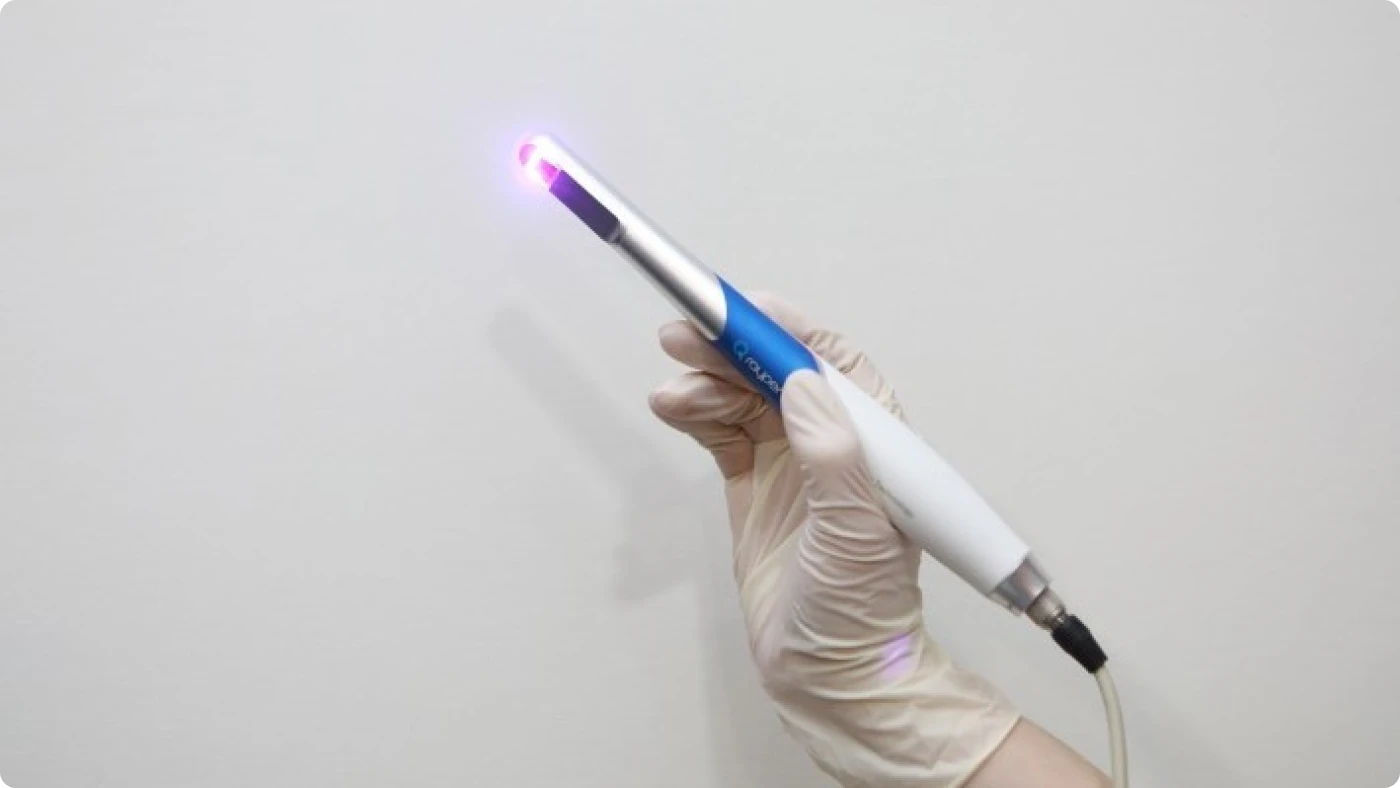
Q-ray fluorescence diagnosis shows the extent of caries and cracks, and HDX Dentri CBCT confirms root-tip lesions and canal shape.
Quicksleeper computer-controlled anaesthesia keeps injection pressure steady. After isolation with a rubber dam, pulpotomy or full root canal treatment is decided on the spot from the bleeding pattern of the pulp.
When treatment switches to a root canal, Plazen plasma-assisted disinfection is added after standard irrigation.
Whether pulp is kept or removed, not postponing a sealed restoration is a principle at Seongmo Dental Clinic.
Teeth are scanned with Primescan 2 and milled in-house with Primemill and SpeedFire, finishing with an overlay or crown the same day.
Seongmo Dental Clinic has practised at the same location since 1998, and the third director has been responsible for care since April 2022.
See also the root canal treatment, natural tooth preservation and same-day restorations pages, the pulpotomy and same-day overlay case, and the Korean original of this column.
Summary for patients
1. Pulpotomy cuts away only the top part of the damaged nerve and keeps the nerve inside the roots alive.
2. Results at one year are reported to be similar to removing the whole nerve, but there is still little data on the very long term.
3. Whether the nerve can be kept is judged less by how much it hurts than by whether bleeding stops soon after the tooth is opened.
4. Sometimes the plan changes to removing the whole nerve after checking the tooth; this is the result of checking step by step.
5. Either way, sealing the tooth properly on top decides the result, so it is better not to put off the final restoration.
Frequently asked questions
Can pulpotomy let me avoid root canal treatment completely?
If the pulpotomy holds, you can keep living pulp in the roots, but this does not apply to every tooth.
If bleeding does not stop when the pulp is opened or inflammation is seen at the root tip, full root canal treatment is needed, and some teeth move on to root canal treatment when pain continues after treatment.
How long does a pulpotomy last?
In a systematic review of 2 randomised trials, clinical success was 98% for both treatments at 1 year and 78.1% for pulpotomy versus 75.3% for root canal treatment at 5 years. The 5-year figures come essentially from one trial, so evidence for results beyond 10 years is still lacking.
Can a tooth that throbs at night still have a pulpotomy?
Teeth with irreversible pulpitis and spontaneous pain were included in the studies, and a meta-analysis of 25 randomised trials reported 82.4% success in such teeth, lower than 92.0% in teeth with normal pulp or reversible pulpitis.
Whether it is possible is judged from the bleeding pattern after opening the pulp and from X-ray findings.
Which hurts less after treatment, pulpotomy or root canal treatment?
In a randomised trial of 60 molars, pain on the day after treatment was reported lower with pulpotomy, and a systematic review found no difference between the treatments in pain on day 7. The degree of pain after treatment varies between individuals with the state of inflammation.
References
Authors, year, journal, volume, DOI and PMID are given as verified; the notes are translated.
- Duncan HF, Galler KM, Tomson PL, Simon S, El-Karim I, Kundzina R, et al. European Society of Endodontology position statement: Management of deep caries and the exposed pulp. Int Endod J. 2019;52(7):923-934. DOI · PMID 30664240 [Review / society position statement] — evidence on management principles for deep caries and exposed pulp and on indications for pulp preservation
- Tomson PL, Vilela Bastos J, Jacimovic J, Jakovljevic A, Pulikkotil SJ, Nagendrababu V. Effectiveness of pulpotomy compared with root canal treatment in managing non-traumatic pulpitis associated with spontaneous pain: A systematic review and meta-analysis. Int Endod J. Published online 2022. DOI · PMID 36209498 [Systematic review & meta-analysis] — evidence directly comparing pain and success of pulpotomy vs root canal treatment in pulpitis with spontaneous pain
- Li W, Yang B, Shi J. Efficacy of pulpotomy for permanent teeth with carious pulp exposure: A systematic review and meta-analysis of randomized controlled trials. PLoS One. 2024;19(7):e0305218. DOI · PMID 38968236 [Meta-analysis (25 RCTs)] — evidence on pulpotomy success by pulp diagnosis and on capping materials (CC BY 4.0)
- Taha NA, Abuzaid AM, Khader YS. A Randomized Controlled Clinical Trial of Pulpotomy versus Root Canal Therapy in Mature Teeth with Irreversible Pulpitis: Outcome, Quality of Life, and Patients’ Satisfaction. J Endod. 2023. PMID 37080387 [Randomised controlled trial] — evidence comparing 1-year success, pain and quality of life of full pulpotomy vs root canal treatment in mature molars
- Thyvalikakath T, LaPradd M, Siddiqui Z, Duncan WD, Eckert G, Medam JK, et al. Root Canal Treatment Survival Analysis in National Dental PBRN Practices. J Dent Res. 2022;101(11):1328-1334. DOI · PMID 35549468 [Cohort] — evidence on survival of root-canal-treated teeth in general practice rather than universities
- Kaaber W, Ranjkesh B, Kirkevang LL. Effect of Type of Coronal Restoration on Periapical Healing and Tooth Survival of Root Filled Teeth: Systematic Review and Meta-Analysis. Aust Endod J. 2025;51(3):849-860. DOI · PMID 40851324 [Systematic review & meta-analysis] — evidence on how coronal restoration affects periapical healing and tooth survival
If you have been told you need a root canal but have not yet decided, check once more at Seongmo Dental Clinic whether the pulp can be kept before the whole nerve is removed.
Seongmo Dental Clinic first checks the extent with Q-ray and CBCT, and decides on the day: pulpotomy if bleeding is controlled, Plazen plasma-assisted root canal treatment if it is not.
Tell us which molar hurts and since when through Naver booking or the Kakao channel.
The pulp’s ability to recover differs with age, depth of decay, cracks and general health, so even with the same diagnosis the treatment path and course can differ from person to person.
📍 3F, 2 Dongsomun-ro 20ga-gil, Seongbuk-gu, Seoul
🚇 30-second walk from Exit 2, Sungshin Women’s University Station (parking: 2 hours at U-Ta Mall)
📞 +82-2-922-3966
📅 Mon/Wed/Fri 09:30–18:30, Tue 09:30–20:00 (evening), Sat 09:30–14:30 (no lunch break), lunch 13:00–14:30, closed Thu, Sun and public holidays
💬 Naver booking · Naver TalkTalk · Kakao channel
🟡 Founded in 1998; the third director has been responsible for care since April 2022
Written 2026-09-16 · Last reviewed 2026-09-30 · Reviewed by the director of Seongmo Dental Clinic (specialist in Integrative Dentistry)


