English Home › Clinical Cases & Doctor’s Columns › Doctor’s Column
Can the nerve be saved instead of a root canal?
When a pulpotomy can replace a full root canal · Seongmo Dental Clinic, Sungshin Women’s University Station · Board-certified specialist in Integrated Dentistry
💡 The short answer. If decay or a crack has reached only the upper part of the pulp and the pain did not linger, the nerve can be saved with a pulpotomy instead of removing it entirely. The conditions are that there is no inflammation at the root tip and that bleeding from the exposed pulp stops within a few minutes. When those conditions are met, Seongmo Dental Clinic performs the pulpotomy and a same-day overlay in one appointment.
Contents
How is a pulpotomy different from a root canal?
A root canal removes the nerve from the crown all the way to the root tip and seals the canal. A pulpotomy removes only the infected nerve in the crown and covers the nerve in the root with a protective material so it stays alive. Because the inside of the canal is not touched, there is no widening or sealing of the canal at all.
A living nerve keeps moisture and sensation in the tooth and continues to defend at the root tip even when bacteria enter. It used to be a method for baby teeth and immature permanent teeth only, but as biocompatible materials advanced its scope widened to mature permanent teeth in adults. Studies continue to report that the success rate of pulpotomy in mature permanent teeth is comparable to root canal treatment.

Which teeth qualify?
There are four conditions.
- Pain pattern — a tooth that twinges with cold and settles soon after, or hurts only on biting, has a chance. A tooth that throbs spontaneously at night or hurts for a long time with heat is closer to root canal treatment.
- Condition at the root tip — there must be no inflammation at the root tip on CBCT or radiographs.
- Condition of the exposed pulp — when the decay is removed and the nerve is exposed, bright red bleeding that stops within a few minutes means a healthy nerve. If pus appears or the bleeding will not stop, we switch to root canal treatment.
- Remaining tooth structure — enough tooth must remain to be covered by an overlay or a crown.
The final judgement is made during treatment by looking at the nerve directly. That is why Seongmo Dental Clinic does not commit to a root canal from the start, but decides after removing the decay and the crack and seeing the state of the nerve.
Is leaving part of the nerve a problem later?
There is a possibility that the remaining nerve becomes inflamed later. In that case a root canal can be done then. Because the canal in the root has not been touched, nothing is lost compared with having done a root canal from the beginning. Saving it now costs nothing.
Across clinical studies, the 1 to 3 year success rate of pulpotomy in mature permanent teeth is reported in the 80 to 90 percent range. What decides success is the seal. Covering the tooth completely with an overlay or crown on the same day, so that bacteria cannot get back in after the nerve is capped, is the key point, and the root tip is checked radiographically at regular check-ups.
How is it done at Seongmo Dental Clinic?
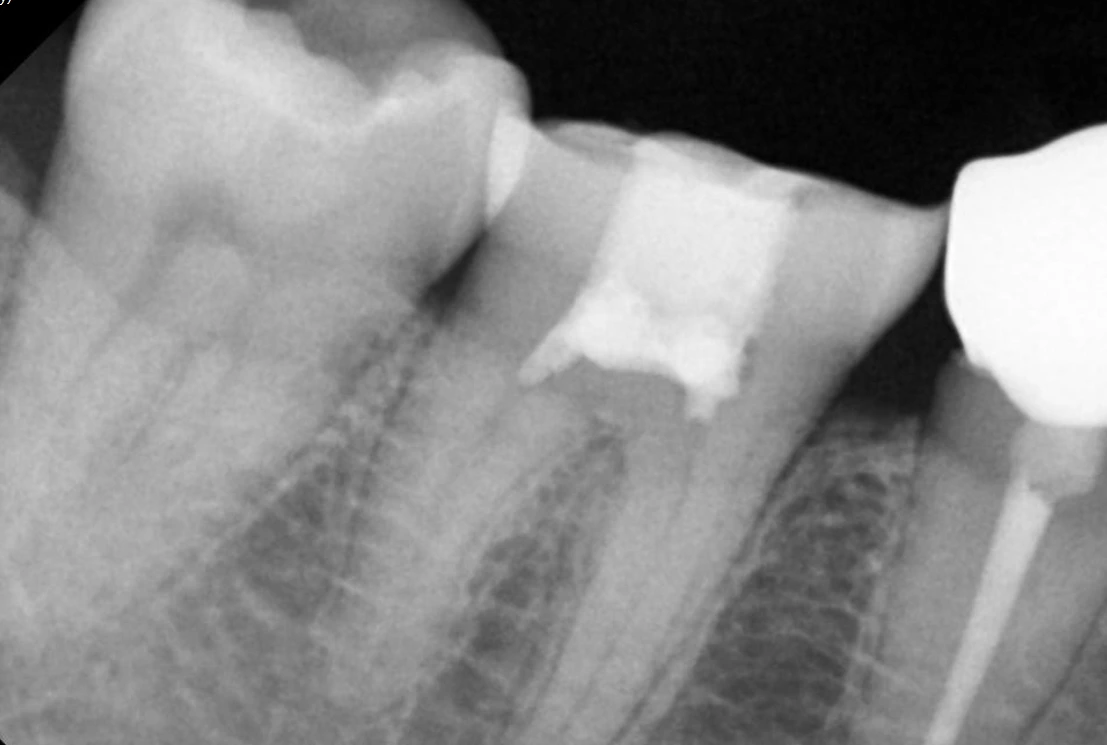
After painless anaesthesia the decay and the crack are removed, and when the nerve is exposed the portion in the crown is cut away. The exposed surface is disinfected with Plazen plasma, haemostasis is confirmed, and it is capped with a biocompatible protective material. Then it is scanned with Primescan, milled with Primemill, fired in SpeedFire and the overlay is bonded.
In an actual case this whole process finished in about 1 hour 30 minutes. The record of a cracked molar completed on the same day without removing the whole nerve is in our clinical cases. An overlay is used instead of a crown to preserve as much remaining tooth structure as possible, and the same-day fabrication process is set out on the one-day crown page.
What signs mean it must become a root canal?
Discomfort on biting for a few days after the procedure is within the normal range. However, if there is spontaneous throbbing at night, pain that continues beyond two weeks, gum swelling, or prolonged pain with heat, you should come in. In that case we switch to root canal treatment; the process is described on the root canal treatment page.
Seongmo Dental Clinic checks once more before extraction, and once more before a root canal. 30 seconds on foot from Exit 2 of Sungshin Women’s University Station, 02-922-3966.
Frequently asked questions
Can it still hurt after a pulpotomy?
Discomfort on biting for a few days after the procedure is within the normal range. If it throbs spontaneously at night or pain continues beyond two weeks, it may need to become a root canal, so you should come in.
Is a pulpotomy covered by insurance?
The pulpotomy itself is a covered item under Korean national health insurance. The overlay or crown placed over it is non-covered.
Can it be done on children’s teeth?
It has long been a standard method for baby teeth and immature permanent teeth. Seongmo Dental Clinic also applies it to mature permanent teeth in adults when the conditions are met.
If a pulpotomy fails, does the tooth have to be extracted?
No. If a problem develops in the remaining nerve, a root canal can be done then, and because the canal in the root has not been touched, treatment is not at any disadvantage.
Related information
Seongmo Dental Clinic opened in 1998. I have held this position as the third director since April 2022, and I have one standard for choosing equipment: if I would not use it on my own family, I do not use it on my patients. One more scanner must not mean more treatment. If anything, it should mean cutting less, extracting less and finishing in one visit, from a more accurate original. The goal is not to be first with new equipment, but to offer the better of what is possible today to the patient sitting in the chair.
📍 3rd floor, 2 Dongsomun-ro 20ga-gil, Seongbuk-gu, Seoul
🚉 30-second walk from Exit 2, Sungshin Women’s University Station (Parking: up to 2 hours at Utah Mall)
📞 +82-2-922-3966
📅 Mon/Wed/Fri 09:30–18:30 · Tue 09:30–20:00 (evening clinic) · Sat 09:30–14:30 (no lunch break) · Weekday lunch 13:00–14:30 · Closed Thu, Sun and public holidays
💬 Booking and enquiries: Naver Booking · Naver Talk · KakaoTalk channel · English page
🟡 Opened in 1998; third-generation director in charge of care since April 2022
⚕️ This article was written for information purposes in line with Korean medical law and the Ministry of Health and Welfare’s medical advertising standards. Equipment specifications given here come from the manufacturer’s official material and the figures on accuracy and comfort are values reported in academic literature; the outcome and course of individual treatment vary with the condition of the mouth. Please decide on a specific diagnosis and treatment plan after consulting your treating clinician.
This article was written as of August 2026. Equipment specifications and cost-related content are reviewed and updated every three months.