English Home › Clinical Cases & Doctor’s Columns › Doctor’s Column
Why we put a Primescan 2 next to our Primescan Connect
Primescan 2 is a cordless 3D intraoral scanner that stores scan data in the cloud without a cable or dedicated computer, with a full-arch scan under one minute and fluorescence and near-infrared 2D imaging according to the manufacturer. Seongmo Dental Clinic runs it alongside the existing Primescan Connect to shorten impression waiting time and feeds the data straight into same-day Primemill restorations.
A column on the wireless, cloud-based Primescan 2 intraoral scanner · written by the director, a board-certified specialist in Integrative Dentistry at Seongmo Dental Clinic, Sungshin Women’s University Station
Our Primescan Connect — an intraoral scanner in the 30-million-won class — was working perfectly well, and yet we brought in another scanner announced in September 2024. Keeping two scanners from the same manufacturer felt like a decision that ought to be explained to our patients.
💡 The short answer. Primescan 2 is a wireless 3D intraoral scanner that stores scan data directly in the cloud, with no cable and no dedicated computer; the manufacturer states a full-arch scan under one minute and adds fluorescence and near-infrared 2D imaging. Seongmo Dental Clinic runs Primescan Connect and Primescan 2 side by side to shorten the wait for impressions, and feeds that data straight into same-day prosthetics on Primemill.
📌 Three-line summary
- Primescan 2 was announced on 5 September 2024. It is a wireless intraoral scanner that stores scan data directly on the DS Core cloud platform without a dedicated computer, and the manufacturer states a full-arch scan in under one minute.
- In two 2025 studies published in the Journal of Dentistry, Primescan 2 showed accuracy that could not be distinguished statistically from the wired Primescan, and in the patient study its trueness did not differ significantly from conventional putty impressions.
- Seongmo Dental Clinic runs Primescan Connect (2022 model) together with Primescan 2 to reduce waiting for scans, and links that data to a same-day chain with about 5 minutes of Primemill crown milling.

Contents
- What is Primescan 2, and how does it differ from the earlier Primescan?
- Why add Primescan 2 when the clinic already had Primescan Connect?
- How does a Primescan 2 scan actually go?
- What are the fluorescence and near-infrared 2D images used for?
- What research reports the accuracy of Primescan 2?
- When is a Primescan 2 scan not the right choice?
- Self-check before your impression appointment
- Frequently asked questions
What is Primescan 2, and how does it differ from the earlier Primescan?
Primescan 2 is a wireless 3D intraoral scanner that stores scan data directly in the cloud without a dedicated computer.
An intraoral scanner photographs the inside of the mouth with an optical camera and converts the shape of the teeth and gums into three-dimensional data. Instead of biting on putty and waiting for it to set, a pen-shaped tip is moved along the tooth surfaces while a 3D model builds up on screen in real time. Crowns, inlays and implant restorations — and occlusal analysis and treatment records as well — all start from this data.
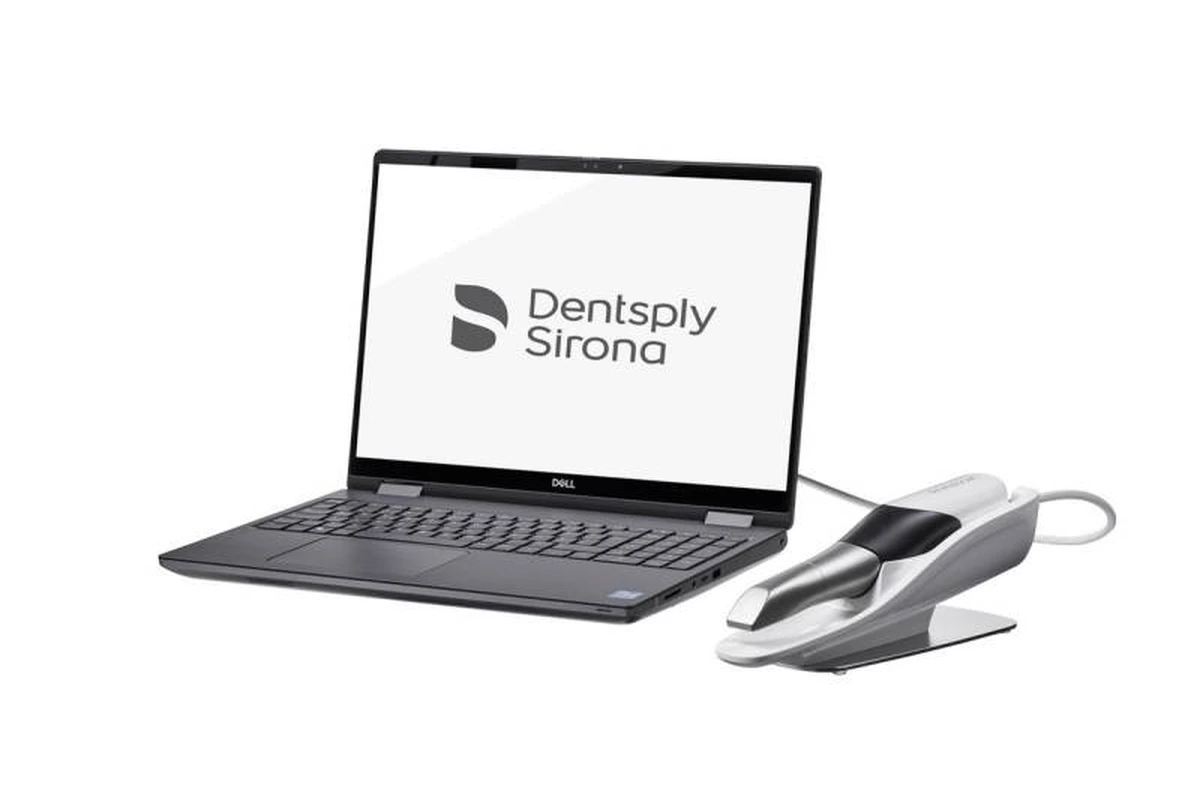
Primescan 2 was announced by Dentsply Sirona on 5 September 2024. The Primescan family went from the 2019 cart-based Primescan through the laptop-connected Primescan Connect of September 2022 to this model. The optical scanning technology is inherited from the previous generation, but the way data is handled has changed. According to the manufacturer’s official material, scanning can be done from any internet-connected PC, laptop or tablet without a dedicated computer, and scan data is stored directly on the DS Core cloud platform (a paid subscription).
The part you hold has changed too. Per the manufacturer, the scanner tip has been redesigned at a flatter angle so it reaches the distal surfaces behind the molars more easily, and a tap sensor was added so that scanning can be started and stopped and switched between 3D and 2D by tapping with a finger. For hygiene, the closed design around the viewing window comes with single-use sleeves as standard, with a steel reusable sleeve carrying a sapphire glass window as an option. Power comes from swappable batteries; three batteries and one charger are included in the basic configuration, and up to four scans per battery are stated.
On the software side there are two scan types: a status scan that captures the whole mouth quickly, and a treatment-site scan that captures only the area being treated. The stored 3D and 2D material can be placed next to radiographs on the Canvas screen in DS Core to explain findings to patients, and because it is cloud-based the latest software applies each time you log in.
- Well suited to — teeth planned for in-house same-day restorations such as crowns, inlays and endocrowns; implant restoration scans; workflows where a scanner has to be shared between rooms; and people with a strong gag reflex to putty impression material.
- Not suited to (alternatives preferred) — a situation where bleeding or saliva hides the margin of the preparation, or a moment when the internet connection is unstable. In those cases we settle the conditions first, or switch to the cable-based Primescan Connect (see item six).
| Item | Primescan Connect (2022, existing) | Primescan 2 (2024, new) |
|---|---|---|
| Announced | September 2022, DS World | 5 September 2024 |
| Connection | USB cable + one validated laptop | Wireless, no dedicated computer |
| Data handling | Processed on the laptop, then sent to DS Core / the lab | Stored on the DS Core cloud as you scan |
| Full-arch scan time | Under 1 minute (manufacturer) | Under 1 minute (manufacturer) |
| Fluorescence / near-infrared 2D | Not supported | Supported (availability differs by country) |
| Controls | Laptop screen and software | Tap sensor for start / stop and 3D↔2D |
| Power | Laptop and cable | Three swappable batteries included, up to 4 scans each |
| Software updates | Installed manually on the laptop | Applied automatically from the cloud |
| Accuracy literature | Many in vitro and in vivo studies since 2019 | No statistically significant difference from the wired Primescan in two 2025 J Dent papers |
| Role in our clinic | Wired backup, laptop-portable | Main scanner, moved between rooms |
Why add Primescan 2 when the clinic already had Primescan Connect?
The reason was flow, not accuracy: waiting time, moving the scanner, and how much information you see while scanning.
To be honest, we had no complaints about Primescan Connect. In a study that validated the first-generation Primescan in five patients (Journal of Clinical Medicine, 2020), full-arch transfer accuracy averaged 33.8µm, reported in the same order of magnitude as the 24.6µm of conventional impressions — accuracy was already sufficient. The problem was not accuracy but the flow of the treatment rooms.
A scanner tied to a laptop and a cable stays in one room. The picture of an office worker who came in on a lunch break, waiting for a scan to finish in the next room, is where the clinic started thinking about a second scanner. Primescan 2 has no cable and a cradle can sit in each room, so the manufacturer explains that it can be handed to the next patient as soon as a scan is done. That is why Seongmo Dental Clinic keeps Primescan Connect and Primescan 2 together: two rooms can scan at the same time, and if one has a problem the other supports it.
The third reason is the information you gain while scanning anyway. The fluorescence and near-infrared 2D imaging does not replace the Q-ray quantitative light-induced fluorescence device the clinic already uses; it is closer to a recording device that leaves one more image of the tooth surface at the very moment the impression is taken. Item four covers this in detail.
Bringing in equipment less than two years after its announcement is always a careful decision. If the reason for an investment this uncomfortable had to be reduced to one sentence, it is this standard: if my own family came in as patients, I would not want them kept waiting, and I would not want their restorations made from a less accurate impression. We did not buy it because it was new. We checked the literature first (item five), and brought it in because the results pointed in the same direction as the natural-tooth preservation principle this clinic has kept.
How does a Primescan 2 scan actually go?
Sleeve on, scan type selected, upper / lower / bite scanned, screen reviewed — all while you stay in the chair.
- ① A single-use closed sleeve is fitted — a new sleeve for every patient. The area around the viewing window is closed off by design so the inside of the tip is not contaminated.
- ② Lifted from the cradle and connected wirelessly to the room screen — no time spent sorting cables or moving a laptop.
- ③ The scan type is chosen — a status scan of the whole mouth, or a treatment-site scan of only the area being treated.
- ④ Upper jaw, lower jaw and bite are scanned — the tip is moved along the tooth surfaces, with start and stop controlled by the tap sensor. The manufacturer states a full-arch scan in under one minute.
- ⑤ Fluorescence / near-infrared 2D images if needed — one tap switches from 3D to 2D to leave a surface record.
- ⑥ Reviewing the screen and linking to design — we enlarge the 3D model stored in DS Core and look at it together, and same-day cases continue into Primemill design.
The time that is saved lies less in the scan itself than in what comes before and after it. Putty impression material means holding your mouth open while it sets; if a bubble or a distortion appears the impression has to be taken again from the start; and then come the stone model and the delivery time to and from the laboratory. With a scan, only the missing part is captured again, and the data moves straight into design on the spot without any delivery. At Seongmo Dental Clinic the flow that links a Primescan 2 scan to same-day prosthetics is scan → design → Primemill milling (about 5 minutes per crown) → SpeedFire sintering and glazing → fitting, and crown materials are chosen to suit the case, including Tessera blocks with a flexural strength of 700MPa or more.
When we say the scan is finished, many patients ask “already?”, and they tell us it was a relief not to have to bite on putty.
For the tooth-preparation stage that needs anaesthesia we work with a computer-controlled constant-rate injection system including i-JECT. The scan itself needs neither anaesthesia nor impression material, so for people with a strong gag reflex we suggest starting with the scan.
⚠️ An intraoral scan does not use radiation, but prosthetic and implant planning may involve radiographs. If you are pregnant or may be pregnant, if you take medication for cardiovascular disease or diabetes, or if you are elderly, please tell us before treatment.
📌 The intraoral scan is carried out as part of the relevant treatment — crown, inlay, implant and so on. Prosthetic fees are non-covered items and vary with material, extent and the condition of the tooth (as of August 2026). The exact cost is explained after your mouth has been examined.
What are the fluorescence and near-infrared 2D images used for?
Fluorescence and near-infrared 2D leave surface and internal signals side by side during the scan, as supplementary images that help confirm early caries.
Fluorescence imaging uses the property that healthy enamel, demineralised areas and bacterial metabolites fluoresce differently under light of a particular wavelength. Near-infrared imaging uses light that penetrates enamel to some degree; demineralised areas are known to scatter it more and therefore appear brighter. Neither uses radiation, so both can be recorded repeatedly at every scan without concern.
The manufacturer’s official material states that Primescan 2 supports both fluorescence and near-infrared 2D images and that availability of the feature differs by country (not offered in Japan or the United States). On the domestic specification installed at our clinic, one tap during a scan switches to 2D imaging.
What we want to be clear about is the role. At Seongmo Dental Clinic the quantitative assessment of caries and cracks is handled by Q-ray, which takes one still image of the whole arch and then analyses it under magnification, while the state of bone and roots is handled by radiographs and 3D CT. The fluorescence and near-infrared 2D of Primescan 2 does not replace these. Its purpose is to leave one more surface record from the same date while we are scanning anyway, so that the same area can be compared under the same conditions at the next check-up.
⚠️ We do not confirm caries or decide the extent of treatment from brightness changes in a fluorescence or near-infrared image alone. One more image must not mean more treatment; early lesions that can be watched are recorded and watched. The principle of not over-treating does not change when equipment is added.
- Well suited to — recording the course of an area suspected of early caries, checking the surface condition around restoration margins, and as a visual aid shown next to the 3D model when explaining findings.
- Not suited to (alternatives preferred) — assessing apical inflammation or bone loss (the territory of radiographs and 3D CT), or quantifying how far caries has progressed (the territory of Q-ray). In those cases the 2D image is used only as reference material.
What research reports the accuracy of Primescan 2?
The key question is whether accuracy holds after going wireless, and two papers published in 2025 address it.
Intraoral scanner accuracy has two measures: trueness, meaning how close the result is to the true value, and precision, meaning how consistent repeated results are. In the literature, 100µm is often used as the clinically acceptable threshold for full-arch scans.
A 2025 in vitro study published in the Journal of Dentistry by a team at the University of Bern, Switzerland, compared two wireless and two wired scanners on three partially edentulous models including implants, 14 times each. In that study Primescan 2 is reported to have shown 3D distance deviations similar to the wired Primescan. The authors added that they did not systematically control Wi-Fi stability or remaining battery, so differences between devices cannot be explained by wireless operation alone.
A 2025 clinical study in the same journal (Giessen and Kiel universities) compared four wireless scanners, one wired scanner and conventional impressions in dentate arches of real patients. A reference device carrying four 5mm steel spheres was measured ten times on a coordinate measuring machine as the reference, and Primescan 2 and Primescan AC are reported to have shown no statistically significant difference from conventional impressions in overall linear distance deviation. The authors also concluded that not all wireless scanners are alike and that device-by-device validation is needed, and stated that the study received financial support from the manufacturer (Sirona Dental Systems).
As important as accuracy is the patient’s experience. A 2024 crossover randomised clinical trial published in Children by a Spanish team had 51 children and adolescents, mean age 12.35 years, experience both alginate impressions and two intraoral scans, and compared them on a 100mm VAS. Primescan scanning is reported to have received significantly better scores than alginate impressions for gagging, pain and overall comfort. This is the basis on which Seongmo Dental Clinic suggests a Primescan 2 scan first to people with a strong gag reflex.
| Study | Design | Key result (as reported) |
|---|---|---|
| Dönmez et al., J Dent 2025 | in vitro · 3 models × 4 scanners × 14 repeats | Primescan 2 showed 3D distance deviations similar to the wired Primescan |
| Schlenz et al., J Dent 2025 | in vivo · 4 wireless + 1 wired + conventional impression, 5mm sphere reference device | No significant difference in trueness between Primescan 2 and conventional impressions |
| Schmidt et al., J Clin Med 2020 | in vivo · 5 patients, first-generation Primescan | Mean 33.8±31.5µm (conventional impression 24.6±17.7µm) |
| Serrano-Velasco et al., Children 2024 | crossover randomised · 51 participants · 100mm VAS | Primescan scored better than alginate for gagging, pain and comfort |
The manufacturer publishes a clinical research overview collecting more than forty papers released between 2022 and 2025. The references in this article include only those whose full text and DOI we checked directly, and because conditions differ from study to study, no figure promises an individual patient’s result.
When is a Primescan 2 scan not the right choice?
When bleeding or saliva hides the margin, or when the mouth cannot be opened wide enough, we settle the scanning conditions first.
The better the equipment, the more important it is to decide in advance when to step back. If any of the following applies, Seongmo Dental Clinic postpones the Primescan 2 scan or considers another method first.
- When gum bleeding or inflammation hides the preparation margin — we scan after gum treatment and haemostasis. A camera cannot see under blood and saliva.
- When the margin lies deep under the gum — we scan after opening the sulcus with retraction cord, and if conditions are not right it can be safer to take a conventional impression of that area as well.
- Edentulous areas or long edentulous spans — the literature reports that error can grow because the scanner has too few reference points to stitch together, so we consider auxiliary markers or conventional impression techniques alongside.
- When the mouth is difficult to open or the gag reflex is severe — we scan section by section with breaks. Scanning can be stopped and resumed freely.
- Moments when the internet connection is unstable — because storage is cloud-based, we switch on the spot to the cable-based Primescan Connect. This is also the practical reason for keeping two units.
⚠️ Preparing a tooth for a same-day restoration is irreversible. Replacing an existing restoration that causes no symptoms simply because the scan data looks good needs care, and in such cases Seongmo Dental Clinic first suggests watching it at regular check-ups.
Before your impression appointment — a self-check
- ☑ I have put off dental treatment because of gagging on putty impressions
- ☑ Waiting two weeks or more in a temporary crown is hard to fit into my schedule
- ☑ A previous restoration had to be remade because the margin did not fit
- ☑ I can only come to the dentist at lunchtime or after work
- ☑ I have been told I have early caries and want it documented so I can see whether it is progressing
If two or more apply, we will look at scan-based diagnosis and whether same-day prosthetics are possible, together.
❓ Frequently asked questions
Does a Primescan 2 scan hurt or make you gag?
It is an optical recording: the tip is moved along the tooth surfaces without anaesthetic or impression material, and the manufacturer states that a full-arch scan takes under one minute. Because nothing has to be held in the mouth while it sets, a randomised study in children and adolescents reported less gagging discomfort. If it still feels difficult, the scan can be taken section by section with breaks in between.
Can the scan and the crown fitting be finished in one day?
In many cases yes, when the indications are met; in-house Primemill milling takes about 5 minutes per crown. That is because scan data flows straight into design, milling and sintering inside the clinic. Depending on apical inflammation or gum condition it can be safer to split the treatment into stages, so the final decision is made after diagnosis.
Is there a separate charge for scanning with Primescan 2?
The intraoral scan is one step within the crown, inlay or implant treatment itself, and the cost depends on the type of treatment and the material (as of August 2026). The prosthetic fee does not change with the scanner model; the exact cost is explained after your mouth has been examined.
Does an intraoral scan involve radiation? Can it be taken during pregnancy?
Primescan 2 is an optical camera system and does not use ionising radiation; the fluorescence and near-infrared 2D images also use visible and near-infrared light, so radiation exposure during the scan is zero. Separate radiographs may still be needed for prosthetic or implant planning, so please tell us if you are pregnant or may be pregnant and the imaging plan will be adjusted.
Which scanner will be used — Primescan Connect or Primescan 2? Do the results differ?
Both units use the same Primescan optical technology, and two 2025 studies in the Journal of Dentistry reported no statistically significant difference in accuracy. Seongmo Dental Clinic mainly uses the wireless Primescan 2, and uses Primescan Connect when the internet connection is unstable or when two rooms need to scan at the same time.
Is there a dental clinic near Seongbuk-gu or Sungshin Women’s University where a crown can be made the same day from a scan, without putty impressions?
A clinic that has both an intraoral scanner and in-house milling and sintering equipment can consider same-day prosthetics when the indications are met; in-house milling takes about 5 minutes per crown. Seongmo Dental Clinic, a 30-second walk from Exit 2 of Sungshin Women’s University Station, runs Primescan 2 and Primescan Connect together with Primemill, SpeedFire and a W5-pro 5-axis wet mill on site, designing the whole day from scan to fitting.
Related information
Seongmo Dental Clinic opened in 1998. I have held this position as the third director since April 2022, and I have one standard for choosing equipment: if I would not use it on my own family, I do not use it on my patients. One more scanner must not mean more treatment. If anything, it should mean cutting less, extracting less and finishing in one visit, from a more accurate original. The goal is not to be first with new equipment, but to offer the better of what is possible today to the patient sitting in the chair.
⚕️ This article was written for information purposes in line with Korean medical law and the Ministry of Health and Welfare’s medical advertising standards. Equipment specifications given here come from the manufacturer’s official material and the figures on accuracy and comfort are values reported in academic literature; the outcome and course of individual treatment vary with the condition of the mouth. Please decide on a specific diagnosis and treatment plan after consulting your treating clinician.
📍 3rd floor, 2 Dongsomun-ro 20ga-gil, Seongbuk-gu, Seoul
🚉 30-second walk from Exit 2, Sungshin Women’s University Station (Parking: up to 2 hours at Utah Mall)
📞 +82-2-922-3966
📅 Mon/Wed/Fri 09:30–18:30 · Tue 09:30–20:00 (evening clinic) · Sat 09:30–14:30 (no lunch break) · Weekday lunch 13:00–14:30 · Closed Thu, Sun and public holidays
💬 Booking and enquiries: Naver Booking · Naver Talk · KakaoTalk channel · English page
🟡 Opened in 1998; third-generation director in charge of care since April 2022
This article was written as of August 2026. Equipment specifications and cost-related content are reviewed and updated every three months.
References
- Dentsply Sirona. Dentsply Sirona presents Primescan 2 powered by DS Core (press release, 2024-09-05). investor.dentsplysirona.com · product page Primescan 2
- Dönmez MB, Çakmak G, Schimmel M, Bayadse M, Yilmaz B, Abou-Ayash S. Scan accuracy of recently introduced wireless intraoral scanners in different fixed partial denture situations. Journal of Dentistry. 2025;153:105558. DOI · PMID 39756606
- Schlenz MA, Chillemi L, Wöstmann B. Clinical study on the accuracy of wireless intraoral scanners for digital full arch impressions of dentate arches. Journal of Dentistry. 2025;163:106132. DOI
- Schmidt A, Klussmann L, Wöstmann B, Schlenz MA. Accuracy of Digital and Conventional Full-Arch Impressions in Patients: An Update. Journal of Clinical Medicine. 2020;9(3):688. DOI
- Serrano-Velasco D, Martín-Vacas A, Cintora-López P, Paz-Cortés MM, Aragoneses JM. Comparative Analysis of the Comfort of Children and Adolescents in Digital and Conventional Full-Arch Impression Methods: A Crossover Randomized Trial. Children. 2024;11(2):190. DOI
- Dentsply Sirona. Primescan Intraoral Scanners — Study Overview: Clinical Research Validating Primescan Technology (manufacturer clinical research overview, 2022–2025 literature). PDF