English Home › Clinical Cases & Doctor’s Columns › Doctor’s Column
Which inlay material is best?
Ceramic, hybrid and gold compared, with warranty periods · Seongmo Dental Clinic, Sungshin Women’s University Station · Board-certified specialist in Integrated Dentistry
💡 The short answer. For molar inlays ceramic is the default: strength, aesthetics and bonding are in balance, and our warranty reflects the difference at 4 years for ceramic and 1 year for hybrid. If the cavity is small, direct bonded resin that removes less tooth comes first, and that carries a 7-year warranty.
Contents
What inlay materials are there?
- Ceramic — lithium disilicate (flexural strength 400 to 500 MPa) and zirconia-reinforced lithium silicate (around 600 MPa) are the representatives. They bond chemically to the tooth and the shade is almost identical to a natural tooth.
- Hybrid — resin mixed with ceramic particles. Softer than ceramic, and staining and wear appear over time, but it is easy to machine and costs less.
- Gold — good fit and durability, and it wears the opposing tooth less. The colour is conspicuous and the cost moves with the gold price.
- Resin (direct bonding) — filled directly on the day without an impression. The option that removes the least tooth when the cavity is small.
Why is ceramic the default?
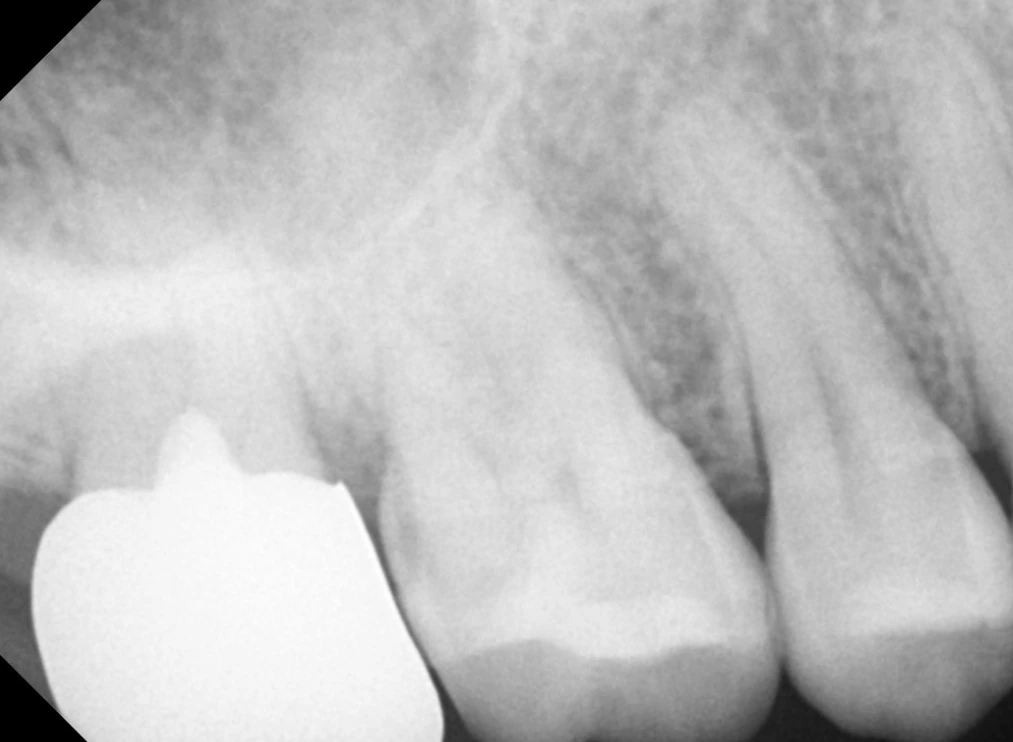
A ceramic inlay bonds to the tooth and holds the remaining walls together with it. Gold, which does not bond, is fitted into the tooth and cannot reinforce the walls. Its strength withstands molar chewing force well, and the shade is hard to distinguish from a natural tooth.
We have a case comparing a ceramic inlay and a hybrid inlay in the same patient after five years. The ceramic kept its colour and form, while the hybrid showed staining and wear at the margins. That is why the warranty differs — 4 years for ceramic and 1 year for hybrid.
When would hybrid or gold be chosen?
Hybrid is chosen when cost is the priority, and when the restoration is more provisional in character — a tooth in a young patient that may well be worked on again in a few years, for instance. Gold is considered for someone who grinds heavily, or when the opposing tooth is ceramic. Seongmo Dental Clinic does not decide the material in advance and recommend it; we decide together after looking at the size and position of the cavity and your chewing habits.
If the cavity is small, is an inlay still needed?
No. When the cavity is small, direct bonded resin removes less tooth than an inlay that requires an impression. Our bonded resin restorations are 150,000 to 350,000 KRW depending on the site and carry a 7-year warranty. Conversely, if the cavity is large enough that a cusp is gone, an inlay is not enough and an overlay covering the cusp is needed. The boundaries between inlay, overlay and crown are set out on the general dentistry page.
How many visits does an inlay take?
Sent to a laboratory, it is two visits — impression and bonding. Seongmo Dental Clinic mills ceramic inlays in-house with Primescan, Primemill and SpeedFire on the same day, so it finishes in one. The record of a molar that had trapped food for over a year, rebuilt from the contact point with a same-day inlay, is in our clinical cases. Costs by material are published on the non-covered fee guide.
The criterion for choosing a material is not the price list but what that tooth will look like in five years. 30 seconds on foot from Exit 2 of Sungshin Women’s University Station, 02-922-3966.
Frequently asked questions
How long does a ceramic inlay last?
It depends on care, but ceramic inlays carry a 4-year warranty on the basis of regular check-ups. Where the bond holds, they are often used well beyond that.
Is a hybrid inlay worse than ceramic?
Not worse so much as different in purpose. It costs less and is easy to machine, but staining and wear appear sooner than with ceramic, which is why its warranty is 1 year.
Are gold inlays still used?
Yes. They are considered for heavy grinders, or where wear on the opposing tooth needs to be reduced. Note, though, that gold does not bond and so cannot reinforce the remaining walls.
Is an inlay covered by insurance?
Inlays are non-covered. Costs by material are published on the fee guide, and if the cavity is small, bonded resin can reduce both cost and the amount of tooth removed.
Related information
Seongmo Dental Clinic opened in 1998. I have held this position as the third director since April 2022, and I have one standard for choosing equipment: if I would not use it on my own family, I do not use it on my patients. One more scanner must not mean more treatment. If anything, it should mean cutting less, extracting less and finishing in one visit, from a more accurate original. The goal is not to be first with new equipment, but to offer the better of what is possible today to the patient sitting in the chair.
📍 3rd floor, 2 Dongsomun-ro 20ga-gil, Seongbuk-gu, Seoul
🚉 30-second walk from Exit 2, Sungshin Women’s University Station (Parking: up to 2 hours at Utah Mall)
📞 +82-2-922-3966
📅 Mon/Wed/Fri 09:30–18:30 · Tue 09:30–20:00 (evening clinic) · Sat 09:30–14:30 (no lunch break) · Weekday lunch 13:00–14:30 · Closed Thu, Sun and public holidays
💬 Booking and enquiries: Naver Booking · Naver Talk · KakaoTalk channel · English page
🟡 Opened in 1998; third-generation director in charge of care since April 2022
⚕️ This article was written for information purposes in line with Korean medical law and the Ministry of Health and Welfare’s medical advertising standards. Equipment specifications given here come from the manufacturer’s official material and the figures on accuracy and comfort are values reported in academic literature; the outcome and course of individual treatment vary with the condition of the mouth. Please decide on a specific diagnosis and treatment plan after consulting your treating clinician.
This article was written as of August 2026. Equipment specifications and cost-related content are reviewed and updated every three months.