English Home › Clinical Cases & Doctor’s Columns › Doctor’s Column
Cracked tooth prognosis: what is the evidence for crowning early?
Seongmo Dental Clinic, Sungshin Women’s University Station — we sort cracked teeth into those to monitor and those to cover by symptoms and nerve status, and when a tooth needs covering we scan it with Primescan 2 and mill the restoration in-house with Primemill and SpeedFire · Written 2026-10-05 · Last updated 2026-10-05 · Written by Dr.
Taeyoon Jang, board-certified in Integrated Dentistry
Key answer. In a 2024 meta-analysis of cracked-tooth outcomes, cracked teeth that were monitored without restoration had a 3-year success rate of 80%.
The authors suggested monitoring as an option when there are no symptoms, and recommended full crowns for symptomatic or root-canal-treated cracked teeth.
Seeing a crack in a tooth does not by itself decide how much treatment is needed. Studies point to biting symptoms and the state of the nerve as the deciding factors.
Does a cracked tooth need a crown straight away, or can it be monitored?
There is no evidence that every cracked tooth must be crowned at once; studies recommend monitoring or a covering restoration (crown) depending on symptoms and whether the tooth has had root canal treatment.
A cracked tooth is one in which a crack starting on the biting surface runs into the tooth. Some cracked teeth cause no symptoms at all. Others give a sharp pain on biting again and again.
So people newly told they have a cracked tooth usually ask one thing: should it be crowned now, or can it be watched? This column sets out how far the current literature answers that question.
What do studies report about the prognosis of cracked teeth?
A 2024 meta-analysis reported a 3-year success rate of 80% for monitored cracked teeth, and an 11.3-fold higher risk of extraction for root-canal-treated cracked teeth without a crown.
Zhang et al. (2024) reviewed 27 studies of cracked teeth followed for at least one year and meta-analysed 26 of them[1]. Tooth survival for cracked teeth with a vital nerve was 92.8–97.8% over 1–6 years. Nerve survival was reported as 85.6–90.4% over 1–3 years.
In the same analysis, direct restorations that did not cover the cusps (the pointed parts of the biting surface) had a risk ratio of 3.2 (95% confidence interval 1.51–6.82) for nerve complications compared with full crowns[1].
The risk ratio for extraction was 8.1, but its confidence interval was very wide at 1.05–62.5.
Features linked to symptoms were reported from a US practice-based research network.
209 dentists enrolled 2,975 vital molars and premolars with a visible crack[2]. Molars had 1.58 times the odds of symptoms, and patients who clench or grind had 1.30 times the odds.
Stained cracks had lower odds, at 0.68.
In the same network, 1,850 cracked teeth left untreated for one year were re-examined[3]. Pain decreased in 23% and increased in 10%. The number of cracks increased in 6% of teeth.
Nerve problems can still develop after a covering restoration. Of 127 patients with cracked teeth diagnosed with reversible pulpitis (an inflamed nerve that can still recover) and treated with a crown, 27 progressed to needing root canal treatment[4].
The 2-year survival of 88 root-canal-treated cracked teeth was 90.0%, falling to 74.1% for teeth with gum pockets deeper than 6 mm[5].
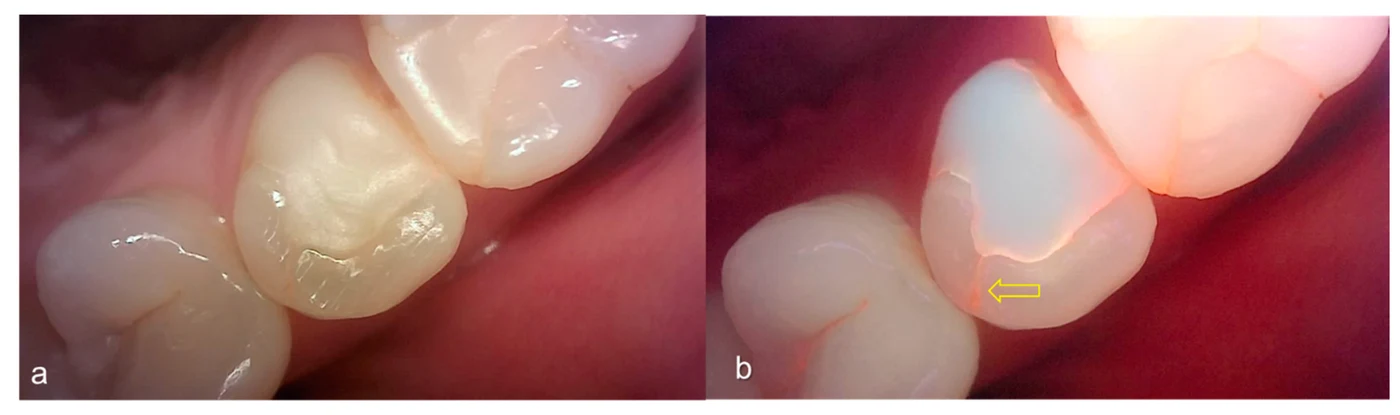
Cracks can be hard to see. A retrospective case study reported a crack line that was not visible on a white-light photo appearing as a red line on a quantitative light-induced fluorescence (QLF) image[6].
| Study (author, year) | Design & sample | Main findings | Level of evidence |
|---|---|---|---|
| Zhang et al., 2024[1] | 27 cracked-tooth studies reviewed · 26 meta-analysed (≥1-year follow-up) | Monitoring 3-year success 80% · non-cusp-covering direct restoration nerve-complication RR 3.2 · root-canal-treated teeth without crown 11.3-fold extraction risk | Systematic review & meta-analysis |
| Hilton et al., 2017[2] | US practice-based network · 209 dentists · 2,975 teeth | Odds of symptoms: molars 1.58 · clenching/grinding 1.30 · stained cracks 0.68 | Observational (cohort enrolment analysis) |
| Hilton et al., 2020[3] | Same network · 1,850 untreated teeth · 1 year | Pain decreased 23% · increased 10% · more cracks 6% | Prospective cohort |
| Krell & Rivera, 2007[4] | Crowned after reversible pulpitis diagnosis · 127 patients | 27 progressed to needing root canal treatment | Retrospective observational study |
| Kang et al., 2016[5] | 175 cracked teeth · 88 root-canal-treated | 2-year survival 90.0% · pockets >6 mm 74.1%, <6 mm 96.8% | Retrospective cohort |
| Oh et al., 2021[6] | Case comparison of QLF, radiographic and visual examination | Crack line not visible under white light seen on fluorescence image | Retrospective case study (diagnostic) |
Where is it hard to apply this evidence directly?
Most cracked-tooth studies are observational, so they show an association between crowns and lower extraction risk without proving that the crown caused the difference.
- Association, not causation — Teeth that were crowned and teeth that were not may have differed from the start. The 11.3-fold figure should be read within this limit[1].
- Wide confidence interval — The extraction risk ratio of 8.1 for direct restorations has a confidence interval of 1.05–62.5, so its true size is uncertain[1].
- Detailed analyses not confirmed — From the abstract checked, results by crack depth and position and the heterogeneity between studies could not be confirmed[1].
- Short follow-up — The untreated-tooth study covers one year[3]. It does not answer what happens after that.
- Different populations — The data come mainly from a US practice-based network and referred patients[2][4]. Conditions may differ from adults in their 20s to 60s visiting a neighbourhood clinic in Seongbuk-gu.
- Little evidence on onlays and overlays — The comparator in the meta-analysis was the full crown. It does not directly answer whether cusp-covering onlays or overlays give the same results.
- Age of the literature — Two of the six cited papers were published in 2021 or later. No long-term randomised comparison of cracked-tooth treatments was found.
So how are cracked teeth judged in real practice?
The direction of treatment for a cracked tooth is decided not by the presence of a crack alone but by biting pain, nerve status, gum pocket depth and whether the tooth has had root canal treatment.
- When monitoring may be considered — A tooth with no symptoms and no decay or large filling besides the crack. The authors suggested monitoring as an option for such teeth[1].
- When a covering restoration is considered — A tooth that hurts on biting. The authors recommended full crowns for symptomatic cracked teeth[1].
- When covering is especially recommended — A cracked tooth that has had root canal treatment[1]. If gum pockets are deep, it is worth having the prognosis explained separately[5].
- Worth knowing in advance — Root canal treatment may still become necessary after a crown[4].
Choosing to monitor assumes the same tooth is rechecked at regular check-ups. Conditions for a more conservative covering restoration are discussed in the column on overlays for cracked molars.
How does Seongmo Dental Clinic decide how to treat a cracked tooth?
Seongmo Dental Clinic does not drill a tooth just because a crack is visible; it checks symptoms and nerve status to separate teeth to monitor from teeth to cover.
Seongmo Dental Clinic uses Q-ray fluorescence imaging to check cracks that are hard to see, and HDX Dentri CBCT to look down to the roots when needed.
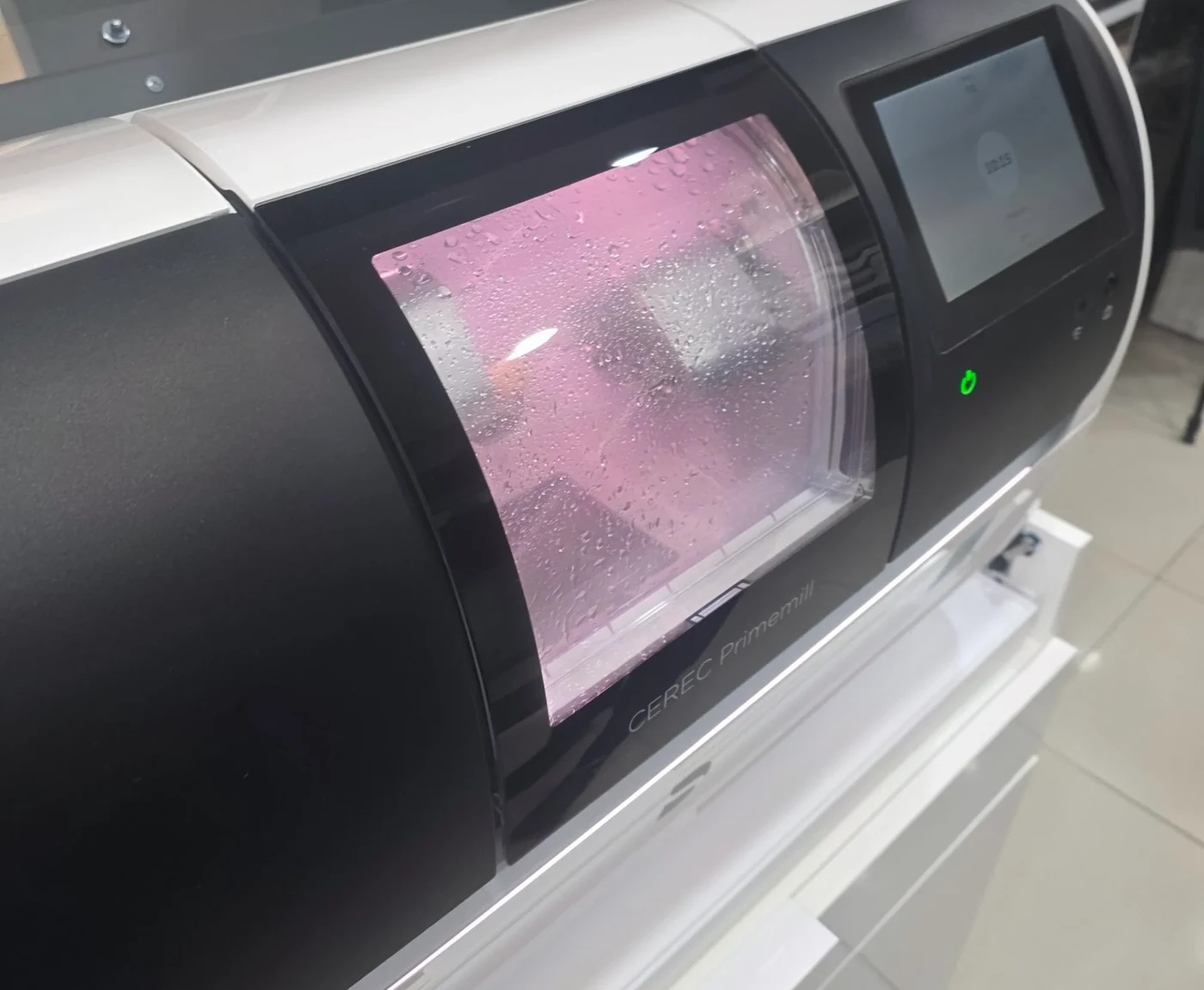
Teeth that need covering are scanned with Primescan 2 or Primescan Connect, and the restoration can be milled in-house with Primemill and SpeedFire and placed on the same day.
If only part of the nerve is affected, pulpotomy (partial nerve treatment) is considered first; if full root canal treatment is needed, plasma-assisted root canal treatment with Plazen is used.
A specialist in Integrated Dentistry with root canal training at UPenn considers preservation before extraction. Preserving natural teeth and avoiding overtreatment are Seongmo Dental Clinic’s standards of care.
See also the same-day digital restorations page, the root canal treatment page, the cracked molar pulpotomy and overlay case, and the Korean original of this column.
Summary for patients
1. A cracked tooth does not always need to be capped straight away.
2. A crack that does not hurt can sometimes be watched at regular check-ups.
3. If the tooth gives a sharp pain when you bite, covering it with a cap is considered.
4. If a tooth that has had root canal treatment is cracked, covering it is more strongly recommended.
5. Sometimes root canal treatment is still needed after capping, so it helps to know this before deciding.
Frequently asked questions
Does every cracked tooth need a crown?
No. In a 2024 meta-analysis, cracked teeth monitored without restoration had a 3-year success rate of 80%, and the authors suggested monitoring as an option for cracked teeth without symptoms. They recommended full crowns for symptomatic or root-canal-treated cracked teeth.
If a cracked tooth is left alone, will the cracks keep spreading?
In a study following 1,850 untreated cracked teeth for one year, the number of cracks increased in 6% of teeth. Pain decreased in 23% and increased in 10%. These are one-year data, so later changes are checked at regular check-ups.
Does a crown prevent the need for root canal treatment?
Not always. Of 127 patients with cracked teeth crowned after a diagnosis of reversible pulpitis, 27 were reported to progress to needing root canal treatment.
Can a cracked tooth that has had root canal treatment last?
The 2-year survival of 88 root-canal-treated cracked teeth was reported as 90.0%. However, teeth with gum pockets deeper than 6 mm had a lower rate of 74.1%, and in a meta-analysis the extraction risk was 11.3 times higher without a crown.
References
Authors, year, journal, volume, DOI and PMID are given as in the original; the notes are translated.
- Zhang S, Xu Y, Ma Y, Zhao W, Jin X, Fu B. The treatment outcomes of cracked teeth: A systematic review and meta-analysis. J Dent. 2024;142:104843. DOI · PMID 38272437 [Systematic review & meta-analysis] — evidence on success and extraction risk of cracked teeth by monitoring, direct restoration and crown
- Hilton TJ, Funkhouser E, Ferracane JL, et al. Correlation between symptoms and external characteristics of cracked teeth: Findings from The National Dental Practice-Based Research Network. J Am Dent Assoc. 2017;148(4):246-256.e1. DOI · PMID 28160942 [Observational (cohort enrolment analysis)] — evidence on features associated with symptomatic cracked teeth
- Hilton TJ, Funkhouser E, Ferracane JL, et al. Symptom changes and crack progression in untreated cracked teeth: One-year findings from the National Dental Practice-Based Research Network. J Dent. 2020;93:103269. DOI · PMID 31899264 [Prospective cohort] — evidence on one-year symptom change and crack progression in untreated cracked teeth
- Krell KV, Rivera EM. A six year evaluation of cracked teeth diagnosed with reversible pulpitis: treatment and prognosis. J Endod. 2007;33(12):1405-1407. DOI · PMID 18037046 [Retrospective observational study] — evidence on the proportion progressing to root canal treatment after a crown
- Kang SH, Kim BS, Kim Y. Cracked Teeth: Distribution, Characteristics, and Survival after Root Canal Treatment. J Endod. 2016;42(4):557-562. DOI · PMID 26944835 [Retrospective cohort] — evidence on 2-year survival of root-canal-treated cracked teeth and gum pocket depth
- Oh SH, Lee SR, Choi JY, Choi YS, Kim SH, Yoon HC, et al. Detection of Dental Caries and Cracks with Quantitative Light-Induced Fluorescence in Comparison to Radiographic and Visual Examination: A Retrospective Case Study. Sensors. 2021;21(5):1741. DOI · PMID 33802443 [Retrospective case study (diagnostic)] — evidence on a crack seen with fluorescence imaging and source of the figure in this column (CC BY 4.0)
If you were told you have a cracked tooth because it gives a sharp pain when you bite, check again at Seongmo Dental Clinic before any drilling whether it is a tooth to monitor or a tooth to cover.
Seongmo Dental Clinic checks the crack with Q-ray fluorescence imaging and, where needed, CBCT, and when a tooth needs covering it makes the restoration in-house by milling.
Tell us which tooth hurts and when through Naver booking or the Kakao channel.
The figures in this column are values reported for the teeth studied; the direction of treatment for a cracked tooth and its later course can vary with the position and depth of the crack and the state of the nerve.
📍 3F, 2 Dongsomun-ro 20ga-gil, Seongbuk-gu, Seoul
🚇 30-second walk from Exit 2, Sungshin Women’s University Station (parking: 2 hours at U-Ta Mall)
📞 +82-2-922-3966
📅 Mon/Wed/Fri 09:30–18:30, Tue 09:30–20:00 (evening), Sat 09:30–14:30 (no lunch break), lunch 13:00–14:30, closed Thu, Sun and public holidays
💬 Naver booking · Naver TalkTalk · Kakao channel
🟡 Founded in 1998; the third director has been responsible for care since April 2022
Written 2026-10-05 · Last updated 2026-10-05 · Dr. Taeyoon Jang, Seongmo Dental Clinic (board-certified in Integrated Dentistry)


