English Home › Clinical Cases & Doctor’s Columns › Doctor’s Column
Does air-polishing (Airflow) differ from ultrasonic scaling?
Seongmo Dental Clinic, Sungshin Women’s University Station — plaque is first made visible with a disclosing agent and washed away with the full EMS Airflow system, and only the remaining calculus is removed ultrasonically · Written 2026-09-11 · Last reviewed 2026-09-29
Key answer. Air-polishing sprays a fine powder with water and air to wash away biofilm and stain, while ultrasonic scaling breaks off hardened calculus with a vibrating tip. In periodontal maintenance studies, gum outcomes were similar for the two methods and pain was reported lower with powder.
“If I have Airflow, do I still need scaling?” This is the question we hear most often in the clinic. This column separates what each method does and how far the papers go, using six papers checked against PubMed and Europe PMC records.
If I get Airflow, can I skip scaling?
Airflow powder cleaning cannot remove hardened calculus, so it does not replace ultrasonic scaling. Powder handles biofilm and stain; the ultrasonic tip handles hardened calculus. They are different steps.
Ultrasonic scaling places a metal tip vibrating at ultrasonic frequency on the tooth to break up calculus (hardened plaque). Calculus does not wash off with water, so it has to be broken mechanically. Because metal touches the tooth, a sensitive or scraping feeling can remain.
Air-polishing sprays a fine powder such as glycine or erythritol with water and air to wash away biofilm and stain. The tip does not scrape the tooth, and the powder dissolves in water. With a thin nozzle it can also clean inside periodontal pockets (the gap between gum and tooth).
So the real question is not “which is better”, but how much of the ultrasonic work powder can take over, and in which patients.
How do the papers compare the two methods?
Randomised trials and a meta-analysis in periodontal maintenance patients report similar pocket reduction with powder and conventional instruments, and lower pain with powder. Gingivitis data mainly address treatment time and comfort.
A University of Geneva team followed 50 periodontal maintenance patients for 12 months at 3-month intervals[2].
One side of each mouth received subgingival erythritol air-polishing and the other ultrasonic debridement.
Across 6,918 sites at baseline, reduction of pockets deeper than 4 mm did not differ, and perceived pain and discomfort were significantly lower with powder.
A 2022 systematic review and meta-analysis in BMC Oral Health screened 823 articles and analysed 4 maintenance trials and 2 implant maintenance trials[4].
In maintenance, repeated air-polishing showed no statistically significant difference in pocket reduction from conventional instruments (weighted mean difference 0.11 mm, p = 0.08).
Bleeding and attachment level also did not differ, while pain scores were lower and patient acceptance higher.
A 2024 randomised trial from the University of Brescia followed 41 patients (39 completed) treated for gingivitis for 12 months[5].
Split-mouth, it compared air-polishing followed by ultrasonic removal of remaining calculus with ultrasonic debridement followed by rubber-cup polishing.
Bleeding and plaque indices showed no significant overall difference; at the 3- and 6-month sessions the powder-first sequence took 24.5% and 25.1% less time, and more patients found it comfortable.
The same team compared cleaning guided by a plaque disclosing agent in 32 healthy adults[3].
Residual plaque on gingival surfaces was 6.1% versus 12.0%, lower in the disclosed group.
Tissue effects of powders are covered by a systematic review that analysed 17 of 1,266 records; sodium bicarbonate powder was reported to cause larger root-surface defects than glycine powder[1].
| Study (author, year) | Design & population | Main findings | Level of evidence |
|---|---|---|---|
| Müller et al., 2014[2] | Split-mouth · 50 maintenance patients · 12 months | No difference in reduction of pockets >4 mm; lower pain with powder | Randomised controlled trial |
| Tan et al., 2022[4] | 823 screened; 4 maintenance + 2 implant trials | No difference in pocket reduction (0.11 mm, p = 0.08); lower pain, higher acceptance | Systematic review & meta-analysis |
| Mensi et al., 2024[5] | Split-mouth · 41 patients after gingivitis treatment · 12 months | No difference in bleeding/plaque; 24.5–25.1% less time; higher comfort | Randomised controlled trial |
| Mensi et al., 2020[3] | 32 healthy adults · single session | Residual plaque 6.1% vs 12.0% (gingival surfaces) with disclosing agent | Randomised controlled trial |
| Bühler et al., 2016[1] | 17 of 1,266 records · mostly lab/extracted teeth | Less root and gum damage with glycine than sodium bicarbonate | Systematic review |
| Sanz et al., 2020[6] | EFP S3 guideline · stage I–III periodontitis | Supra- and subgingival instrumentation as the basis of stepwise therapy | Clinical practice guideline |
Where is it hard to apply this evidence directly?
Most comparison studies of powder cleaning enrolled periodontal maintenance or post-gingivitis patients, and no study has compared the two methods directly in routine check-ups of Korean adults. Two of the six papers are from the last five years.
- Population — the 12-month trial and the meta-analysis looked at residual pockets in maintenance patients who had finished periodontal treatment[2][4]. The results cannot be moved directly to a first cleaning with heavy calculus or to active periodontitis.
- Powder — the powder in the 12-month trial contained 0.3% chlorhexidine[2], so equal results with plain erythritol powder cannot be assumed.
- Sample and measure — the disclosing-agent study reports one session in 32 people and uses residual plaque area, a surrogate measure[3]. It does not show long-term change in gum health.
- Tissue damage — data on powder effects on root surfaces come mostly from extracted teeth and lab work[1]. The degree in the mouth can vary with pressure, distance and time.
- Implants — only 2 implant maintenance trials entered the meta-analysis, with no patient-reported outcomes[4]. Evidence for peri-implant care is still limited.
So how are the two methods divided in the clinic?
Hardened calculus needs ultrasonic scaling; when calculus is minimal and biofilm and stain dominate, the share of powder cleaning can grow. The two are judged as a question of sequence, not substitution.
The sequence shown by the 2024 trial and the disclosing-agent study is disclosing agent → powder cleaning → ultrasonic only for remaining calculus[3][5]. Once biofilm is removed, calculus margins become visible and the metal tip touches only where calculus actually is.
- Good cases for more powder — mainly coffee or tea stain, biofilm around orthodontic appliances, shallow residual pockets during maintenance after periodontal treatment, and people who have postponed scaling because of sensitivity to the metal tip.
- Ultrasonic first — visible supra- or subgingival calculus, the instrumentation step of stage I–III periodontitis[6], and root cleaning of deep pockets.
- Postpone or change powder — acutely swollen gums, respiratory disease or a sodium-restricted diet, and exposed root surfaces (coarse powders are avoided[1]).
In what order does Seongmo Dental Clinic use powder and ultrasonics?
Seongmo Dental Clinic first checks plaque with a disclosing agent, washes away biofilm and stain with EMS Airflow, and then removes only the remaining calculus ultrasonically. It follows the sequence reported in the literature.
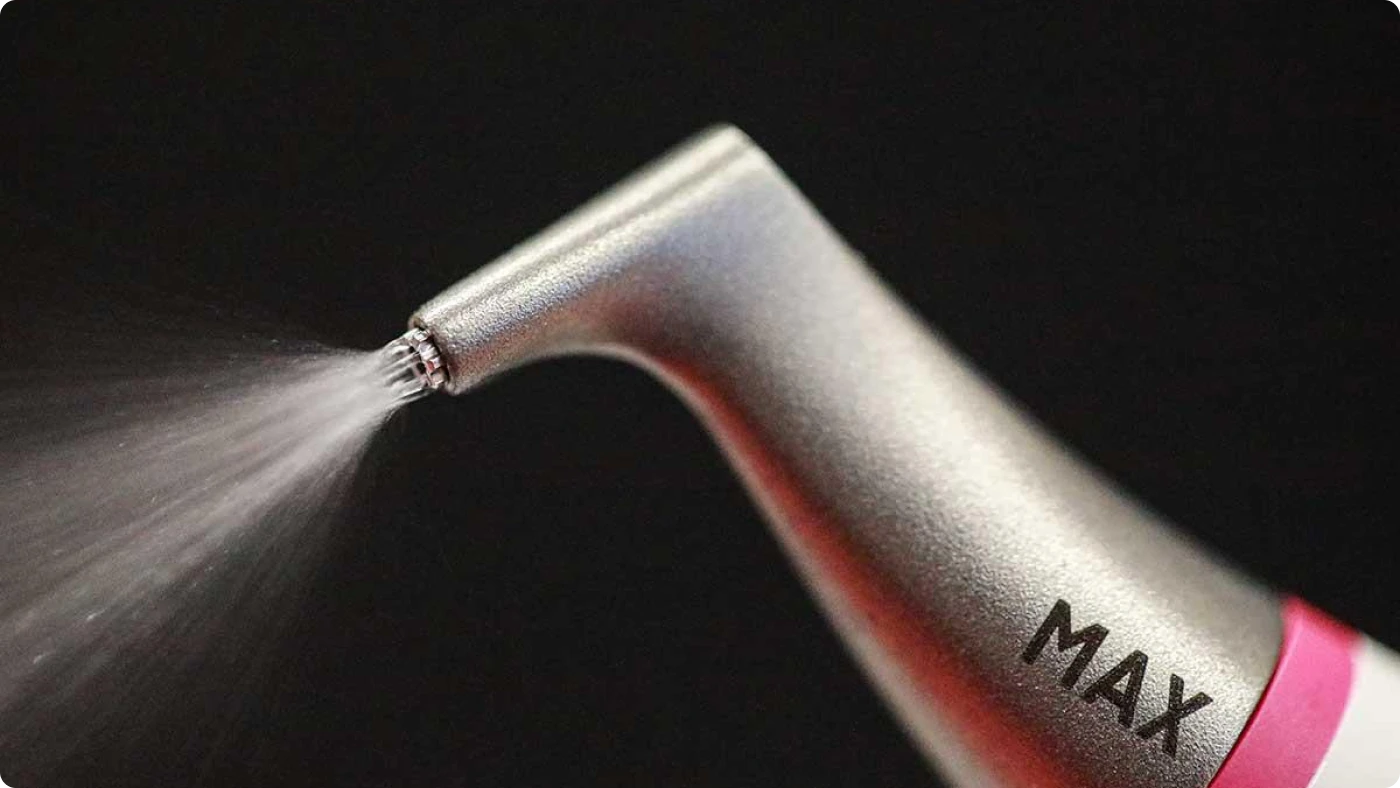
Seongmo Dental Clinic has the full EMS Airflow system in the Sungshin Women’s University area of Seongbuk-gu.
Following the manufacturer’s specifications, 14 μm erythritol powder is sprayed with 37 °C warm water, and the Perioflow nozzle is used for 4–9 mm pockets.
Early caries and cracks are recorded the same day with Q-ray fluorescence diagnosis, and when sensitivity is strong, Quicksleeper computer-controlled anaesthesia keeps injection pressure steady.
Coarse powders are not used on exposed root surfaces. See the scaling guide, dental equipment and general dentistry pages, and the Korean original of this column.
The director, a board-certified specialist in Integrative Dentistry, decides the share of powder and ultrasonics from the distribution seen with the disclosing agent.
Not increasing cleaning sessions just because new equipment exists, and not scraping where scraping is not needed, is the standard at Seongmo Dental Clinic.
Summary for patients
1. Powder cleaning uses a fine powder that dissolves in water to wash sticky germ film and stain off the teeth.
2. Hard, set-in tartar does not come off with powder, so scaling with a vibrating instrument is still needed.
3. In a study that followed people for a year after gum treatment, gum results were similar with both methods, and powder hurt less.
4. Washing with powder first and then removing only the remaining tartar shortens the time the instrument touches your teeth.
5. If your gums are very swollen or you have a breathing condition, the method can be changed, so please tell us beforehand.
Frequently asked questions
Can powder cleaning wear down teeth or damage the gums?
In a systematic review of 17 studies, fine powders such as glycine were reported to cause smaller root-surface defects and less gum damage than sodium bicarbonate powder.
These data come mostly from extracted teeth and lab work, and the actual degree can vary with powder type, spray pressure and gum condition.
Is powder cleaning less painful than ultrasonic scaling?
A 12-month randomised trial of 50 periodontal maintenance patients and a 2022 meta-analysis reported lower pain scores with powder cleaning than with conventional instruments.
The participants had already finished gum treatment, and sensitivity varies from person to person with gum recession and tooth condition.
If I only get regular powder cleaning, will it prevent gum disease?
Powder cleaning removes biofilm and stain, while hardened calculus must be removed with ultrasonic or other instruments.
The European Federation of Periodontology guideline places supra- and subgingival instrumentation at the base of periodontitis treatment, and daily brushing and interdental cleaning remain the foundation of prevention.
Can I have powder cleaning if I have dental implants?
The meta-analysis included 2 randomised trials of air-polishing in implant maintenance, reporting reductions in pocket depth and bleeding, but the evidence is still limited.
When peri-implantitis has progressed, powder cleaning alone may not be enough, so the condition is first checked with X-rays and probing.
References
Authors, year, journal, volume, DOI and PMID are given as verified; the notes are translated.
- Bühler J, Amato M, Weiger R, Walter C. A systematic review on the effects of air polishing devices on oral tissues. Int J Dent Hyg. 2016;14(1):15-28. DOI · PMID 25690301 [Systematic review] — evidence on root-surface and gum damage by powder type
- Müller N, Moëne R, Cancela JA, Mombelli A. Subgingival air-polishing with erythritol during periodontal maintenance: randomized clinical trial of twelve months. J Clin Periodontol. 2014;41(9):883-9. DOI · PMID 25041441 [Randomised controlled trial] — evidence comparing pocket reduction and pain with powder vs ultrasonic cleaning in maintenance
- Mensi M, Scotti E, Sordillo A, Agosti R, Calza S. Plaque disclosing agent as a guide for professional biofilm removal: A randomized controlled clinical trial. Int J Dent Hyg. 2020;18(3):285-294. DOI · PMID 32348624 [Randomised controlled trial] — evidence that disclosing-agent-guided cleaning reduces residual plaque
- Tan SL, Grewal GK, Mohamed Nazari NS, Mohd-Dom TN, Baharuddin NA. Efficacy of air polishing in comparison with hand instruments and/or power-driven instruments in supportive periodontal therapy and implant maintenance: a systematic review and meta-analysis. BMC Oral Health. 2022;22:85. DOI · PMID 35321688 [Systematic review & meta-analysis] — evidence comparing outcomes and pain of air-polishing vs conventional instruments in maintenance and implant care
- Mensi M, Scotti E, Sordillo A, Dalè M, Calza S. Air-polishing followed by ultrasonic calculus removal for the treatment of gingivitis: A 12-month, split-mouth randomized controlled clinical trial. Int J Dent Hyg. 2024;22(4):949-958. DOI · PMID 38689395 [Randomised controlled trial] — evidence on time and comfort of powder-first then ultrasonic sequence
- Sanz M, Herrera D, Kebschull M, Chapple I, Jepsen S, Beglundh T, et al. Treatment of stage I-III periodontitis-The EFP S3 level clinical practice guideline. J Clin Periodontol. 2020;47 Suppl 22(Suppl 22):4-60. DOI · PMID 32383274 [Clinical practice guideline] — evidence on the place of instrumentation in stepwise periodontitis therapy
If you have put off scaling for more than a year because the metal tip feels sensitive, start at Seongmo Dental Clinic by checking what is actually on your teeth with a disclosing agent.
Seongmo Dental Clinic first washes away biofilm and stain with EMS Airflow and removes only the remaining calculus ultrasonically.
Tell us a convenient time through Naver booking or the Kakao channel.
Sensitivity and gum response after cleaning vary with the amount of calculus, how far the gums have receded and everyday brushing habits; the figures here are averages of study participants.
📍 3F, 2 Dongsomun-ro 20ga-gil, Seongbuk-gu, Seoul
🚇 30-second walk from Exit 2, Sungshin Women’s University Station (parking: 2 hours at U-Ta Mall)
📞 +82-2-922-3966
📅 Mon/Wed/Fri 09:30–18:30, Tue 09:30–20:00 (evening), Sat 09:30–14:30 (no lunch break), lunch 13:00–14:30, closed Thu, Sun and public holidays
💬 Naver booking · Naver TalkTalk · Kakao channel
🟡 Founded in 1998; the third director has been responsible for care since April 2022
Written 2026-09-11 · Last reviewed 2026-09-29 · Reviewed by the director of Seongmo Dental Clinic (specialist in Integrative Dentistry)


