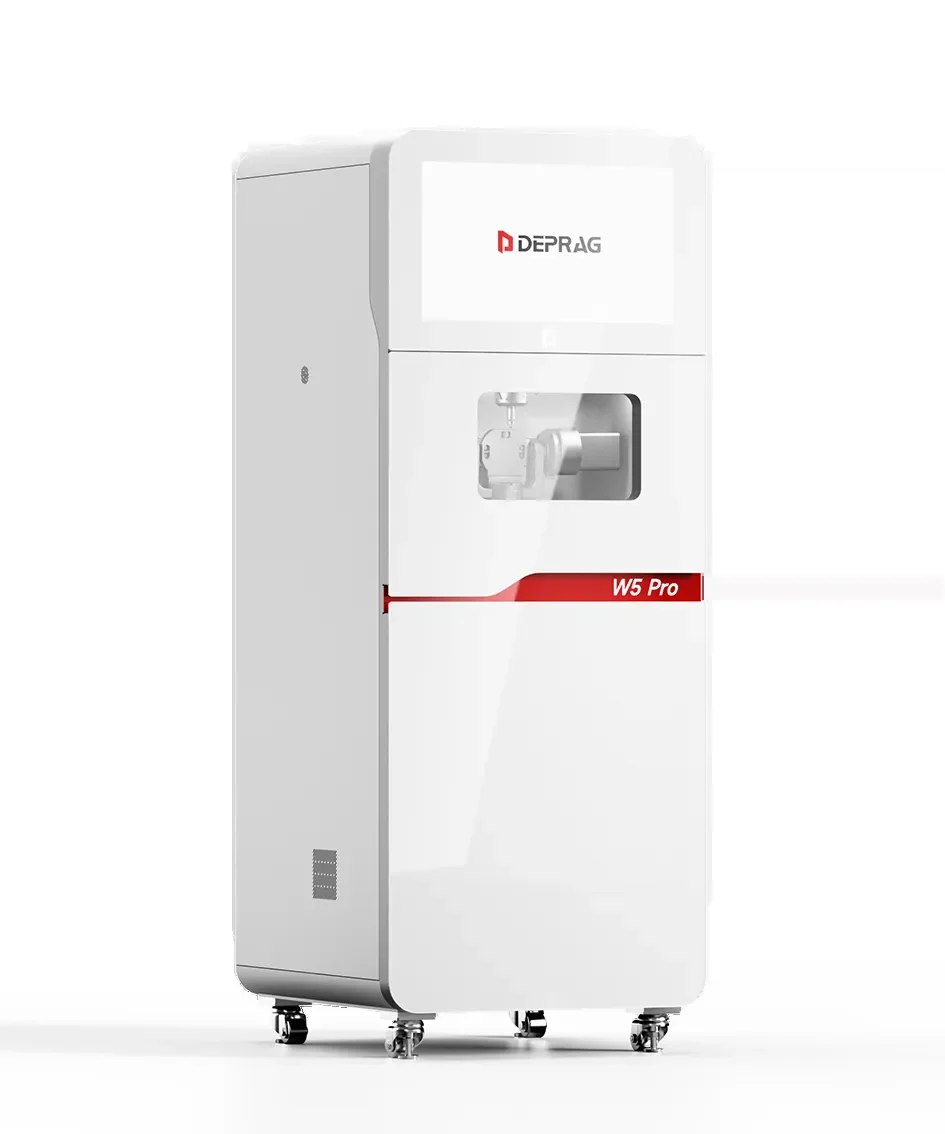
Sungshin Univ. Dental Clinic 5-Axis Wet Milling Machine,
what does it do?
It used to take an impression sent to an outside lab, and 1–2 weeks before the finished restoration came back to the clinic. In between, patients had to get by on a temporary, and if the restoration didn’t fit, the whole process repeated. The 5-axis wet milling machine Seongmo Dental Clinic installed in-house brings that process into the treatment room. Data from the Primescan 3D intraoral scanner is designed directly by the director, and the W5 Pro mills the material to that exact design. Because the designer and the treating clinician are the same person, the shape actually needed inside the mouth is carried straight into the restoration.
Simultaneous 5-Axis Control — reaching angled and inner surfaces
Wet Milling — why it can cut glass-ceramic and titanium
60,000rpm Spindle — fast enough that thin margins don’t chip
24×2 Tool Magazine — even tool changes are automatic
Why does it need to be 5-axis, not 3-axis?
?A tooth isn’t a straight column. The chewing surface has contours, the sides curve inward, and the gum-line margin runs at an angle. A 3-axis machine, which only moves up and down, can only cut surfaces the tool reaches vertically — so undercuts end up more blunted than they really are, and the gap is filled with cement.
The larger the gap, the more the cement washes out, letting bacteria in and starting secondary decay.
is the biggest reason we adopted a 5-axis mill. What materials, and at what precision,
Materials MillableThe W5 Pro mills zirconia, glass-ceramic, PMMA (temporary resin), titanium, cobalt-chrome, PEEK, composite, and wax
— nearly every material used in dental restorations. Each material suits a different clinical need.
. Shade is matched to the tooth color measured with the VITA Easyshade for a natural-looking result.
, and it’s used where a natural look matters most, such as anterior veneers or esthetic inlays.
.
.What is the treatment sequence
?All five steps happen in-house. With no shipping or waiting between stages, some cases can go from tooth prep to final restoration in a single day
.PRIMESCAN
An optical scan of the mouth, no rubber impression material needed. It captures the shape of teeth and gums with millions of data points per second.
Director Designs It PersonallyCAD DESIGN
The treating director directly checks the bite, margins, and contact relationships while designing the restoration. Designer and clinician are the same person.
5-Axis Wet MillingW5 PRO
The material block is cut to match the design data. A single crown typically finishes milling within tens of minutes.
Sinter, Polish & GlazeSPEEDFIRE
Zirconia finishes the surface with polishing and glazing after about 30 minutes of ultra-fast sintering.
Intraoral Try-in & SeatingSEATING
Bite and margin fit are checked intraorally before seating. If adjustment is needed, it’s remilled on the spot.
What’s different from an outside lab
| ? | Outside Lab Order | |
|---|---|---|
| In-house 5-Axis Wet Milling | Turnaround | 1–2 weeks, including shipping & lab schedule |
| Same day to a few days, depending on the case | Designer | A lab technician who never saw the mouth directly |
| The treating director designs it personally | Sources of Error | Impression distortion · plaster model · transport |
| Scan data milled directly | Revisions & Remakes | Re-order and wait another 1–2 weeks |
| Adjusted and remilled on the spot | Temporary Period | Worn continuously until the restoration arrives |
| Minimized or skippable | Metal/Ceramic Milling | Varies by lab’s equipment |
Wet milling handles even titanium and glass-ceramicLab technicians at outside labs also make excellent restorations. The difference isn’t the people — it’s the variables introduced in the process
. Impression material deforms as it sets, is transferred to a plaster model, and error accumulates at every shipping stage. In-house milling skips those steps, going straight from scan data to restoration.Terms
- worth knowing
- 5-Axis Machining
- A milling method that adds two rotational axes (A, B) to the three linear axes (X, Y, Z), letting the tool approach every surface of the material at the ideal angle.
- Wet Milling
- A method that sprays coolant onto the cutting point. Essential for milling heat-sensitive glass-ceramic and metal.
- Margin
- The boundary where a restoration meets the tooth. The wider this gap, the greater the risk of secondary decay.
- Undercut
- A surface that curves inward. A classic shape a 3-axis tool can’t reach, requiring 5-axis milling.
- Custom Abutment
- The connector piece between an implant fixture and crown, milled to match the patient’s own gum contour.
- Sintering
The process of firing milled zirconia at high heat to reach its final density and strength. Completed in about 30 minutes with the Speedfire.FAQ
Q.Can I really get a crown in a single day?
Q.What’s the difference between wet and dry milling?
Q.Is an in-house restoration as accurate as one from an outside lab?
Q.Are implant restorations also made with this machine?
Q.Is every restoration made the same day?
Q.What does it cost?
A restoration’s lifespan is decided by a gap you can’t see.
We treat with an in-house restorative system — scan, design, mill, and seat — that the director personally oversees from start to finish.
Book a Consultation Seongbuk-gu Seongmo Dental Clinic · 02-922-3966 · Exit 2, Sungshin Women’s University StationEquipment specs: per official DEPRAG W5 Pro specifications (spindle 2.5kW/60,000rpm, torque 398Ncm, milling precision under 0.003mm, tool magazine 24×2). Treatment time and same-day restoration availability may vary depending on individual oral condition and treatment scope. This page is provided for medical-device information purposes; an accurate diagnosis and treatment plan will be provided through an in-office consultation.