English Home › Clinical Cases & Doctor’s Columns › Clinical Case
Ceramic Inlay vs Hybrid Inlay — What Changed After 5 Years in the Same Mouth?
A five-year comparison of a glass-ceramic inlay and a hybrid inlay placed in the same mouth.
The glass-ceramic kept its gloss and margins close to their original state, while the hybrid was functioning without fracture but showed loss of gloss and surface change first; the flexural strength of glass ceramic is reported at about 360-400 MPa, roughly double that of resin-based hybrid material (about 120-200 MPa).
Many patients about to receive an inlay find themselves torn between ceramic and hybrid materials.
To give the conclusion first: after 5 years in an actual mouth, the glass-ceramic inlay kept its gloss and margins close to the day it was placed.
The hybrid inlay placed around the same time was still functioning without fracture, but — as is characteristic of the material — loss of gloss and surface changes appeared first.
Seongmo Dental Clinic, by Sungshin Women’s University Station, aims for restorations close to natural teeth with in-house ceramic fabrication equipment and a precision bonding system.
- Today’s photo was taken at the regular check-up of a patient I personally treated 5 years ago.
- The flexural strength of glass-ceramic is reported at about 360–400 MPa — roughly twice that of resin-based hybrid materials (about 120–200 MPa).
- Chairside ceramic restorations are reported to survive at about 97% at 5 years and about 90% at 10 years — and half of that lifespan is determined by bonding quality.
- Two inlays after 5 years in the same mouth: the ceramic (#47) kept its gloss and margins, while the hybrid (#46) is functioning without fracture but shows surface changes.
The Key Questions This Article Answers
- How did the two inlays change after 5 years in the same mouth? (follow-up photo)
- Why do ceramic inlays last? (material comparison table)
- Half of an inlay’s lifespan: how is ‘bonding’ done?
- What is biomimetic restoration?
- When a ceramic inlay is not the right choice, cost, and FAQ
Five Years in the Same Mouth — How Did the Ceramic and Hybrid Inlays Change?
An inlay is a restoration fabricated from an impression of the prepared cavity and precisely bonded to the tooth.
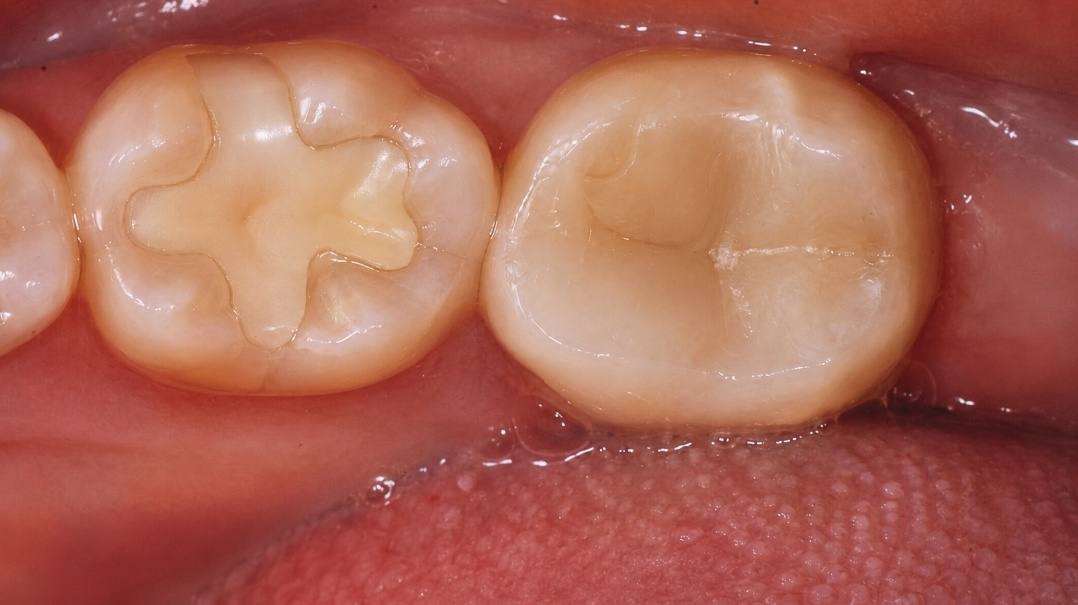
On the right of the photo, #47 (the lower second molar) is the glass-ceramic inlay I placed at Seongmo Dental Clinic 5 years ago.
#46 on the left is a hybrid inlay placed at another clinic around the same period.
It is a clinically rare scene: two materials that have spent the same years side by side in one mouth.
Even after 5 years, the surface gloss of the #47 ceramic inlay is barely distinguishable from enamel, and the boundary between restoration and tooth (the margin) remains hard to find with the naked eye. The anatomical form of the occlusal surface is also preserved close to the day of treatment.
This does not at all mean the #46 hybrid inlay was a bad treatment. Functioning for 5 years without fracture also means the procedure and maintenance were done well.
However, as is characteristic of resin-based materials, the gloss dulls and the outline of the restoration gradually becomes more visible.
Differences in material properties only become visible to the eye after this much time.
Why Do Ceramic Inlays Last? — A Material Comparison
Glass-ceramic is a dental restorative ceramic with strength and gloss similar to natural enamel.
A glass-ceramic inlay is a restoration milled from ceramic crystal materials such as lithium disilicate and bonded to the tooth; a hybrid inlay is made of a composite that mixes ceramic filler into a resin matrix. The names sound similar, but the physical properties belong to different families.
Glass-Ceramic Inlay vs Hybrid (Resin-Based) Inlay
| Item | Glass-ceramic inlay | Hybrid inlay |
|---|---|---|
| Main composition | Ceramic crystal (e.g., lithium disilicate) | Resin matrix + ceramic filler |
| Flexural strength | About 360–400 MPa | About 120–200 MPa |
| Surface gloss | Enamel-like, retained long term | Tends to dull over time |
| Wear resistance | High — occlusal form preserved long term | Wears faster than ceramic |
| Marginal staining | Low | Relatively higher at the margins |
| Color stability | Excellent | Can discolor with water absorption |
| Long-term survival | About 90% at 10 years reported (chairside ceramic) | Varies widely with conditions |
| Repairability | Partial repair is limited | Relatively easy to repair in the mouth |
| Cost | Relatively higher | Relatively lower |
Long-term studies of chairside CAD/CAM restorations published in the Journal of the American Dental Association (JADA) report survival of about 97% at 5 years and about 90% at 10 years.
For areas like molars where chewing force concentrates, reports consistently find ceramic better than hybrid at keeping its form and surface over time.
Gloss is not only a cosmetic issue. Losing gloss means the surface has become microscopically rough, and stain and bacterial film attach more easily to a roughened surface.
After 5 years, the surface difference between the two inlays ultimately becomes a difference in how easy they are to keep clean.
Why We Put the Most Effort into ‘Bonding’
Bonding chemically unites the restoration and the tooth, preventing microleakage and debonding.
It is no exaggeration to say an inlay’s lifespan is half material, half bonding.
A ceramic inlay is not ‘fitted into’ the tooth but ‘bonded onto’ it, and if bonding is incomplete, even the best material can lead to microleakage, secondary caries, and debonding.
What led me to build our current bonding system was seeing, again and again, well-made restorations whose lifespan was decided at the bonding step.
Ceramic bonding at Seongmo Dental Clinic proceeds as: ① thorough moisture control, including a rubber dam → ② conditioning the ceramic surface (Monobond Etch & Prime — etching and silane treatment in one step without hydrofluoric acid, compressing the traditional 9 steps into 4) → ③ conditioning the tooth surface (Scotchbond Universal Plus) → ④ applying RelyX Universal cement and light-curing.
Based on the official clinical documentation of Ivoclar and 3M, we use a dark-cure try-in workflow that does not pre-cure the adhesive, controlling even the thickness error of the bonding layer.
Shade is not left to the naked eye either. With the VITA Easyshade V spectrophotometer we verify shade numerically down to the ΔE 0.5 level, so the ceramic blends naturally with the neighboring teeth. You can see the equipment behind this process on our equipment page.
What Is Biomimetic Restoration? — Our Treatment Principle
Biomimetic restoration is a treatment approach that reproduces the structure and properties of enamel and dentin with materials.
A natural tooth is a composite structure: hard enamel over dentin that absorbs its shocks.
In biomimetic restoration, glass-ceramic with a flexural strength of 360–400 MPa takes the role of enamel, while the precision bonding layer and the short-fiber-reinforced material everX Flow (flexural strength about 147 MPa, fracture toughness about 2.8 MPa·m1/2) take the role of dentin.
It is a concept of restoring the whole tooth structure, not just one material.
Ceramic inlays at Seongmo Dental Clinic are fabricated through an in-house digital chain: ① digital impression with a 3D intraoral scanner → ② milling in house → ③ finishing in a dedicated sintering furnace → ④ precision bonding on the same day.
I design the inlay’s form and margins (CAD) myself — from design to bonding, one person’s plan has to carry through for the goal of saving natural tooth structure to hold at the restoration stage.
Learn more about our same-day restoration system.
In the end, as much as which material is used, what determines a restoration’s lifespan is whether the clinic has a system that can design that material to fit the tooth structure and bond it accurately to the very end.
Use beyond 10 years is reported depending on maintenance — which is why such restorations are often called long-lasting.
There Are Cases Where a Ceramic Inlay Is Not the Right Choice
A ceramic inlay is not the answer for every tooth; the judgment changes with the remaining tooth structure and the bite.
- Small early cavities: direct resin filling can be the more conservative choice that removes less tooth than an inlay. Recommending an inlay for every small cavity can be over-treatment.
- Little remaining tooth structure, or cracks: instead of an inlay, an onlay, endocrown, or crown that covers and protects the chewing surface is recommended.
- Severe grinding or attrition: planning should assume bite analysis and a night guard in parallel to reduce fracture risk.
- Margins deep below the gum where moisture control is difficult: bonding reliability drops, so other restorative approaches are considered.
⚠️ Caution: inlay treatment is performed under local anesthesia. If you have cardiovascular disease, are pregnant, or have any concerns about anesthesia, please tell us before treatment.
Seongmo Dental Clinic uses the i-JECT computer-controlled anesthesia system to keep the injection rate constant and reduce discomfort.
📌 About cost: inlays are a non-covered item, and the cost can vary with tooth position, extent of caries, and material (as of August 2026). The exact cost is explained in person after diagnosis and before treatment begins.
Before Inlay Treatment, Check These Points
- ☑ Does the clinic compare and explain the pros and cons of each material (ceramic vs resin-based)?
- ☑ Does it follow moisture control and standard bonding protocols such as a rubber dam?
- ☑ Does it verify tooth shade with a measuring device rather than by eye?
- ☑ Does it distinguish between resin, inlay, and onlay according to the remaining tooth structure?
- ☑ Does it explain non-covered costs before treatment begins?
- ☑ Does it present a plan for regular follow-up after treatment?
Frequently Asked Questions (FAQ) — Ceramic Inlays
These are the questions patients considering a ceramic inlay ask most often in our consultation room.
Q. Which should I choose — a ceramic inlay or a hybrid inlay?
A. For molars that bear strong chewing forces, many reports favor glass-ceramic with a flexural strength of about 360–400 MPa.
The judgment still depends on how much tooth structure remains, your bite, and the opposing tooth, so it is best to decide after having the pros and cons of each material explained and compared.
Q. I already have a hybrid inlay. Should I replace it with ceramic?
A. No. If there is no fracture, no secondary caries, and no gap at the margin, there is no reason to replace it. Seongmo Dental Clinic does not recommend replacing restorations that are functioning well; observing the margins and wear at regular check-ups is sufficient.
Q. How long does a ceramic inlay last?
A. A 10-year survival rate of about 90% has been reported for chairside ceramic restorations.
Depending on bonding quality, oral care, and whether you grind your teeth, use beyond 10 years is reported as well — which is why they are often described as long-lasting restorations — but no treatment is permanent without maintenance.
Q. How many days does treatment take? Is same-day treatment possible?
A. Yes, it is possible. Seongmo Dental Clinic takes digital impressions with a 3D intraoral scanner and mills and sinters the restoration in house, so in many cases everything from caries removal to bonding the ceramic inlay is completed on the same day.
The schedule can vary with the depth of the cavity and the booking situation.
Q. Does the treatment hurt?
A. It is performed under local anesthesia, so pain during the procedure tends to be minor. A computer-controlled anesthesia system reduces the discomfort of the injection itself, and an intraosseous anesthesia system is available for patients on whom anesthesia does not take easily.
Q. How much does it cost?
A. Inlays are a non-covered (out-of-pocket) item, so the cost can vary with the tooth position, the extent of the caries, and the material (as of August 2026). The exact cost is explained after diagnosis and before treatment begins — advance notice is our standing principle.
Q. What happens if the ceramic chips or breaks?
A. Ceramic can also fracture under very strong forces or with grinding habits. Depending on the extent, we respond with partial repair or re-fabrication, and a night guard is recommended for patients who grind their teeth.
This article was written as of August 2026.
What, in the end, makes a good dental clinic? At Seongmo Dental Clinic we believe verified materials and advanced equipment are only the starting line.
What decides the lifespan of a treatment is the philosophy placed on top of them — the question, “If this were my family’s tooth, with which material and which bonding would I treat it?” We treat every patient’s tooth like a family member’s.
“We promise to explain as much as we possibly can.”
Seongmo Dental Clinic — caring for the patient’s mind as well as the teeth
This article was written in compliance with the Korean Medical Service Act and the medical advertising guidelines of the Ministry of Health and Welfare.
It is intended to help patients understand and to provide accurate information; please decide on a specific treatment plan or diagnosis after sufficient consultation with your doctor.
3rd floor, 2 Dongsomun-ro 20ga-gil, Seongbuk-gu, Seoul
🚶 30-second walk from Exit 2, Sungshin Women’s University Station (Line 4)
🚗 Parking: up to 2 hours at Yuta Mall, right in front of the clinic
📞 +82-2-922-3966
Naver Booking (Korean): booking.naver.com
Naver Talk (Korean): talk.naver.com
KakaoTalk Channel: pf.kakao.com
Website: seongmodental.com/en/
References
- Fasbinder DJ. Clinical performance of chairside CAD/CAM restorations. J Am Dent Assoc. 2006;137 Suppl:22S-31S.
- Fasbinder DJ, Dennison JB, Heys D, Neiva G. A clinical evaluation of chairside lithium disilicate CAD/CAM crowns. J Am Dent Assoc. 2010;141 Suppl 2:10S-14S.


