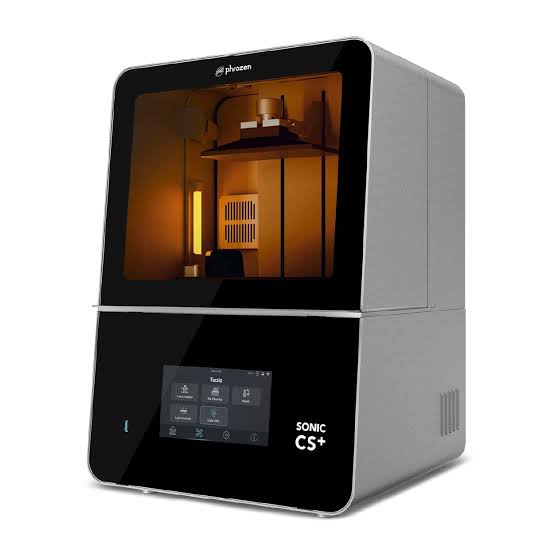
Sungshin Univ. Dental Clinic Chairside 3D Printer,
What kind of device is it?
Dental clinics with a 3D printer are no longer rare. What matters is which printer, and what workflow, you use. A typical hobby/model-grade printer takes hours to print and lacks dental-material certification — the timeline ends up no better than sending the case to a lab. The Sonic CS+ is built for a chairside setting where printing must finish while the patient waits. With the small build plate (Mini Plate), a single restoration takes about 15 minutes, and even the standard plate builds at up to 100mm per hour.
Dual Build Plates — one piece fast, or several at once
Dual Heating System — resin temperature IS precision
Validated Resin Profiles — optimal settings built in per material
Why did we choose a printer using a 385nm light source?
A photopolymer 3D printer cures liquid resin layer by layer with light. Most printers on the market use a 405nm source. The Sonic CS+’s 385nm UV-A short wavelength penetrates the resin more evenly, giving precise control over cure depth. This is especially useful with viscous dental resins — layer boundaries stay sharp and shape distortion from over-curing is reduced.
For a surgical guide’s sleeve, the print must match the design data exactly — this is how digital precision carries all the way into the mouth.
What do we print in-house?
Temporaries — printed the same day, on the spot, right after your tooth is prepped
Implant Surgical Guides — a template that carries the simulated surgery straight into the mouth
TMJ Splints & ARS — precision appliances for occlusal treatment
Custom Trays & Diagnostic Models — for precise impressions and consultations
One thing we want to be clear about: final crowns and veneers are made not with the 3D printer but with our 5-axis wet mill and Speedfire. The printer handles resin-based appliances, the mill handles final restorations — that division of labor is how our in-house digital system is structured.
Printing isn’t the last step — CURE+ Post-Curing
A part fresh off the printer is a “semi-finished” piece with uncured resin still on its surface. It must go through post-curing under UV after washing before the material reaches its final strength and biocompatibility. Skip this step and even a perfectly printed part can’t go in the mouth.
Our dedicated post-curing unit, CURE+, irradiates all three wavelengths — 365, 385, and 405nm — to fully react the photoinitiator regardless of resin type, and pairs this with 60°C heating to shorten cure time. Its flash-curing method (short pulsed exposure) prevents discoloration and warping from over-curing, while material-specific preset profiles reproduce the same quality every time.
What is the treatment sequence?
Everything from scanning to seating happens in-house. Depending on the case, the entire appliance can be made within a single visit.
3D Intraoral ScanPRIMESCAN
An optical scan of the mouth, no rubber impression material needed. Surgical guides are registered against HDX Dentri 3D CT data.
Director Designs It PersonallyCAD DESIGN
The treating director designs the appliance directly. What was observed intraorally is reflected exactly in the design.
In-house PrintingSONIC CS+
A single restoration takes about 15 minutes; most appliances finish printing within the visit.
Wash & Post-CureCURE+
Uncured resin is washed off and three-wavelength post-curing secures final strength and biocompatibility.
Adjust & SeatSEATING
Fit and bite are checked intraorally before seating. If adjustment is needed, we revise the design and reprint on the spot.
What’s different from an outside lab
| ? | Outside Lab Order | |
|---|---|---|
| In-house Sonic CS+ Print | Turnaround | Days to a week, including shipping & lab schedule |
| 15 minutes for a single restoration, seated same-day | Data Transfer | Impression → plaster model → transport |
| Scan data printed directly | Revisions | Re-order and wait for re-shipment |
| Revise design and reprint immediately | Quality Control | Varies by lab’s equipment & materials |
| Validated resin profiles + standardized CURE+ | Emergency Response | Days of waiting if a temporary breaks |
Reprinted the same visitTerms
- worth knowing
- Chairside
- Refers to work completed in-house, right beside the treatment chair, while the patient is present.
- LCD Photopolymerization (MSLA)
- A 3D printing method that passes UV light through an LCD panel in the shape of each layer to cure liquid resin one layer at a time.
- XY Resolution
- The smallest detail a single layer can render. The Sonic CS+ achieves 22µm (0.022mm).
- Layer Height
- The thickness of each printed layer. Thinner is more precise, thicker is faster (50–100µm selectable).
- Post-Curing
- The essential step after printing where UV light and heat fully cure the resin to reach final strength and biocompatibility.
- Surgical Guide
An appliance that carries the implant position, angle, and depth planned from CT/scan data directly into surgery.FAQ
Q.Is a device made with a 3D printer as precise as one made by an outside lab?
Q.Can I really get a temporary the same day?
Q.Is the resin used for printing safe?
Q.Are final crowns also made with the 3D printer?
Q.Is an implant surgical guide used for every case?
Q.What does it cost?
When the waiting disappears, the quality of care changes.
We treat with an in-house digital fabrication system — scan, design, print, cure, and seat — that the director personally oversees from start to finish.
Book a Consultation Seongbuk-gu Seongmo Dental Clinic · 02-922-3966 · Exit 2, Sungshin Women’s University StationEquipment specs: per official Phrozen Sonic CS+ specifications (385nm UV-A LCD, XY resolution 22µm, layer height 50/100µm, print speed up to 100mm/hr, Mini/Standard dual build plates), CURE+ post-curing unit (365/385/405nm, 60°C heating, flash curing). Treatment time and same-day fabrication availability may vary depending on individual oral condition and treatment scope. This page is provided for medical-device information purposes; an accurate diagnosis and treatment plan will be provided through an in-office consultation.