Genuinely painless anesthesia, and saving natural teeth to the very end
Periodontal ligament anesthesia (the director’s core technique) · QuickSleeper 5 intraosseous anesthesia · i-ject computer control · 32G ultra-fine needles · ampoule warmer · full member of the Korean Dental Society of Anesthesiology. Plazen® plasma endodontics, root canal retreatment, apicoectomy, intentional replantation, endocrowns, professional whitening, bonded composite restorations, ICON resin infiltration, TMJ care and dental botox — all in one place.
premium grade only
gel · spray · rinse
complete coverage
of Anesthesiology
holding Plazen®
“I suffered because the anesthesia didn’t work” — that does not happen here
There are two main reasons people fear the dentist: the anesthetic injection hurts, and the anesthesia did not work, so they had to endure pain throughout treatment. To solve both, we operate the director’s specialised periodontal ligament anesthesia technique, the QuickSleeper 5 intraosseous unit and i-ject computer-controlled painless anesthesia in stages. “Are you sure you actually anesthetised me?” is the question we most like to hear.
| Item | A typical clinic | Seongmo Dental Clinic |
|---|---|---|
| Topical anesthesia | One gel, or skipped | Three types combined — gel, spray and rinse |
| Needle gauge | Standard needles, 30G or thicker | 32G ultra-fine, premium grade |
| Anesthetic temperature | Injected at room temperature | Warmed close to body temperature with an ampoule warmer |
| Injection speed control | Relies on the dentist’s hand feel | Automatic precision control by i-ject computer |
| Core anesthesia technique | Mainly infiltration and block anesthesia | Periodontal ligament anesthesia (immediate, selective, painless) |
| Numbness afterwards | Lip, cheek and tongue numb for hours | Only the treated tooth — back to normal right after treatment |
| Difficult cases | Anesthesia fails → endure the treatment | Fully resolved with QuickSleeper intraosseous anesthesia |
| Anesthesia expertise | General | Full member, Korean Dental Society of Anesthesiology |
Stage 1 — Topical anesthesia, essential before the injection
We block even the momentary sting as the needle touches the mucosa. Three types of topical anesthesia are selected and combined to suit the situation.
Lidocaine gel — the most basic and the most reliable
We apply plenty of lidocaine gel to the mucosa at the injection site and wait. We never rush. We allow enough time until the moment the needle touches is barely felt.
Verakine spray — for areas where gel is difficult
For the palate, deep buccal areas and other sites where gel is hard to apply, we use Verakine spray. Its cooling and anesthetic components penetrate deep into the mucosa and numb a wide area.
Lidocaine rinse — for a strong gag reflex or general sensitivity
A lidocaine rinse lowers sensitivity throughout the mouth. It is particularly effective for patients with a strong gag reflex or whose whole mouth is sensitive.
Stage 2 — i-ject computer-controlled painless anesthesia: pressure pain eliminated at source
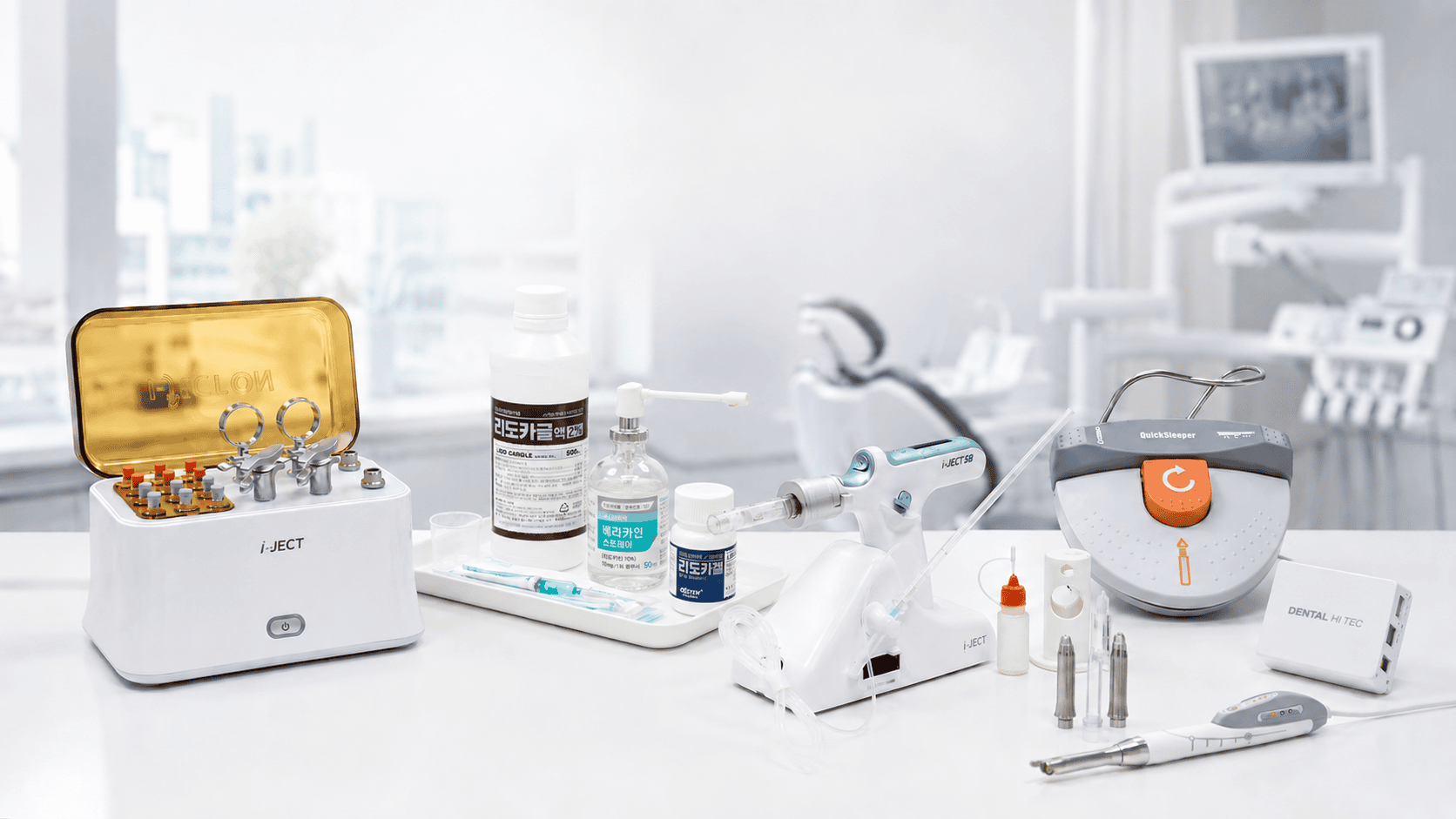
What i-ject changes
- Automatic pressure control in 0.1 ml/sec increments — the biggest cause of injection pain is the pressure of anesthetic entering too quickly. i-ject controls the delivery rate in 0.1 ml/sec increments so tissue pressure stays constant; many patients do not even notice the moment the injection begins.
- 32G ultra-fine needles — we never economise on needles — a blunter needle tears tissue and hurts more, and finer needles cost more. We use only premium 32G needles, because the price difference of a single needle translates directly into the patient’s experience of pain.
- Ampoule warmer — the sharp, alien sensation of cold anesthetic disappears when the solution is warmed close to body temperature (37°C) before injection.
- pH and temperature optimised in advance — the acidity and temperature of the anesthetic affect tissue irritation, so we optimise these conditions before injection to reduce chemical irritation as well.
- Skilled in a wide range of block techniques — inferior alveolar, nasopalatine, posterior superior alveolar, mental and infraorbital nerve blocks are selected according to the situation.
Stage 3 — The director’s core technique: periodontal ligament anesthesia
Periodontal ligament anesthesia is one of the director’s most specialised techniques. It is only possible when precise injection technique is combined with a computer-controlled unit such as i-ject, and patients who receive it consistently say they “could not tell whether the anesthesia had been given”. There is a reason ordinary clinics rarely perform it — it is difficult.
- Immediate effect — no waiting — ordinary infiltration anesthesia takes 5–10 minutes to pass through bone and reach the nerve. Because periodontal ligament anesthesia is delivered directly through the ligament space around the tooth, the effect is almost immediate. There is no tense waiting time.
- Only the tooth is numbed — no numb lip, cheek or tongue — conventional block anesthesia numbs a wide area of nerve, leaving the lip, cheek and tongue numb for hours. Periodontal ligament anesthesia precisely numbs only the area around the tooth being treated, so you can eat straight after treatment.
- No pain — synergy with i-ject — the solution is delivered into the ligament space at a constant 0.1 ml/sec under i-ject computer control. With topical anesthesia followed by i-ject periodontal ligament anesthesia, many patients never feel the sensation of being injected at all.
Stage 4 — QuickSleeper 5 for cases where anesthesia does not work
QuickSleeper 5 is an intraosseous anesthesia system that delivers the solution directly inside the alveolar bone, and it is the final safety net for difficult cases in which conventional techniques fail. Only a small number of clinics hold it, and handling it requires trained skill.
Why anesthesia failed at other clinics — the causes, case by case
- Lower anterior teeth — D1 cortical bone and bilateral nerve supply — the bone of the lower front teeth is extremely hard D1 cortical bone, which anesthetic can barely penetrate. In addition, the inferior alveolar nerve supplies both sides of this region, so a one-sided block leaves the opposite nerve unaffected. Solution: inject directly inside the bone with QuickSleeper intraosseous anesthesia.
- Lower molars — thick cortical bone — the outer cortical bone of the lower molars is very thick, so infiltration alone cannot get through it, and even an inferior alveolar nerve block is sometimes incomplete. Solution: combine block, periodontal ligament and intraosseous anesthesia.
- Severely inflamed sites — acidic pH reduces the effect — badly inflamed tissue turns acidic and the ionisation balance of the anesthetic breaks down, which is why waiting longer does not help. Solution: QuickSleeper intraosseous anesthesia bypasses this environment and acts directly near the nerve.
- Anesthesia-resistant constitutions — differences in metabolism or nerve distribution — some patients metabolise anesthetic quickly or have a different nerve distribution, so ordinary methods do not work well. Our principle: if anesthesia is insufficient we never ask you to endure it. We secure complete anesthesia with QuickSleeper before starting treatment.
Immediate effect
Because the solution is delivered into cancellous bone, there is no 5–10 minute wait; the effect is almost immediate.
Computer-controlled pressure
QuickSleeper 5 automatically controls delivery rate and pressure, eliminating the pressure pain of intraosseous injection at source.
Only the treatment site
It acts locally on the bone around the tooth being treated, so there is no lip, tongue or cheek numbness for hours afterwards.
I keep postponing treatment because I am afraid of the anesthetic injection.
Three types of topical anesthesia (gel, spray and rinse) numb the mucosa before the needle even touches it, i-ject computer control blocks pressure pain, and a 32G ultra-fine needle reduces the irritation of the needle itself. Many patients tell us the injection passed without them realising it had been given.
I was told at another clinic that anesthesia does not work well on me. Can that be solved?
In the lower anterior and molar regions, infiltration anesthesia alone is often incomplete because of cortical bone thickness and nerve distribution. We combine periodontal ligament anesthesia, block anesthesia and QuickSleeper intraosseous anesthesia to suit the situation, securing complete anesthesia in any case. If anesthesia is insufficient, we never ask you to endure it.
Having my mouth numb for hours after treatment is very inconvenient.
Periodontal ligament anesthesia numbs only the area around the tooth being treated, so sensation in the lip, cheek and tongue returns to normal immediately after treatment. There is none of the hours-long numbness of a conventional block, and you can eat straight away.
Does anesthesia work even when inflammation is severe?
Severely inflamed tissue becomes acidic, which makes it hard for anesthetic to take effect. We bypass that environment with QuickSleeper intraosseous anesthesia, acting directly near the nerve. No one here has to suffer through treatment without working anesthesia.
Can I receive periodontal ligament anesthesia anywhere?
It is technically demanding and needs a computer-controlled unit such as i-ject to be performed properly, so ordinary clinics rarely offer it. Our director holds it as one of his core techniques and is a full member of the Korean Dental Society of Anesthesiology.
I need treatment on a lower front tooth and I hear anesthesia does not work well there.
The lower anterior region is extremely hard D1 cortical bone that infiltration anesthetic struggles to penetrate, and the inferior alveolar nerve supplies both sides, so a single block is not enough. We resolve these cases reliably with QuickSleeper intraosseous anesthesia.
I am looking for a clinic near Sungshin Women’s University that is good at anesthesia.
Seongmo Dental Clinic (30 seconds from Exit 2 of Sungshin Women’s University Station) operates periodontal ligament anesthesia, QuickSleeper 5 intraosseous anesthesia and i-ject computer-controlled painless anesthesia, delivered personally by a director who is a full member of the Korean Dental Society of Anesthesiology. Enquiries: 02-922-3966.
If you have suffered because anesthesia did not work, or have been postponing treatment out of fear of the injection, come and have a completely different experience here.
Four ways to save a natural tooth to the very end
Preserving natural teeth is our first principle. Root canal treatment, retreatment, apicoectomy, intentional replantation — before extraction is ever recommended, we review every method that could save the tooth. Since opening in 1998 we have never once changed our conviction that “no restoration is better than a natural tooth”. With Plazen® underwater plasma sterilisation, Maruchi MTA premium sealing material, the i-ject and QuickSleeper painless anesthesia units and precise electric-motor handpieces, all four treatments below are carried out in house. If you have been told somewhere that a tooth “has to come out”, please have it checked once more.
holding Plazen®
irrigation → short sterilisation
→ faster visit cycle
→ fewer appointments
Treatment 1 — Plazen® plasma root canal treatment
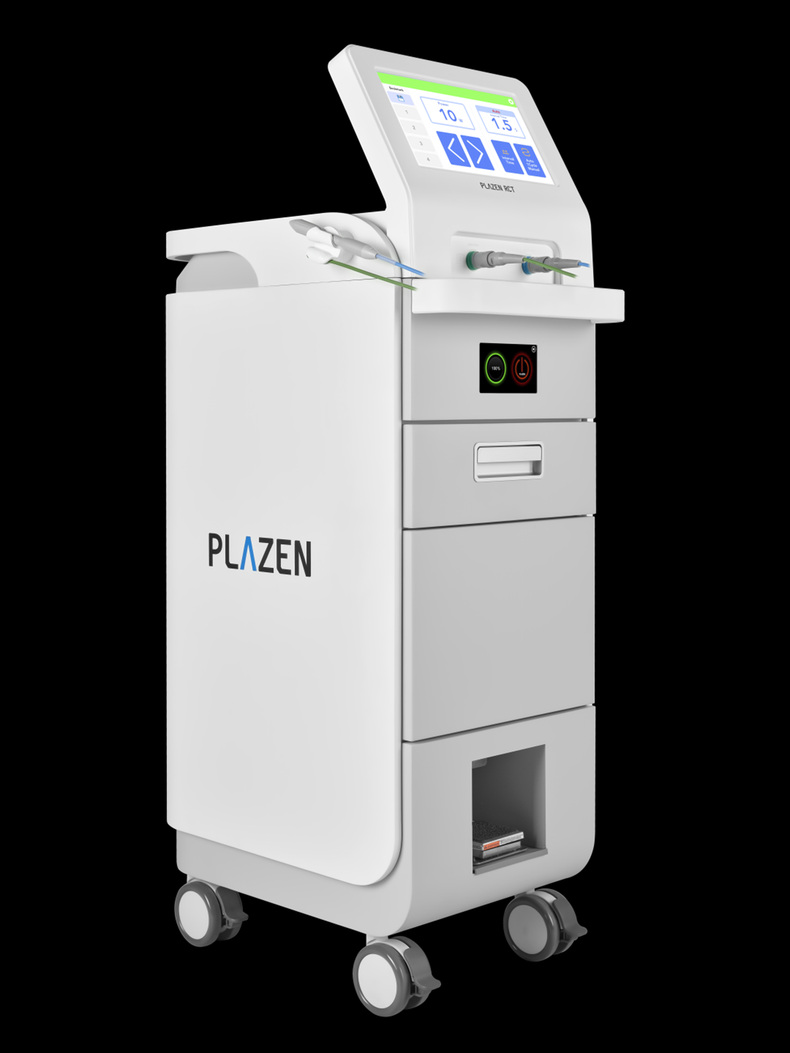
Plazen® (Plazen RCT®) is an endodontic support device that fills the canal with water and generates an underwater plasma discharge, sterilising bacteria even in the fine accessory canals that files and irrigants cannot reach.
- How it differs from conventional endodontics — the conventional approach scrapes the canal with files and irrigates with sodium hypochlorite (NaOCl). But files cannot reach deep into the fine accessory canals and dentinal tubules that branch like tree roots, so bacteria remain and the infection recurs. With Plazen®, reactive oxygen species penetrate every corner like a mist and sterilise areas a file can never touch.
- Two seconds per canal — treatment time falls dramatically — conventional irrigation takes about 15 minutes per visit; Plazen® irradiation takes just two seconds per canal. Pulp removal, filing, plasma sterilisation and canal filling are completed in around 30 minutes, reducing the burden of repeated visits.
- Markedly less post-operative pain — because bacteria and organic matter in the canal are almost completely removed, the “debris” that could escape beyond the apex is minimised. Patients who used to ache for days after root canal treatment tell us it “hurt less than expected”.
- The same national health insurance fee — under Health Insurance Review and Assessment Service rules, root canal treatment is covered by national insurance, and although this is expensive specialist equipment we provide Plazen® at no additional charge, at exactly the same insured fee. Better treatment for the same cost.
- No NaOCl — no bleach smell, no risk — there is none of the distinctive bleach odour of conventional irrigant, and no risk of bleached clothing from splashes.
- More comfortable with painless anesthesia and an electric motor — the i-ject and QuickSleeper units minimise injection pain, and the electric-motor handpiece reduces damage to tooth structure during canal shaping through precise speed control.
Plazen® is held by only about 400 clinics nationwide. It is verified equipment also in use in the Department of Conservative Dentistry at Seoul National University Bundang Hospital, and we provide it at the national insurance fee with no extra charge.
Treatment 2 — Root canal retreatment
Retreatment is performed when a tooth that previously had root canal treatment becomes infected again: the old filling material is removed and the canal is re-disinfected and refilled. In many patients who say “I had root canal treatment but it hurts again”, the cause is bacteria left behind in fine accessory canals the files could not reach.
- Why retreatment is difficult — the canal is already filled, so the existing material (gutta-percha and so on) must be removed first. Bacteria hidden deep inside complex, twisting canals are hard to eliminate completely, and the resistant strain E. faecalis in particular is difficult to remove with ordinary irrigants.
- Plazen® sterilises even the finest canals — applying Plazen® plasma after removing the old filling eliminates residual bacteria hiding in accessory canals and isthmuses that files could never reach. Reactive oxygen species are effective even against resistant strains such as E. faecalis.
- Minimal mechanical enlargement — protecting the tooth walls — over-widening the canal during retreatment thins the walls and raises the risk of fracture. Because Plazen® takes care of sterilisation, filing can be limited to securing minimal space, so tooth structure is better preserved.
- Comfortable retreatment with painless anesthesia and an electric motor — retreatment can take longer because of the extra step of removing old material. The i-ject and QuickSleeper units minimise anesthetic pain, and precise electric-motor speed control reduces unnecessary damage while old filling is removed.
Treatment 3 — Apicoectomy
An apicoectomy treats inflammation at the root tip (a periapical lesion) that retreatment cannot resolve: through a minimal gingival incision the lesion is removed surgically and the root end is precisely sealed with Maruchi MTA. If instruments cannot reach from above, we deal with it directly from below.
- Plazen® minimises loss of root length — textbooks specify 3 mm resection as the rule, but when Plazen® plasma sterilises every corner of the root tip, only a minimal amount needs to be cut — or bacteria can be killed with no resection at all — so the tooth’s support is preserved intact.
- Maruchi MTA — premium biocompatible sealing material — after resecting the root tip we seal it with Maruchi MTA, a premium-grade Mineral Trioxide Aggregate with excellent biocompatibility and sealing ability, which lowers the chance of recurrence.
- Teeth with posts — sterilised directly through the post — even when a metal post is set deep inside a crown and retreatment from above is difficult, irradiating the post directly with Plazen® plasma sterilises bacteria below the post and in the surrounding dentinal tubules. It blocks periapical infection without removing the crown or post.
- Electric-motor high-speed bur — precise, rapid surgery — a high-speed bur on an electric motor cuts bone and tooth at a constant speed without judder. Unlike an air turbine with fluctuating speed, the surgical site is smoother and heals faster. The i-ject and QuickSleeper units also minimise anesthetic pain before surgery.
| Situation | When an apicoectomy is considered |
|---|---|
| Retreatment has failed | Symptoms recur after retreatment, or the periapical lesion persists |
| Tooth with a post | A metal post is set so deep that access from above is impossible |
| Large periapical lesion | CT shows inflammation at the root tip too large to remove completely from above |
| Alternative to extraction | “Extraction then an implant” has been recommended, but you want to save the natural tooth |
Treatment 4 — Intentional replantation
Intentional replantation temporarily extracts the tooth, treats the root tip precisely outside the mouth and then replants it. It is the last preservation option for teeth in anatomical positions that even an apicoectomy cannot reach.
- Lower molars — when an apicoectomy cannot reach — the root tips of lower molars lie close to nerves and vessels, which makes surgical access difficult. Because intentional replantation takes the tooth out and works on it outside the mouth, treatment is possible regardless of anatomical position.
- Plazen® irradiation in the mouth → extraction → precise treatment outside — before extraction we irradiate with Plazen® plasma in the mouth to sterilise the canal and root tip as far as possible. The tooth is then extracted and the root tip resected and sealed with Maruchi MTA under direct vision outside the mouth. With no limits on visibility or access, treatment can be more complete than intraoral surgery.
- Replanted in the shortest possible time — the longer the tooth is outside the mouth, the more the periodontal ligament cells are damaged. Rapid team co-ordination keeps the extraoral time to a minimum and improves the prognosis.
- The last option before an implant — when intentional replantation succeeds, the natural tooth can serve for decades more. Even if it fails an implant remains as a second choice, but we try this method first.
A natural tooth, once lost, cannot be brought back. We hold all four methods — Plazen® root canal treatment, retreatment, apicoectomy and intentional replantation — and we review every possibility before extraction.
I have had root canal treatment twice and it still hurts. What should I do?
When retreatment does not resolve it, a periapical lesion at the root tip may be the cause. After precise diagnosis with 3D CT we review apicoectomy or intentional replantation. Please have this checked before deciding on extraction.
Is Plazen® root canal treatment more expensive than conventional treatment?
No. We apply exactly the national health insurance endodontic fee with no additional charge. The equipment was expensive, but giving patients better treatment at the same price is the director’s philosophy.
An apicoectomy is surgery — does it hurt a lot?
It is performed under local anesthesia, and the i-ject and QuickSleeper units minimise the pain of the injection itself. Surgery takes 30–60 minutes, and normal daily life is possible afterwards with analgesics. Many patients say it was far more comfortable than they expected.
Can retreatment really bring a tooth back?
Retreatment is often more demanding than initial root canal treatment. We combine Plazen® plasma to sterilise fine canals and resistant strains that files cannot reach; an accurate prognosis is given after diagnosis.
Is there a clinic near Sungshin Women’s University that can save a natural tooth without extraction?
Seongmo Dental Clinic (30 seconds from Exit 2 of Sungshin Women’s University Station) holds all four options — Plazen® root canal treatment, retreatment, apicoectomy and intentional replantation — as a clinic centred on preserving natural teeth. We will check once more before extraction. Enquiries: 02-922-3966.
“Would you extract it immediately if it were your own family?” As long as there is a possibility, we look for a way to save the natural tooth first.
Saving a tooth after root canal treatment without a post
An endocrown is a single ceramic restoration that extends into the canal chamber and bonds directly to the tooth, with no metal post. The direct ceramic-to-tooth bond strength is roughly 25–40 MPa (μTBS), higher than the dentine interface of a post space (around 17 MPa), and the simpler the bonding sequence, the fewer points there are to fail. In anterior cases where only the root remains, our own specialised ceramic technique can save the tooth instead of extracting it.
Why a post and zirconia crown does not last
| Aspect | Conventional — post + zirconia crown | Seongmo Dental Clinic — endocrown |
|---|---|---|
| Bonding sequence | Four stages: zirconia crown → resin core → post → tooth | One stage: ceramic bonded directly to the tooth (about 25–40 MPa) |
| Tooth structure | The post is only there to hold the resin core in place; inserting it thins the tooth walls and raises the fracture risk. Conservative dentistry textbooks even carry the phrase “no post is the best post”. | With no post, no additional tooth wall is cut away; the ceramic bonds directly to the tooth through resin cement, with no intermediate stage. |
| Force distribution | Zirconia (1,000 MPa+) is excessively strong and transmits chewing force straight down. With four bonded stages and strong force, one stage loosens or fractures over time. | Our specialised ceramic balances strength and elasticity to absorb and distribute chewing force. The simpler the bond, the longer it lasts. |
Features and range of application
- Anterior teeth — possible even when only the root remains — even when a front tooth is so badly fractured that almost no crown structure is left, we first consider saving it with our specialised technique and an endocrown approach rather than extracting it.
- Applicable to both anterior and posterior teeth — it is mainly used on front teeth, but in our clinical experience posterior teeth are often possible too. It may be unsuitable where there is bruxism, deep bite, malocclusion or clenching, so a consultation is needed; even then it is sometimes possible if you agree to wear a night guard.
- We save teeth that other clinics wanted to extract — most clinics do not perform endocrowns, often because they cannot or because it is difficult, and as a result patients are advised to “extract and place an implant”. Because this treatment is available here, we can offer one more option to people who were told elsewhere to have the tooth out.
Which teeth can an endocrown be used on?
Mainly anterior teeth with severe crown damage after root canal treatment. Some premolars are also possible after consultation. Suitability is decided from the amount of remaining tooth structure and the occlusion.
Does an endocrown last longer than a post and crown?
Because the bonding sequence drops from four stages (post + crown) to a single direct bond, there are fewer points of failure. The direct ceramic-to-tooth bond strength (about 25–40 MPa) is higher than the post–dentine interface (10–20 MPa).
What material do you use for endocrowns?
We use our own specialised ceramic material, characterised by a balance of strength and elasticity that absorbs and distributes chewing force. The specific material is explained during consultation.
Is an endocrown completed on the same day?
Yes — it is completed in house on the day through the four-stage Dentsply Sirona digital workflow with no outsourcing, on the assumption that anesthesia, preparation and root canal treatment are complete.
I have been advised to have the tooth extracted. How do I find out whether an endocrown could save it?
We assess remaining tooth structure, root condition and occlusion comprehensively with 3D CT and an oral examination. Contact Seongmo Dental Clinic on 02-922-3966 and we will check first whether it is possible.
Before accepting a recommendation to extract, check first whether an endocrown could save the tooth. Before you give up on a natural tooth, we will look for a way.
Four strengths of our whitening — how it differs from ordinary whitening
Our professional whitening is a four-stage combined system: EMS powder scaling first, then high-intensity light on the cleaned tooth surface with the large Osstem Beautis Light unit (up to 2,200 mW/cm²), followed by immediate application of a premium desensitising agent. The director, a full member of the Korean Academy of Esthetic Dentistry, adjusts light output across three levels according to individual sensitivity, and we use MFDS-approved genuine Osstem high-concentration whitening gel (Beautis). Difficult cases that ordinary whitening struggles with — non-vital tooth discolouration, tetracycline staining, fluorosis — are approached with dedicated protocols.
output, large unit
in the clinic
individual sensitivity
Large Osstem Beautis Light unit plus EMS powder scaling first
We hold two large stand-type units and one small pendant-type unit. Treatment is normally performed with a large unit; for patients who already have very sensitive teeth we use the small unit. Before whitening, EMS Airflow® powder scaling removes staining completely — anyone prone to staining knows how poorly an ordinary scaler removes it. A clean tooth surface takes up whitening gel more evenly and more deeply.
Genuine Osstem high-concentration gel (Beautis) plus a premium desensitiser afterwards
We use MFDS-approved genuine Osstem high-concentration whitening gel (Beautis). Where needed, our own premium desensitising agent is applied immediately after treatment to relieve sensitivity quickly. That is what allows us to use far stronger light exposure than ordinary whitening, and most patients are highly satisfied with no sensitivity.
Walking bleaching — for non-vital tooth discolouration
A tooth discoloured after root canal treatment (a non-vital tooth) has limits to what external light exposure can achieve. Walking bleaching places the whitening agent directly inside the canal to lighten the tooth from within, and is effective for both blackened and yellowed non-vital discolouration.
Specialised whitening for difficult cases — tetracycline, fluorosis, post-trauma
Tetracycline staining is approached with intensive high-strength premium whitening. For fluorosis (mottled enamel) we choose premium whitening or ICON resin infiltration depending on the degree of discolouration. For age-related yellowing and post-traumatic discolouration we identify the cause precisely and use a dedicated protocol to recover the best brightness achievable from the current condition.
| Type of discolouration | Recommended approach |
|---|---|
| Coffee, wine, smoking | Powder scaling first, then professional whitening with the large Beautis Light unit |
| Age-related yellowing | High-output light exposure plus a premium desensitiser afterwards |
| Non-vital tooth discolouration | Walking bleaching — whitening from inside the tooth |
| Tetracycline staining | Intensive high-strength premium whitening |
| Fluorosis / post-trauma | Premium whitening or ICON resin infiltration after identifying the cause |
How many sessions does professional whitening need?
For ordinary staining, one or two sessions produce a dramatic change. Difficult cases such as tetracycline staining or fluorosis may need additional sessions; we advise you after diagnosis.
Will my teeth be very sensitive after whitening?
Because our own premium desensitising agent is applied immediately after treatment, most patients are satisfied with no sensitivity. For those who already have marked sensitivity we adjust the intensity using the small unit.
Can a tooth that has turned black be whitened?
A non-vital tooth that has turned black or yellow after root canal treatment is lightened from within by walking bleaching (internal whitening), which is a different method from external light-activated whitening.
Is powder scaling really necessary before whitening?
An ordinary scaler does not remove staining well. Whitening gel must be applied to a clean surface from which staining has been completely removed with EMS Airflow® powder for even, deep penetration. This is a core reason our whitening results differ.
Can teeth with implants or restorations be whitened?
Implants and restorations themselves do not whiten. Because a colour difference can appear after natural teeth are whitened, we take the state of your restorations into account when planning whitening.
Complete removal of staining with powder scaling → high-output light exposure with a large unit → a premium desensitiser where needed. That is why the result is different.
The most effective treatment for cervical and occlusal wear
A bonded composite restoration repairs a defect directly with composite resin while cutting the tooth as little as possible, and it is used most often for cervical and occlusal wear. We first find early decay, secondary decay and cracks that are invisible to the eye and to radiographs using the Q-ray quantitative light-induced fluorescence analyser, then restore on a minimal-preparation principle. The bond is strong, so restorations stay in place and last.
Indications
- Cervical wear composite ★ most common — non-carious cervical lesions (NCCL) at the neck of the tooth are restored with composite, resolving sensitivity and improving appearance at the same time.
- Occlusal wear composite — biting surfaces worn by bruxism, clenching or abrasive foods are rebuilt with composite. Restoring height and shape also reduces the load on the jaw joint.
- Pit and fissure, proximal, simple and complex composites — treatment is not limited to cervical and occlusal wear: occlusal grooves, between teeth, and simple or complex restorations according to the extent of decay are all possible. The strong bond keeps them in place for a long time.

| Lesion detected | Characteristics |
|---|---|
| Early decay | Enamel demineralisation stage — found while it can still be managed without a drill |
| Secondary decay | Recurrent decay around an existing restoration — hard to detect by eye or on a panoramic radiograph |
| Tooth cracks | Fine fissures — seen intuitively as red lines under fluorescent light |
How long does a composite restoration for cervical or occlusal wear last?
Restored with correct bonding technique, it lasts several years or more. Where there are excessive habits such as bruxism or clenching, we recommend using a night guard as well.
Does composite treatment involve cutting a lot of the tooth?
For cervical and occlusal wear, the damaged area is minimally tidied before restoration, so almost no healthy tooth structure is removed. We follow a strict minimal-preparation principle.
If cervical wear is severe, is a crown needed instead of composite?
Most cervical wear can be handled with composite. Only where wear is so severe that remaining structure is inadequate or the fracture risk is high do we consider an overlay or onlay.
Is there a separate charge for the Q-ray examination?
Q-ray is used as part of the general oral examination; costs are explained during consultation. Finding early decay and cracks early saves considerably more in later treatment costs.
Can decay between the teeth be treated with composite?
Yes. A proximal composite restores the tooth without cutting the neighbouring tooth. Where the decay is extensive an inlay may be more advantageous, so we advise you after diagnosis.
When decay is found, we do not reach straight for the drill. We first consider how small and how natural the restoration can be.
Removing white spots without cutting the tooth (ICON resin infiltration)
ICON resin infiltration works by infiltrating and curing genuine German DMG Icon resin into the pores inside demineralised enamel, removing white spots without cutting any tooth tissue at all. There is no anesthesia and no drill; it is completed in a single same-day session, and it is a completely different concept from a composite restoration or a veneer. It is the procedure in which our no-prep, minimal-prep principle is most fully realised, and combined with professional whitening it produces more even, brighter front teeth. Indications include post-orthodontic demineralisation, fluorosis, enamel hypoplasia and demineralisation from mouth breathing.
| Item | ICON resin infiltration | Veneer | Esthetic composite |
|---|---|---|---|
| Tooth reduction | 0 mm — none | 0.3–0.5 mm | A small amount |
| Anesthesia | Not needed | Needed | Sometimes |
| Number of sessions | One, completed the same day | 2–3 | 1–2 |
| Suitable cases | White spots with an intact surface, early smooth-surface caries, smooth-surface demineralisation | Extensive discolouration, shape irregularities | Decay, wide demineralisation |
※ ICON resin infiltration carries an additional charge. We confirm whether it is indicated with Q-ray precise diagnosis first and then advise you.
The ICON process (completed the same day)
- Step 1. Q-ray precise diagnosis — fluorescent light is used to check the extent of demineralisation and the surface condition. If the surface is already broken down, we tell you honestly that an alternative to ICON is needed.
- Step 2. HCl surface pre-treatment (etching) — a 15% gel opens the enamel surface to create a path for the resin to infiltrate the pores inside.
- Step 3. Ethanol drying — moisture is removed completely so the resin can penetrate deeply and evenly.
- Step 4. ICON resin infiltration and light curing — genuine DMG Icon resin is applied and cured with a light unit. You can eat immediately the same day.
Can ICON remove the white spots that appeared on my front teeth after orthodontics?
Demineralised white spots around brackets after orthodontic treatment are the classic indication for ICON. After checking the surface condition with Q-ray diagnosis, they are improved naturally in a single same-day session.
Can ICON remove white spots caused by fluorosis?
Mild to moderate fluorosis with an intact surface is an indication for ICON. Where brown staining is also present or the surface is rough, micro-abrasion or a composite restoration is more appropriate.
How long does the effect of ICON last?
Because the resin infiltrates the pores within the enamel and cures there, it lasts a long time. If the cause persists — mouth breathing, excessive acidic foods — new demineralisation can appear elsewhere, so managing the cause matters.
Can I have ICON and professional whitening together?
Yes. Whitening brightens the whole tooth while ICON removes the spots, so the front teeth end up even and bright. The order and plan are explained after diagnosis.
Are there cases where ICON cannot be used?
Where the enamel surface has already broken down physically, or demineralisation has progressed deep into the dentine, ICON alone cannot solve it. We tell you honestly after diagnosis whether it is indicated.
Not cutting what can be solved without cutting is our principle. Combined with professional whitening, the result is more even and brighter front teeth.
Resolving the underlying cause without surgery
Our TMJ treatment is a tailored system based on precise CT diagnosis, in which the most appropriate treatment is selected according to each patient’s symptoms and cause. Conservative medication, PHL physiotherapy, custom splints, an ARS appliance, lateral pterygoid botox and the other ten non-surgical treatments are not a fixed sequence of steps but independent methods, applied alone or in combination according to the patient’s condition. Beyond relieving symptoms such as clicking on opening, jaw pain, restricted opening and dislocation, we find and resolve the underlying cause through precise diagnosis. Surgery really is the last resort, and most cases are resolved by non-surgical means.
Our TMJ treatment programme
- Precise diagnosis — CT, history, auscultation, inspection — CT imaging together with history-taking, auscultation and inspection maps the anatomical structure precisely and identifies the root cause of the problem.
- Conservative medication — for early or acute pain we first use conservative medication that supports the body’s natural recovery rather than unnecessary intervention.
- PHL combined physiotherapy plus spray-and-stretch — combined low-level laser (LLLT), infrared and electrical stimulation energy relieves inflammation and pain quickly, with cooling-spray stretch therapy alongside it to relax the muscles.
- Custom splint — used for joint noise, pain, bruxism, clenching and degenerative arthritis. It guides the joint into its most stable position and fundamentally releases muscle tension.
- ARS (anterior repositioning splint) — for demanding cases of non-reducing disc displacement in which the disc has slipped forward and the mouth will not open. Made in house to reduce the cost to the patient.
- Snoring and sleep apnoea splint — a custom appliance secures airway space without surgery, helping to relieve snoring and sleep apnoea.
- Jaw-closing muscle botox — we do not do one-third treatments — botox to the masseter alone is a one-third treatment. Precise injection into all three jaw-closing muscles (temporalis, medial pterygoid, masseter) fundamentally resolves overload on the joint.
- Lateral pterygoid botox — recurrent dislocation — recurrent jaw dislocation is treated with lateral pterygoid botox, available at only a small number of clinics in Korea, weakening the pull of the muscle that draws the condyle too far forward.
- Precision injection therapy — intra-articular injections (steroid, hyaluronic acid), prolotherapy (ligament strengthening) and trigger point injection (TPI) relieve inflammation and strengthen weakened tissue.
- Advanced manual and specialist procedures — including joint lavage — jaw dislocation is resolved immediately by manual reduction (closed reduction). Joint lavage washes out inflammatory mediators, and demanding specialist procedures such as release of joint ankylosis and auriculotemporal nerve anesthesia are also performed.
My jaw clicks. Does it need treatment?
It may be reducing disc displacement, where the disc slips out momentarily and returns. If there is no pain and only noise, observation is possible, but treatment is needed once pain appears or the mouth starts to open less.
Does TMJ treatment require surgery?
In most cases it improves sufficiently without surgery, through splints, physiotherapy, medication and botox. We put conservative treatment first.
What is the relationship between bruxism and jaw joint pain?
Bruxism and clenching place excessive load on the joint, causing pain and functional problems. Protecting the teeth with a night guard and reducing muscle over-activity with masseter and temporalis botox improves symptoms markedly.
What should I do if my mouth suddenly will not open?
It is most likely non-reducing disc displacement, where the disc does not return to place. Please visit a dentist as soon as possible for ARS appliance treatment or manual (closed) reduction.
Which clinic near Sungshin Women’s University is good at TMJ treatment?
Seongmo Dental Clinic (30 seconds from Exit 2 of Sungshin Women’s University Station, 02-922-3966) runs a ten-part non-surgical TMJ programme, from precise CT diagnosis through to lateral pterygoid botox, which few clinics in Korea can perform.
Surgery really is the last resort. After precise diagnosis we work up in stages from the most conservative treatment.
Dental botox that treats all the jaw-closing muscles, not just the masseter
Dermatology clinics, general practices and most dental clinics inject only the masseter (the square-jaw muscle). We treat not only the masseter but the remaining jaw-closing muscles — temporalis and medial pterygoid — as well as the lateral pterygoid, salivary glands, SCM and trapezius: most of the muscles involved in pain, function and appearance. Treatment is performed personally by a specialist who works with teeth, masticatory muscles and the jaw joint, using only MFDS-licensed genuine products, Hitox and Coretox.
Injecting the masseter alone is a one-third treatment of the jaw-closing muscles. Only by also addressing the temporalis and medial pterygoid can you reach the underlying cause of bruxism, jaw joint pain and headache.
masseter · temporalis · medial pterygoid
submandibular · parotid
addressed together
Coretox
| Injection site | General dental / dermatology | Seongmo Dental Clinic |
|---|---|---|
| Masseter (square jaw) | ✓ | ✓ |
| Temporalis | Rarely done | ✓ available |
| Medial pterygoid | Mostly not possible | ✓ available |
| Lateral pterygoid (jaw dislocation) | Almost never possible | ✓ available |
| Salivary glands (submandibular · parotid) | Only some sites | ✓ both glands |
| SCM · trapezius | Mainly for cosmetic purposes | ✓ including referred pain |
| Occlusal analysis | Not linked | Linked to T-Scan analysis |
① Jaw-closing muscle botox — pain, function and appearance together
These are the three muscles that act when you bite. Bruxism, clenching, jaw joint pain and headache often arise from over-tension in all three, so addressing them together is far more effective.
- Masseter — square jaw and bruxism — the best-known site. Reducing the volume of a developed masseter improves a square jaw line and relieves jaw pain from bruxism and clenching. On its own, however, the effect is limited; the synergy is much greater when combined with the temporalis and medial pterygoid.
- Temporalis — temple pain and headache — this muscle becomes over-tense along with the masseter during bruxism and clenching, and its tension is often the direct cause of temple headache and migraine. It must be treated together with the masseter to address the whole closing pattern.
- Medial pterygoid — deep jaw pain — located deep on the inner side of the lower jaw, it is rarely treated in dermatology clinics or general dental practices. Patients who still have pain inside the jaw or in front of the ear after masseter and temporalis botox often have the medial pterygoid as the cause.
② Lateral pterygoid botox — available at only a few clinics in Korea
Lateral pterygoid botox is used for patients whose jaw dislocates repeatedly (recurrent dislocation) or whose joint feels unstable on wide opening. Access is very demanding, few clinics in Korea can perform it, and only a specialist in the jaw joint can locate the muscle accurately.
③ SCM and trapezius botox — referred pain plus a better line
Jaw joint disorders often extend into referred and radiating pain in the sternocleidomastoid (SCM) and trapezius. We understand this connection, so when the origin of neck and shoulder pain lies in the jaw joint we address it together. There is a cosmetic effect at the same time: relaxing the SCM improves the neck line and relieves headache, and reducing the trapezius gives a slimmer shoulder line — function and appearance treated together.
④ Salivary gland botox — both submandibular and parotid
Both enlarged salivary glands, submandibular and parotid, can be treated. Reducing fullness under the jaw and beside the ear improves the lower facial line, and it also helps regulate excessive saliva production.
Is having botox at a dental clinic better than at a dermatology clinic?
A specialist who works with the masticatory muscles and jaw joint understands the position and function of the masseter, temporalis and medial pterygoid most accurately. Being able to confirm bruxism and clenching patterns with T-Scan occlusal analysis and optimise the dose is another strength unique to dental botox.
Can I just have masseter botox?
If the aim is bruxism, headache or jaw joint pain, masseter botox alone addresses only one third of the jaw-closing muscles. The temporalis and medial pterygoid are often over-tense as well, so patients who found masseter-only treatment insufficient notice a clear difference when all three muscles are treated.
My jaw keeps dislocating. Can botox solve that?
Recurrent dislocation is often caused by over-tension of the lateral pterygoid. Lateral pterygoid botox is demanding to access and few places in Korea offer it, but we perform it on the basis of specialist experience in jaw joint treatment. We check suitability first through consultation.
What is the difference between Hitox and Coretox?
Both are genuine MFDS-licensed Korean botulinum toxin type A products. They differ in protein composition and formulation characteristics, and we select according to your treatment site and condition.
I am looking for a dental clinic near Sungshin Women’s University that is good at botox.
Seongmo Dental Clinic (30 seconds from Exit 2 of Sungshin Women’s University Station) is a specialist-run botox clinic covering all the jaw-closing muscles, the lateral pterygoid, salivary glands, SCM and trapezius across pain, function and appearance. Enquiries: 02-922-3966.
This is different from botox into the masseter alone. Treatment is performed personally by a specialist who understands the jaw-closing muscles as a whole.
Related treatment guides
Official references
- Health Insurance Review and Assessment Service (hira.or.kr)
- Korean Dental Association (kda.or.kr)
| Clinic | Seongmo Dental Clinic |
|---|---|
| Director | Jang Tae-yoon |
| Address | 3rd floor, 2 Dongsomun-ro 20ga-gil, Seongbuk-gu, Seoul |
| Phone | +82-2-922-3966 |
| Getting here | Sungshin Women’s University Station (Line 4), Exit 2 — 30-second walk |
| Parking | Utah Mall — up to 2 hours free |
| Mon · Wed · Fri | 09:30–18:30 |
| Tuesday | 09:30–20:00 |
| Saturday | 09:30–14:30 (no lunch break) |
| Lunch | 13:00–14:30 |
| Closed | Thursday, Sunday and public holidays |
Medical disclaimer — all dental treatment can involve side effects such as pain, bleeding or infection depending on individual oral condition. Apicoectomy, intentional replantation and endocrowns cannot be applied in some cases, depending on the remaining tooth structure. ICON resin infiltration cannot be used where the enamel surface has already broken down. With botox, the effect and its duration vary with individual muscle condition. Please decide your specific treatment plan after a full consultation with your clinician.
This page was updated with the latest information as of June 2026.